
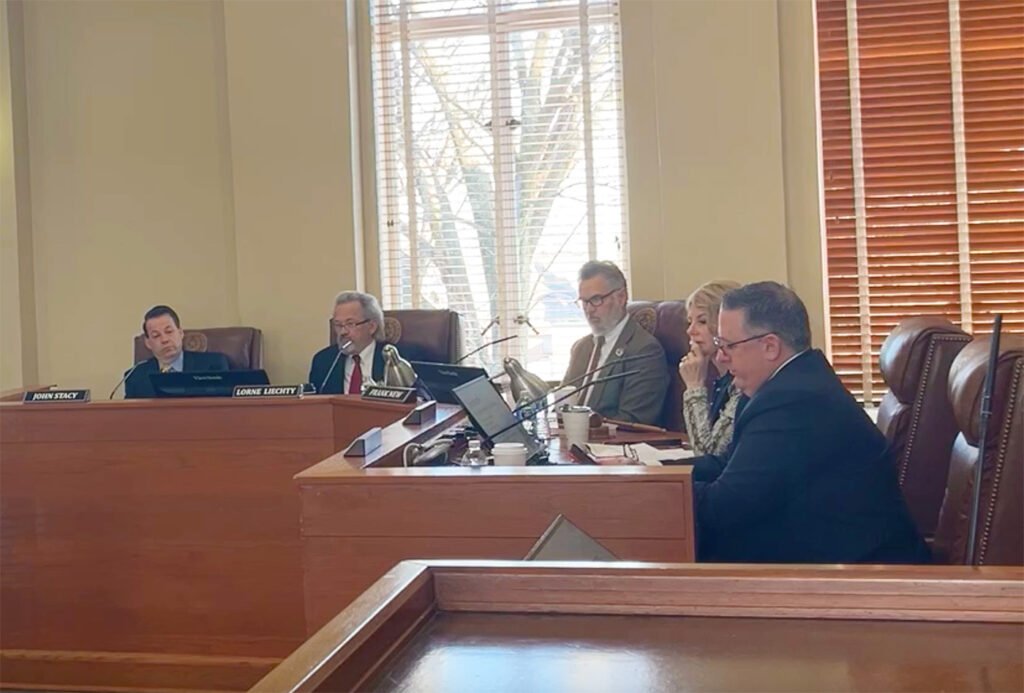
A civil lawsuit filed on July 18, 2025, accuses Rockwall County and several of its top elected officials of unlawfully blocking the River Rock Trails plats despite repeated findings that the project met statutory and regulatory requirements.
The complaint, brought by DMDS Land Company and D.R. Horton, alleges that County officials exceeded their legal authority, ignored state law, and allowed political considerations to override ministerial land-use decisions tied to the River Rock Trails development off FM 548.
Named as defendants are Rockwall County, County Judge Frank New, Commissioners Bobby Gallana, Dana Macalik, Lorne Liechty, and John Stacy — each sued in both their official and individual capacities.
At the heart of the lawsuit is a question that extends beyond a single development: Can a County repeatedly deny legally compliant plat applications based on shifting standards, political opposition to growth, or moralized narratives about development — even when state law says approval is mandatory?
The plaintiffs argue the answer is no — and that Rockwall County’s actions amount to an unconstitutional abuse of power that infringes on private property rights, disrupts housing supply, and undermines the rule of law governing land development in Texas.
The River Rock Trails Lawsuit: A Dispute Years in the Making
The lawsuit follows a prolonged and increasingly contentious series of Commissioners Court meetings, workshops, appeals, executive sessions, and related public commentary spanning 2023 through mid-2025.
Throughout that period, D.R. Horton and its representatives repeatedly asserted that four preliminary plat applications for River Rock Trails — Phase 1A, Phase 1B, a wastewater treatment plant, and a remainder tract — satisfied the objective requirements of the Texas Local Government Code and Rockwall County’s own subdivision regulations.
County officials nonetheless denied each application multiple times, often citing infrastructure apportionment, open space requirements, wastewater facilities, and broad “health, safety, and welfare” concerns — issues the developer contends were either already addressed, premature for the preliminary plat stage, or outside the County’s legal authority to impose.
By spring 2025, the County conducted what it described as its first-ever infrastructure apportionment appeal. Even after that process concluded, the developer’s resubmitted plats were again denied in June 2025.
According to the complaint, the denials did not stem from noncompliance, but from an evolving effort to stop or slow development the County politically opposed.
What the Lawsuit Alleges
The civil action asserts that DMDS Land Company, the landowner, and D.R. Horton, the contract purchaser and developer, fully complied with statutory and regulatory requirements — yet were denied approval anyway.
Among the allegations:
• The County failed to issue timely, legally sufficient written denial notices as required by state law
• Denial reasons shifted over time or appeared after statutory deadlines
• Conditions were imposed that exceed County authority at the preliminary plat stage
• Comparable developments were approved using conditional or phased compliance while River Rock Trails was not
• Officials acknowledged on the record that plat approval is ministerial — not discretionary — once requirements are met
The plaintiffs argue these actions violated due process, equal protection, and property rights under both Texas law and the U.S. Constitution.
Clarifying Two Separate Developments: Wildwood vs. River Rock Trails
The lawsuit traces a shift in County behavior beginning in early 2023 — but it is important to clarify a key distinction.
Wildwood is not River Rock Trails. Wildwood is a separate development, governed by a different municipal utility district, and involved a different plat application.
That distinction matters because Wildwood’s final plat was approved by Commissioners Court on April 23, 2024. Although Judge New voted against it, the motion passed. Following that lawful approval, Judge New refused to sign the plat.
River Rock Trails — a separate development located off FM 548 — subsequently encountered repeated denials, escalating conditions, and shifting rationales despite technical compliance.
The plaintiffs argue this divergence reflects not a change in law, but a change in political posture toward growth, density, and housing type.
Public Commentary, Political Pressure, and Fire Services as Leverage

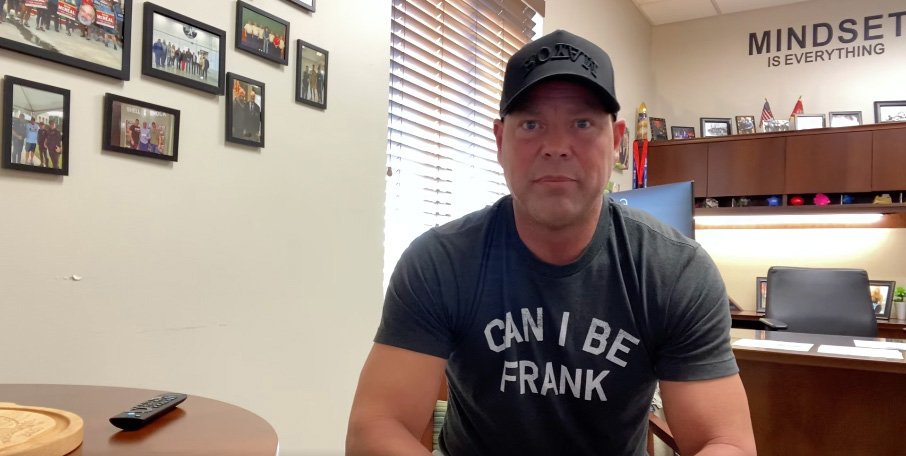
The complaint also highlights extensive public commentary during Commissioners Court meetings by McLendon-Chisholm Mayor Bryan McNeal, who repeatedly urged the County to deny the River Rock Trails plats.
In those appearances, McNeal framed the development as a threat to public safety, community character, and moral order — using language referencing crime, “evil,” and societal harm. He also repeatedly tied fire and emergency services to development outcomes, at times suggesting such services should be withheld or leveraged unless density was reduced.
According to the lawsuit, fire and EMS agreements are not statutory prerequisites for preliminary plat approval and cannot legally be used to negotiate density or land-use outcomes.
Despite this, McNeal’s statements coincided with escalating County enforcement and repeated denials — even after developers explained, on the record and in private meetings, that such agreements cannot alter plat compliance.
Documented Record Contradicts Public Claims About Fire Protection
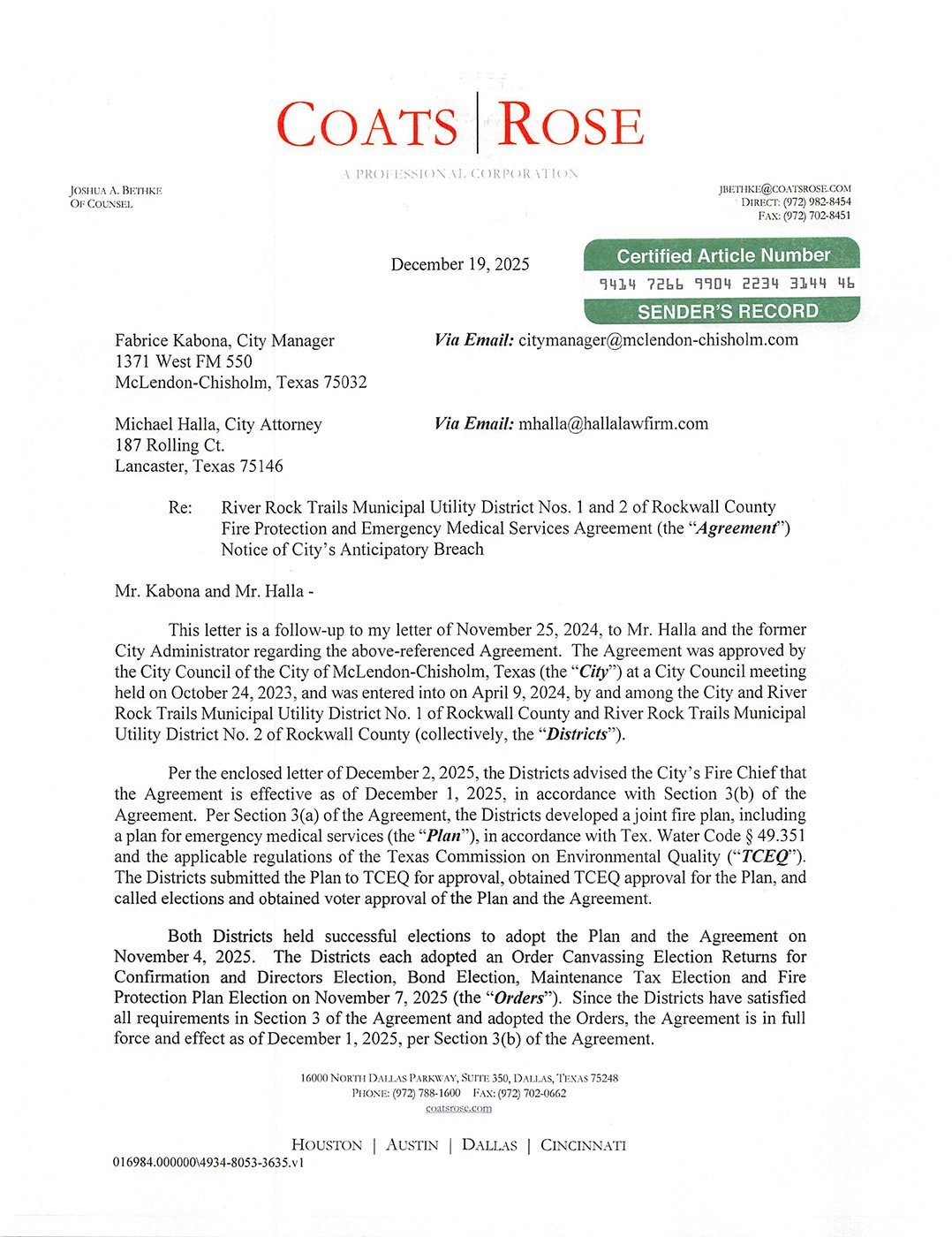
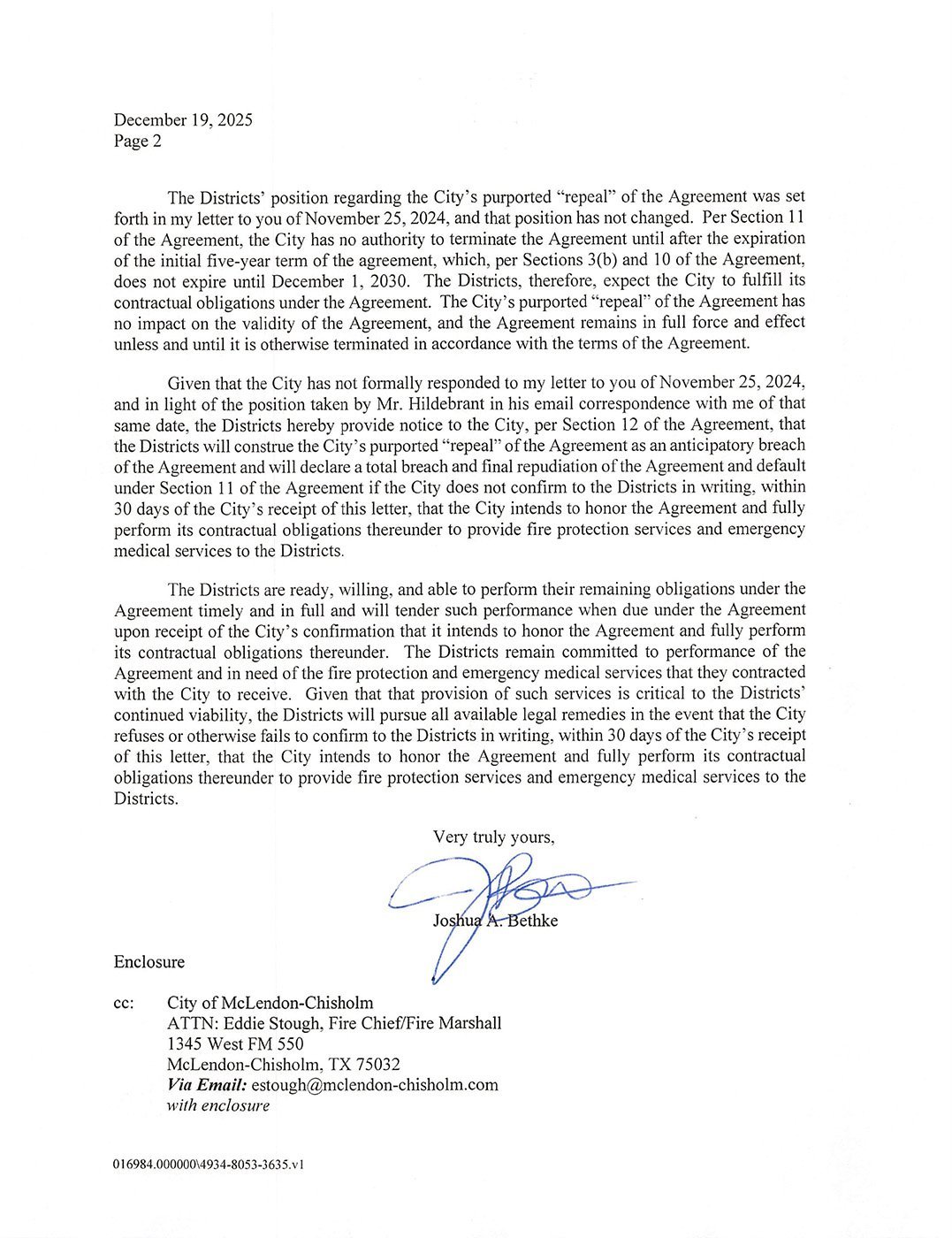
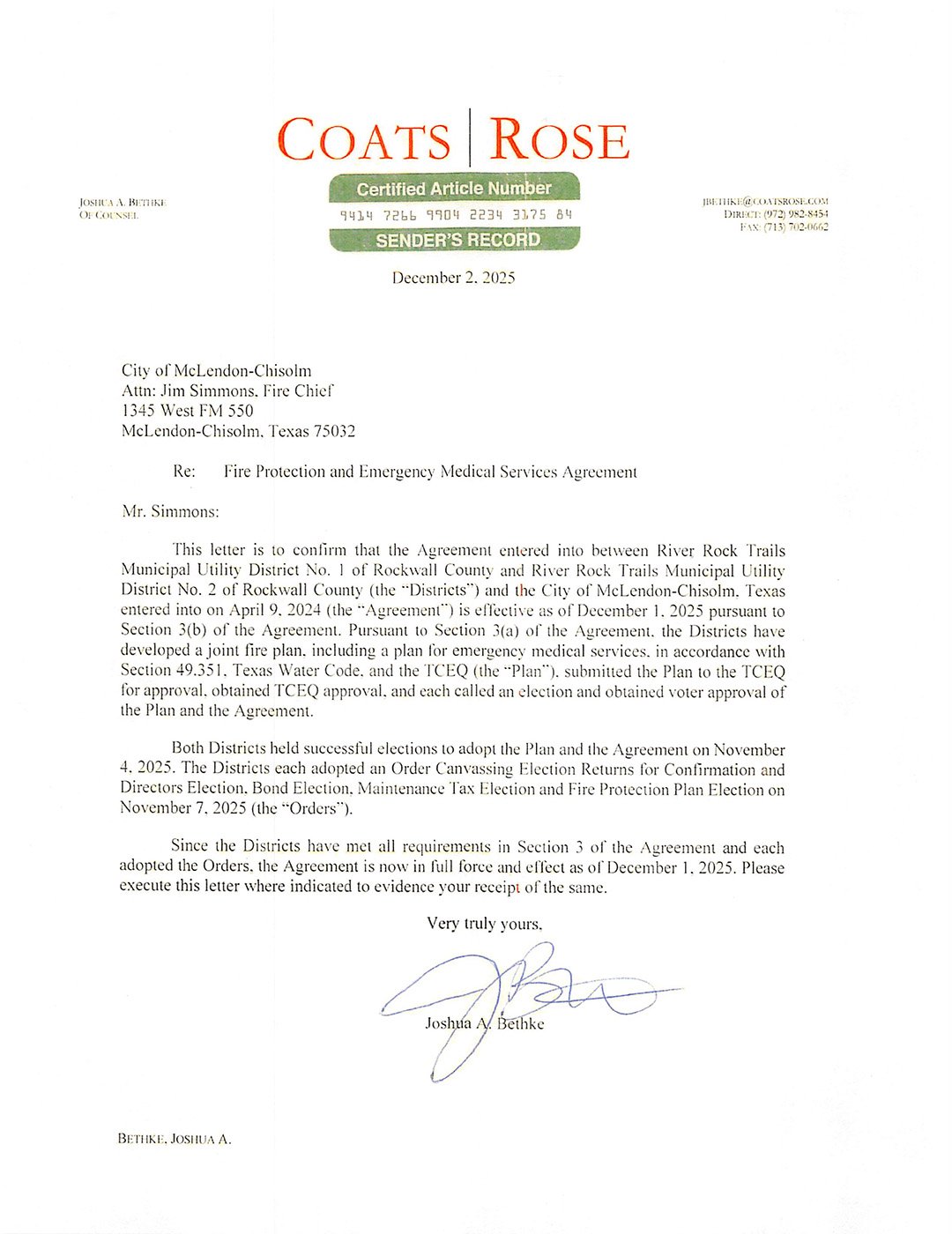
Exhibit A1: Notice of Anticipatory Breach | December 19, 2025 Letter from Coats Rose to City of McLendon-Chisholm
Exhibit A2: Fire Protection and Medical Services Agreement on December 2, 2025
Court filings and correspondence reviewed by this publication show that the Fire Protection and Emergency Medical Services Agreement repeatedly referenced by City officials was not a proposed subsidy or incomplete arrangement, but a formally executed contract governed by Texas law.
In December 2025, legal counsel for the River Rock Trails Municipal Utility Districts notified the City of McLendon-Chisholm that all contractual conditions had been satisfied, including approval by the Texas Commission on Environmental Quality, voter authorization, and adoption of a joint fire plan. The agreement, counsel wrote, was in “full force and effect,” and any attempt by the City to repeal it outside the contract’s termination provisions would constitute an anticipatory breach.
The letters further stated that the districts were prepared to fully fund fire protection and emergency medical services through voter-approved taxation — contradicting public assertions that the agreement imposed an unfunded burden on the City or functioned as a subsidy for development.
The February 2, 2024 Workshop: A Turning Point
A key moment cited in the lawsuit occurred during a February 2, 2024 Rockwall County Commissioners Court workshop that combined two related agenda items: discussion of possible amendments to the County’s Subdivision and Land Development Regulations, including infrastructure cost apportionment under Chapter 232 of the Texas Local Government Code, and discussion of a proposed interlocal cooperation agreement and development agreement tied to the River Rock Trails Municipal Utility Districts.
The workshop was informational only, with normal rules of decorum suspended and no action items posted. Both City and County officials emphasized that the purpose was to gather input and clarify legal authority—not to approve or deny any plat applications.
During the discussion, County officials and staff repeatedly acknowledged on the record that Texas counties lack zoning authority and cannot negotiate density, housing type, or land-use outcomes through the plat process. Yet the conversation increasingly centered on growth concerns, density, and how the County might exert greater leverage over developments it opposed — even as participants conceded such authority did not exist under current law.
According to the River Rock Trails lawsuit, the plaintiffs argue that what followed — escalating conditions, repeated denials, and shifting rationales — marked a departure from technical plat review toward a politicized effort to influence development outcomes beyond the County’s lawful role.
Disruption, Delay, and Process Integrity
As the plat process continued, McNeal’s repeated public appearances before Commissioners Court coincided with:
• Private meetings to strategize against an applicant.
• Re-denials of plats after prior issues were resolved
• New justifications raised after statutory deadlines
The lawsuit alleges this pattern reflects unlawful delay and the misuse of discretionary power in a process Texas law defines as ministerial once compliance is established.
In short, the plaintiffs argue the issue ceased to be whether the plats complied — and became whether the development was politically acceptable.
Questions Raised for the Courts — and the Public
Rather than drawing conclusions, the record raises critical questions:
• If a plat meets all statutory requirements, can it be denied based on opposition to growth, builder type, price point or density?
• Can fire or emergency services be used — explicitly or implicitly — as leverage in land-use disputes?
• What happens when public statements are acknowledged privately as political messaging rather than factual positions?
• What safeguards exist when regulatory processes become politicized?
• Where is the line between “local control” and unconstitutional interference with property rights?
These are now questions for the courts to decide.
What the Plaintiffs Are Asking
The lawsuit seeks declaratory and injunctive relief compelling the County to approve the plats, along with monetary damages, attorneys’ fees, and a jury trial. It also asks the court to rule that Rockwall County exceeded its legal authority and violated constitutional protections.
As the River Rock Trails case moves forward, the central question before the court will be whether county officials crossed the line from lawful regulation into unlawful obstruction.
If successful, the case could have implications well beyond River Rock Trails — potentially reshaping how Texas counties handle plat approvals amid political pressure over growth and housing.
Why This Lawsuit Matters
This case is not solely about one development. It raises broader concerns about:
• The limits of County authority in land-use regulation
• The role of political pressure in administrative processes
• The protection of property rights under Texas law
As the case proceeds, it will test whether statutory safeguards are sufficient when regulatory processes become politicized — and whether landowners can rely on the law when compliance is no longer enough.
What the Lawsuit Ultimately Exposes
As the lawsuit moves forward, public statements from County leadership have increasingly centered on fear—fear of growth, fear of density, fear of change—rather than the statutory standards that govern plat approval. Missing from nearly every public appearance is a direct explanation of what actually triggered the litigation: the repeated denial of technically compliant plats, the shifting rationales for those denials, and the County’s refusal to treat plat approval as a ministerial act once legal requirements were met.
Instead, the narrative has been simplified for public consumption. The developer is framed as unwilling to “pay its fair share,” despite the fact that municipal utility districts are, by law, responsible for financing and constructing new water and wastewater infrastructure through bonds paid by future residents—not by counties or cities. That framework is not controversial. It is foundational to how Texas growth has occurred for decades.
The lawsuit argues that Rockwall County used plat denials as leverage to extract concessions it lacked legal authority to demand—particularly after elected officials publicly expressed opposition to housing type, density, and population growth. When infrastructure concerns are invoked without acknowledging the statutory role of MUDs, the question shifts from cost to control.
At its core, this case is not a referendum on whether growth is inconvenient or uncomfortable. It is a test of whether a County can deny property rights based on policy preferences rather than law. Whether officials can substitute fear-based rhetoric for statutory compliance, as alleged in the complaint. And whether the approval process can be transformed into a gatekeeping mechanism—deciding not just how development occurs, but who is allowed to live there at all.
That is the issue now before the courts.
And it raises a question far larger than any single development: is the fight truly about infrastructure, or about who gets to decide who belongs in Rockwall County?
The courts will now determine whether Rockwall County crossed the line from regulation into retaliation—using the plat process as a tool of leverage rather than a neutral application of state law. The answer will define whether growth decisions in Texas are governed by statutes and due process, or by the political preferences of those temporarily in office.
As the River Rock Trails lawsuit proceeds, the court will be asked to determine whether Rockwall County acted within its statutory authority when it repeatedly denied the developer’s plat application.
Supporting documents, public meeting transcripts, official correspondence, and social media statements referenced in this article are published separately as exhibits for readers who wish to review the primary source material directly.
Readers with additional records, documentation, or firsthand knowledge related to the River Rock Trails proceedings are encouraged to share information for review. Submissions may help clarify the public record as this litigation moves forward.
Exhibits referenced in this reporting include:
• Exhibit B — Plaintiff’s Original Complaint (pp. 1 – 2 ; 11) and related communications
• Exhibit C — Public Records: River Rock Trails Plat Proceedings (2023–2025)
• Exhibit D — Questions Regarding Water Supply
• Exhibit E — Deficiency List, JBI Response and Revised Plans
• Exhibit F — Public Social Media Statements (F1; F2; F3; F4; F5; F6; F7; F8; F9)
• Exhibit G — McLendon-Chisholm Fire Protection and EMS Services Agreement (April 9, 2024)
• Exhibit H* — Public Statements Referencing DR Horton Correspondence & PIR Response (H1; H2 PIR MC JAN 2026 and H3 AG RESPONSE TO CITY ATTORNEY APRIL 2026)
*Editor’s Note (January 29, 2026):
Related public social media statements by Mayor Bryan McNeal are compiled as Exhibit H-1. After publication, the City of McLendon-Chisholm responded to a Public Information Request, releasing additional records, which are included as Exhibit H-2.
*Editor’s Note (April 20, 2026):
Exhibit H-3 has been added to the list which is a letter from the Attorney General’s Office expressing that the City of McLendon-Chisholm failed to comply with requirements of section 552.301 of the Government Code that the requested information is public and must be released unless there is a compelling reason to withhold the information from disclosure.