
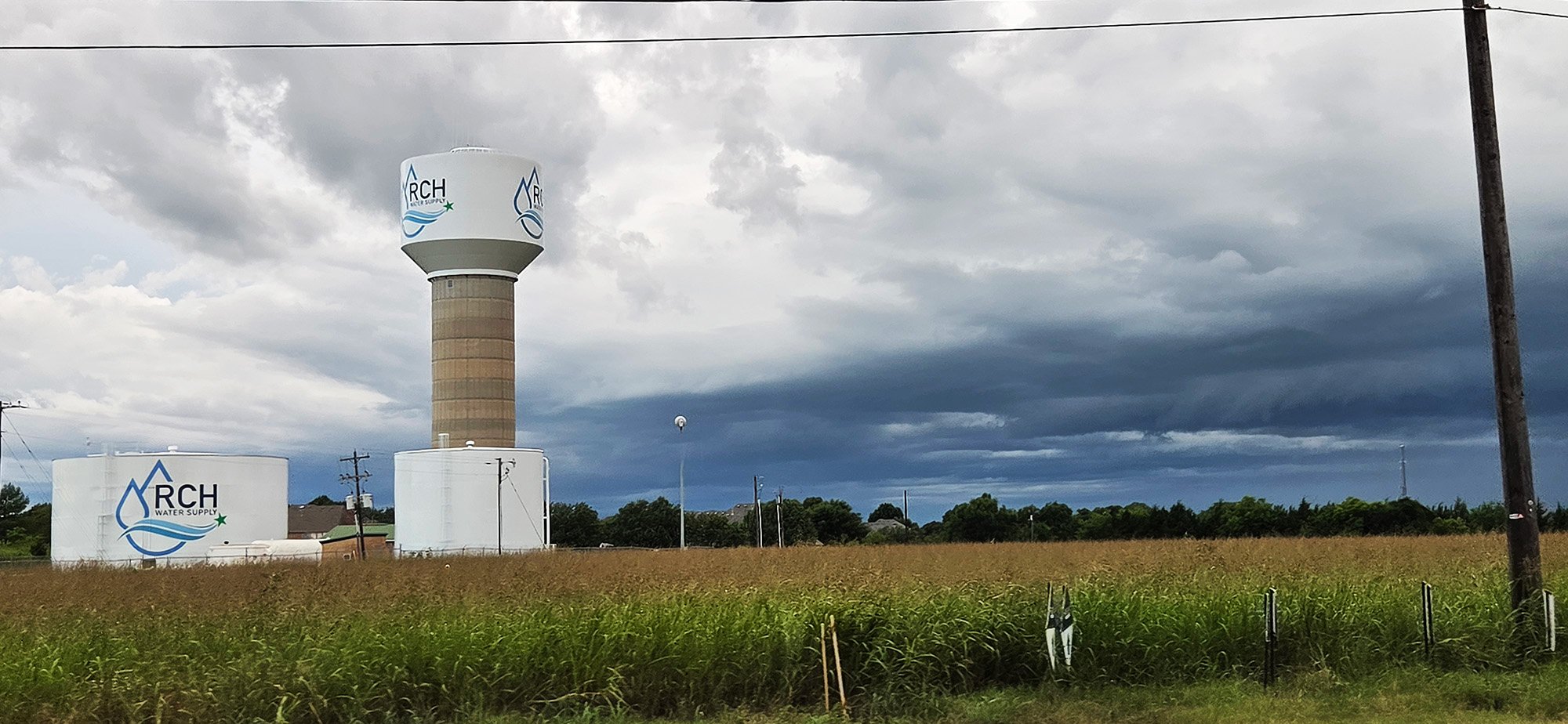

On November 24, 2026, RCH Water Supply Corporation submitted financial statements to the Public Utility Commission of Texas (PUCT) revealing an $18 million increase in reported liabilities in just six months.
The following day, RCH announced that it would replace its regular December board meeting with a workshop addressing population growth, water consumption, capital expenditures, finances and the potential conversion of the nonprofit corporation into a Special Utility District (SUD).
Meanwhile, a civil judgment exceeding $808,000 remains under appeal, and the City of McLendon-Chisholm has been pursuing the sale of publicly owned water infrastructure.
For households already adjusting to higher water bills, these developments raise important questions about the cost of future infrastructure, the corporation’s financial obligations and who will ultimately be responsible for them.
What Changed in Six Months?
On May 20, 2026, RCH CEO Robin Mayall announced the completion of the corporation’s 2025 financial audit, highlighting a clean audit opinion, positive operating results and financial stability.
Six months after the close of that fiscal year, RCH was reporting considerably larger financial obligations.
In a letter dated November 24, professional engineer Tyler N. Hendrickson of Velvin & Weeks Consulting Engineers submitted RCH’s second-quarter financial compilation and a CoBank loan amortization schedule to the PUCT.
The correspondence, filed as Item 41 in Docket No. 58867, specifically addresses the financial leverage requirements associated with RCH’s application to amend its Certificate of Convenience and Necessity (CCN).
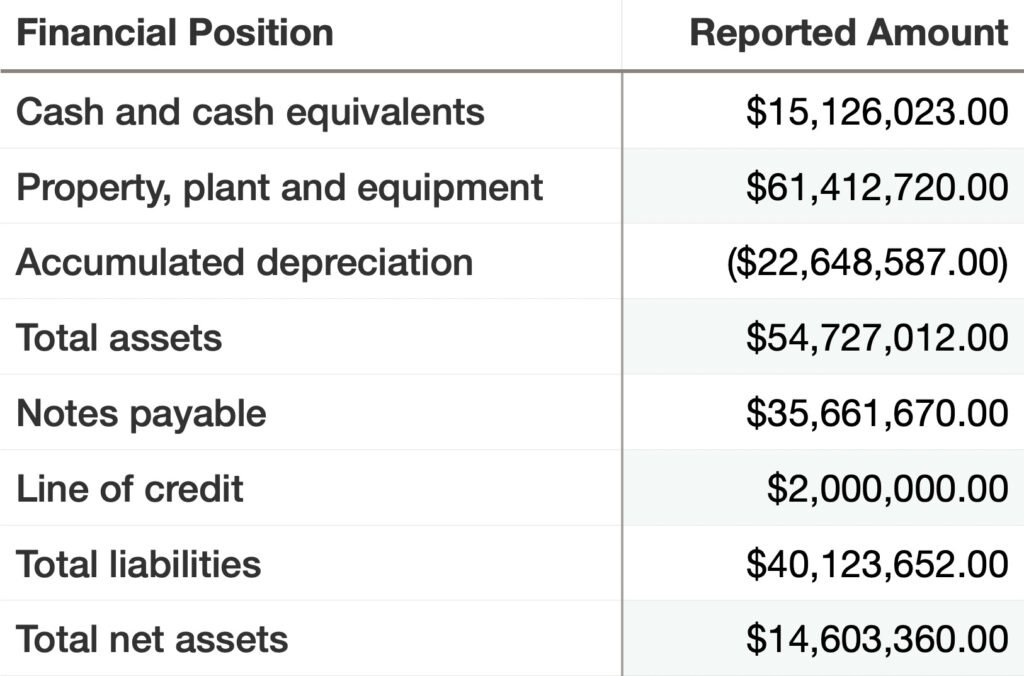
Source: PUCT, Docket No. 58867, Item 41. Unaudited financial statements compiled by Whitley Penn LLP.
Between December 31, 2025, and June 30, 2026, RCH’s reported liabilities increased from $22.06 million to $40.12 million, an increase of approximately 82%.
According to Note E of the December 2025 audited financial statements, RCH converted an existing line of credit into a long-term note payable to finance system improvements. The outstanding balance was $18.61 million, carrying a fixed interest rate of 6.36% and secured by RCH’s water system assets. Scheduled principal and interest payments through 2045 totaled approximately $32.96 million.
By June 30, 2026, RCH reported $35.66 million in outstanding notes payable, along with a separate $2 million line of credit balance.
During that same six-month period, reported cash and cash equivalents increased from $1.81 million to $15.13 million. An increase in cash alongside an increase in borrowing should not be mistaken for an increase in earnings.
RCH’s second-quarter operating income was $433,752. After accounting for interest revenue and interest expense, its reported increase in net assets was $413,336. Neither figure establishes how much unrestricted cash is available to satisfy future debt obligations.
The June financial compilation contains no detailed debt disclosures or cash flow statement explaining the financing arrangements behind these substantial changes.
The CoBank amortization schedule accompanying the November 24 PUCT filing identifies an original scheduled principal amount of $18.77 million at a fixed interest rate of 6.36%. The schedule projects a remaining principal balance of $18.37 million as of June 22, 2026.
Compared with the $35.66 million in notes payable and separate $2 million line of credit reported in the June compilation, approximately $19.29 million in reported borrowing is not accounted for in the supplied repayment schedule.
Equally noteworthy, RCH’s reported current portion of notes payable – the principal due within the next 12 months – was $502,715. That amount matches, to the nearest dollar, the principal scheduled for repayment under the original CoBank amortization schedule over that same period.
Neither document explains the repayment terms, interest rates, maturity dates or collateral requirements associated with the remaining reported borrowing. The CoBank schedule represents projected repayments rather than confirmation of actual payments.
Borrowing money to construct utility infrastructure is not unusual. However, understanding the terms of that borrowing and the revenue necessary to repay it is particularly important for the customers financing those obligations.
What the Accountants Did Not Verify
RCH’s December 2025 financial statements were independently audited by Snow Garrett Williams in accordance with generally accepted accounting principles (GAAP).
The June 2026 statements were compiled by Whitley Penn LLP using the tax basis of accounting. The accountants also identified departures from that accounting method involving depreciation and amortization, the financial effects of which had not been determined.
The two reports therefore differ in both accounting methodology and the level of assurance provided.
Whitley Penn’s July 31, 2026, compilation report expressly states:
We did not audit or review the financial statements.
The accountants were not required to verify the accuracy or completeness of the information supplied by management.
More notably, management chose to omit substantially all customary financial disclosures. The accountants acknowledged that the omitted information could influence readers’ conclusions regarding the corporation’s financial position.
The report concludes:
We are not independent with respect to RCH Water Supply Corporation.
Professional accounting standards permit accountants to perform a compilation without being independent, provided that the lack of independence is disclosed. The reason for that lack of independence need not be stated. Given Whitley Penn’s previous forensic accounting work for RCH, the scope of its current financial responsibilities warrants clarification.
Although these disclosures do not establish financial misconduct, they limit the ability to reconcile the two reports and evaluate the substantial increase in liabilities.
There is also an inconsistency within the 2025 audit itself.
Note I states that beginning net assets were decreased by $29,463 to correct a prior-year membership accounting error. Yet the accompanying table and Statement of Activities both reflect an increase of that amount.
Whether this is a drafting error or an accounting error warrants clarification.
As of November 25, I could not locate the June financial compilation on RCH’s website. The latest financial report listed remained the December 2025 audit.
It took a filing with a state regulatory agency to bring the newer financial figures to my attention.
Where Is the Water Revenue Going?
During the three months ended June 30, RCH reported approximately $1.61 million in water revenue and $1.17 million in operating expenses.
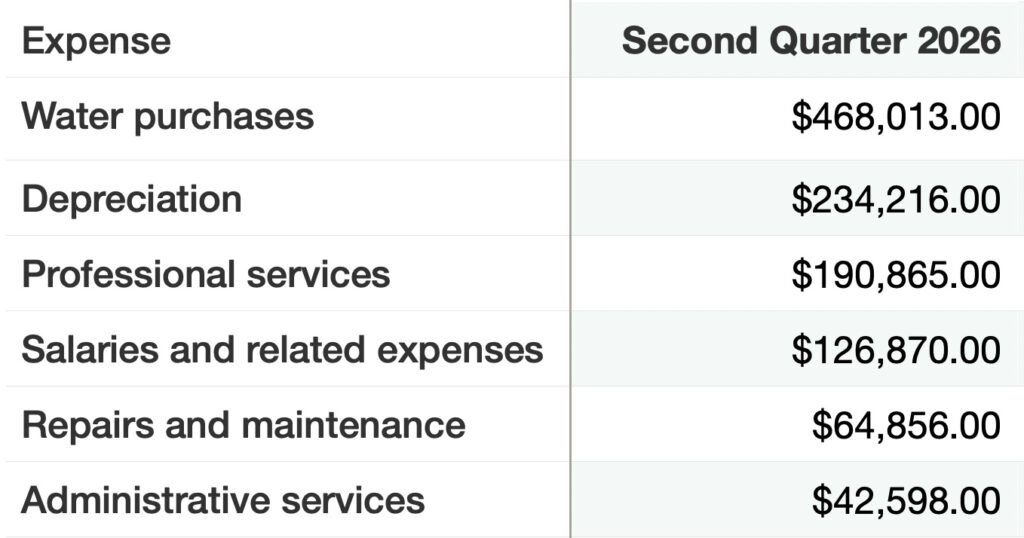
Source: PUCT, Docket No. 58867, Item 41. Unaudited financial statements compiled by Whitley Penn LLP.
Professional services, salaries and administrative services collectively amounted to $360,333 during the quarter. Reported repairs and maintenance expenditures totaled $64,856.
The previous year’s expenses provide additional perspective.
In 2025, RCH reported $1.12 million in professional services, $751,672 in salaries and related expenses and $263,468 in administrative services.
Combined, those three categories exceeded $2.13 million, representing 35% of the corporation’s annual water revenue.
Engineering, legal, accounting and consulting services can represent necessary expenditures for a utility undergoing significant infrastructure improvements. However, the financial reports do not identify the recipients of those payments or provide an itemized breakdown of the services performed.
Identifying who receives these payments has proven considerably more difficult. As an RCH customer, I have submitted requests for financial and contractual records, encountered proposed charges exceeding $2,000 and had subsequent requests go unanswered.
I previously obtained CEO Robin Mayall’s employment agreement and original offer letter, documenting his initial annual salary of $170,000 plus bonuses to serve as general manager. Other requested contracts have not been provided to me.
Texas law subjects qualifying nonprofit water supply corporations to the Public Information Act. Access to financial and contractual records is particularly important when members are being asked to absorb rising operating costs and finance additional infrastructure.
Who is receiving these payments, what services are being performed and how are contractors selected?
Readers interested in how RCH’s existing rates compare with neighboring utility providers can refer to my previous investigation, A Side By Side Look At Local Water Rates.
The PUCT’s Leverage Test and a Possible Special Utility District
A CCN establishes the territory in which a utility is authorized and obligated to provide service.
Before approving an application, the PUCT evaluates the applicant’s ability to provide continuous and adequate service.
Under 16 Texas Administrative Code §24.11(e)(2)(A), one method of satisfying the leverage test involves maintaining a debt-to-equity ratio of less than one.
RCH reported $35,158,955 in long-term debt and $14,603,360 in net assets, producing a ratio of approximately 2.41 to 1.
That exceeds the threshold for this particular method. Alternative criteria are available, including demonstrating sufficient unrestricted cash to cover two years of debt service. Whether RCH’s reported $15.13 million cash balance includes funds available for that purpose cannot be determined from the compilation alone.
The debt-to-equity calculation does not, by itself, establish that RCH has failed the overall leverage test.
Another provision of the regulation is particularly interesting in light of the upcoming workshop.
Under 24.11(e)(4)(C), cities and districts may demonstrate financial capability in lieu of meeting the leverage and operations tests through a financial advisor’s confirmation of sufficient bond financing capacity, accompanied by qualifying audited financial statements.
Under Chapter 65 of the Texas Water Code, a special utility district operates as a political subdivision of the state with its own governing board and statutory powers.
Those powers include acquiring infrastructure, issuing bonds, establishing service charges and exercising eminent domain within applicable legal limitations.
Utility revenues can be pledged toward the repayment of bonds.
Conversion would not erase RCH’s existing financial obligations, nor would it occur without regulatory approvals and applicable election requirements.
Whether the potential conversion is related to RCH’s current financial leverage requirements has not been established. Nevertheless, it introduces another financing option worth examining.
RCH Continued Receiving Water From Rockwall
In August, RCH celebrated the completion of its new take point, reservoir and pump station.
On September 18, 2026, the corporation announced that it was directly connected to North Texas Municipal Water District (NTMWD) and that its new transmission line had been opened to its distribution system following successful testing.
However, municipal water flow records I reviewed indicate that RCH continued receiving water from the City of Rockwall in October.
The operational, contractual or engineering reasons for continuing to utilize Rockwall’s water supply remain unclear from the available records.
Additional elevated water storage has been discussed in previous years. Obtaining a wholesale water supply and maintaining adequate water storage are separate components of a distribution system. Elevated storage facilities can help maintain water pressure, accommodate fluctuating demand and provide emergency reserves.
Neither the November financial filing nor the workshop notice specifically identifies financing for a proposed water tower. Customers should pay particular attention to the infrastructure projects presented at the December workshop, their anticipated costs and how RCH intends to finance them.
One Year After RCH Announced Its Court Victory
RCH’s November 24 financial filing arrived on another significant anniversary. One year earlier, the corporation announced its $808,098.77 judgment against former manager Robin Baley, doing business as H2O Services.
On November 16, 2026, following two unopposed requests for extensions, Baley’s attorney, R. Michael Northrup, filed a 43-page reply brief with the Fifteenth Court of Appeals in Austin.
The filing challenges the trial court’s determination of liability, the handling of the burden of proof and the calculation of the monetary award.
Among the more revealing passages is testimony from RCH Board President David Naylor concerning Baley’s compensation.
When questioned about the gross amount of the disputed checks, Naylor testified:
My assumption is all of her overhead, all of her payroll is embedded in the $7.50 she received as an ACH transaction.
When asked whether that was an assumption, Naylor agreed.
Baley’s attorney argues that the gross amount of the checks does not establish RCH’s actual financial loss. He identifies regulatory fees, website hosting, RCH letterhead, water line marking supplies and meter lockouts among the expenses he contends should have been considered.
The reply brief also revisits the location of historical financial records. Baley testified that monthly reports were boxed and transferred to RCH’s pump station, normally by Dwight Lindop.
As documented in my September investigation, RCH Water Rates and the $808,098 Judgment Under Appeal, video and correspondence from the 2023 management transition provide additional context concerning the transfer of records.
Baley is seeking reversal of the judgment, with alternative requests for reassessment of the award or a new trial. RCH prevailed in the trial court and continues to defend its judgment.
There is another connection between the litigation and RCH’s current financial reporting. RCH previously described Whitley Penn’s work in connection with the investigation of former management as forensic accounting. Its 2024 federal tax return identified the firm as a recipient of more than $318,000 in accounting fees.
Whitley Penn subsequently compiled the June 2026 financial statements submitted to the PUCT.
RCH’s 2025 independent audit confirms that none of the judgment had been collected by the end of that year and that no gain had been recognized. The June compilation contains no updated litigation disclosure.
One Board President, Two Utilities
RCH is not the only utility in which board president David Naylor holds a leadership position. He also serves as president and CEO of Rayburn Electric Cooperative, a Rockwall-based wholesale electricity provider serving four distribution cooperatives across North Texas.
In an April 2026 interview with Energy Changemakers, Naylor discussed Rayburn’s financial challenges following Winter Storm Uri, its efforts to change state law to access additional financing mechanisms and its subsequent infrastructure expansion.
Those efforts coincided with the passage of Senate Bill 1580 in 2021, which authorized electric cooperatives to recover extraordinary storm-related expenses through securitized financing over a period of up to 30 years.
A review of five years of Rayburn’s federal tax returns also offers perspective on the financial scale of nonprofit utilities.
Between 2020 and 2024, Naylor received more than $4.13 million in combined compensation and benefits.
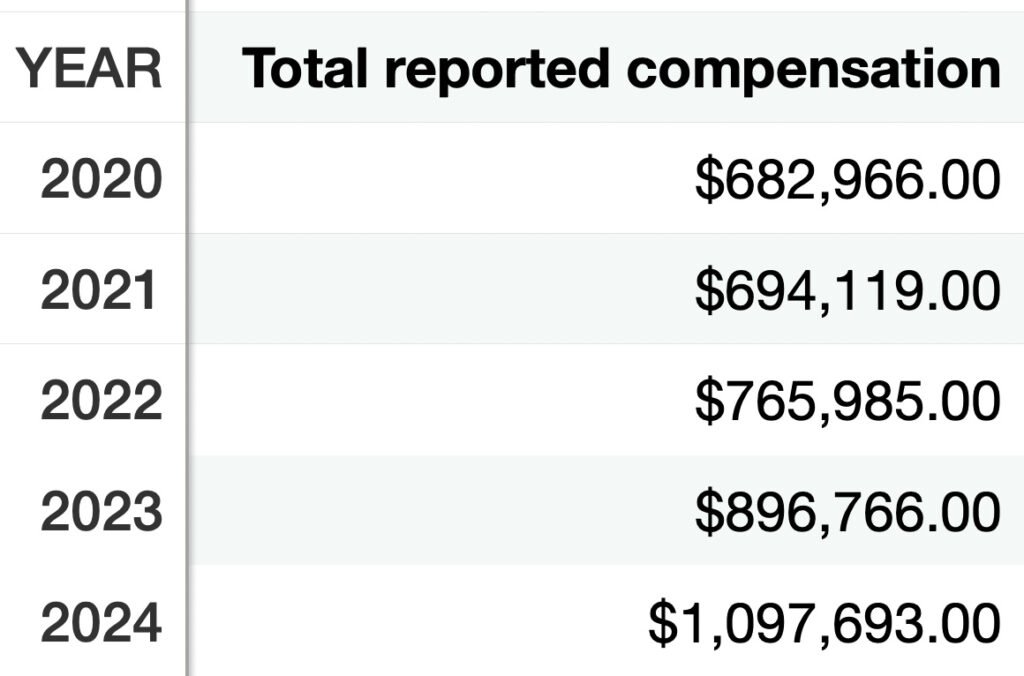
Source: Rayburn Country Electric Cooperative IRS Form 990 filings, Part VII, Section A. Figures include reportable compensation, retirement contributions and other benefits.
His annual compensation increased approximately 61% during that period. Rayburn’s reported executive compensation increased from $1.95 million to $3.99 million.
Both Rayburn and RCH report federal tax-exempt status under Section 501(c)(12) of the Internal Revenue Code, a designation that does not prohibit substantial executive compensation, borrowing or infrastructure ownership.
Rayburn reports using compensation surveys of comparable utilities to establish executive pay. RCH’s 2024 tax return, by contrast, reported no compensation for Naylor in his capacity as its board president.
Conversion to a special utility district could introduce a different compensation structure. Under Chapter 49 of the Texas Water Code, district directors may receive fees of office and expense reimbursements. Section 49.056(c) also permits a director to serve as the district’s general manager, with compensation established by the other directors, subject to statutory restrictions.
Naylor’s compensation from Rayburn does not establish what he or any other director might receive under a special utility district. Whether RCH’s potential conversion would involve changes to board compensation, executive employment agreements or administrative staffing remains unclear.
Are Data Centers Part of the Growth Forecast?
Naylor’s Energy Changemakers interview also addressed Rayburn’s growing involvement with data centers. As of April, Rayburn had approved approximately 1,000 megawatts of data center electrical demand, with another 2,000 megawatts under evaluation.
In June, Fox 4 reported that Rayburn secured a $411 million Texas Energy Fund loan at a 3% interest rate to help construct a $685 million natural gas power plant in Sherman. Naylor separately described that generation expansion as intended for ordinary growth rather than dedicated data center demand.
Electricity is only one consideration in data center development. Water requirements can also be significant, depending on facility design and cooling technology.
Naylor has described Rayburn’s strategy as assigning data center electricity and associated infrastructure costs to those customers to protect existing cooperative members.
No water service agreement between RCH and a data center developer has been identified in the records reviewed for this article. Nevertheless, as RCH prepares to discuss population growth, water consumption and capital expenditures, members would benefit from knowing what types of development are included in its projections.
What financial protections would be in place for existing residential customers if large commercial developments require substantial expansion of RCH’s water infrastructure?
McLendon-Chisholm’s $2.96 Million Water Infrastructure Decision
While RCH evaluates opportunities for expansion, the City of McLendon-Chisholm has been pursuing the sale of water infrastructure it already owns.
In June, the City published an invitation for sealed bids for approximately 30,225 linear feet of water distribution mains, 37 fire hydrants and associated equipment within Sonoma Verde Phases I and II.
The City’s bid specifications reference a January 2025 valuation by Raftelis Financial Consultants estimating the fair market value of those assets at $2.96 million.
In October, I received confirmation that no sale had been finalized with any party.
Sonoma Verde was developed through a Public Improvement District (PID), a municipal financing mechanism that allows qualifying public improvements to be financed through assessments on benefiting properties.
My previous investigation, McLendon-Chisholm Water Infrastructure When the Claims Don’t Hold Water, examined the agreements and obligations associated with those improvements.
Within the same development, the City operates under two distinctly different utility service arrangements.
McLendon-Chisholm contracts with Inframark to administer sewer services and billing while retaining ownership of its sewer infrastructure and collecting revenue to support the system.
Under the existing water service arrangement, however, RCH collects retail water revenue while the City retains maintenance responsibilities associated with its distribution infrastructure.
The City’s independent auditor identified this financial imbalance during the February 10, 2026, City Council meeting.
Selling the infrastructure is one potential response. Renegotiating the existing water service agreement to address maintenance costs and revenue obligations is another.
RCH’s potential conversion to a special utility district introduces a new consideration. McLendon-Chisholm could eventually find itself negotiating with a separate political subdivision possessing its own statutory powers and financing capabilities.
No connection between the proposed municipal asset sale and RCH’s potential conversion has been established. Nevertheless, municipal infrastructure represents more than a maintenance obligation. It is a public investment that can influence future development negotiations and long-term water planning.
Has the City adequately evaluated the financial and strategic benefits of retaining infrastructure valued at nearly $3 million as part of its own long-term water plan?
Before ownership changes hands, residents should be able to examine the financial analysis, alternative service arrangements and projected long-term consequences supporting that decision.
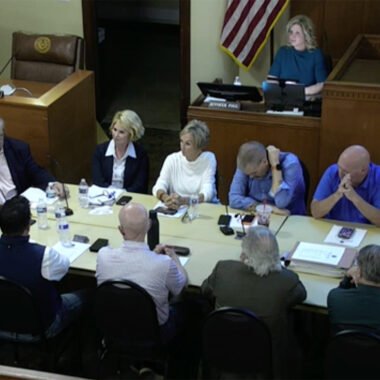
RCH’s December 1 Workshop
RCH’s Board of Directors will conduct a workshop in place of its regular December meeting.
According to the notice posted November 25, the discussion will address historical and projected water consumption, population growth, infrastructure planning, capital expenditures, finances, potential board expansion and possible conversion to a special utility district.
That same day, CEO Robin Mayall published a Thanksgiving message celebrating RCH’s infrastructure accomplishments and emphasizing continued maintenance and responsible planning. The message made no mention of the upcoming workshop or potential conversion.
Members interested in reviewing historical water consumption ahead of the discussion will find that RCH’s Annual Usage Reports have not been updated beyond August 31, 2025. The remaining four months of 2025 are blank, and no 2026 report is listed.
The corporation’s dedicated board meeting document archive is similarly outdated. Its most recent regular board meeting minutes are dated April 1, 2025, although subsequent meeting announcements and agendas appear elsewhere on the website.
Without more current records, members have limited information with which to independently evaluate the growth projections, financial assumptions and infrastructure expenditures scheduled for discussion.
Date: Tuesday, December 1, 2026
Time: 4pm
Location: Chisholm Baptist Church, 1388 S. State Highway 205
The notice specifies that no action will be taken during the workshop.
As RCH evaluates its future, McLendon-Chisholm’s elected officials have a responsibility to understand the financial and governmental implications of those plans before making permanent decisions concerning municipal assets.
For residents, the significance of this discussion extends beyond their next water bill.
It is about who will own the infrastructure, who will finance the growth and who will be accountable to the people paying for it.
Author’s Disclosure: The author is an RCH Water Supply Corporation customer, property owner and former member of the McLendon-Chisholm City Council. This article draws upon regulatory filings, financial statements, court records, municipal documents and firsthand public records requests.



1 comment
Wow! What a thorough article. Sounds like PUC-T needs to investigate and get answers needed. Why are so many documents unattainable from RCH?