
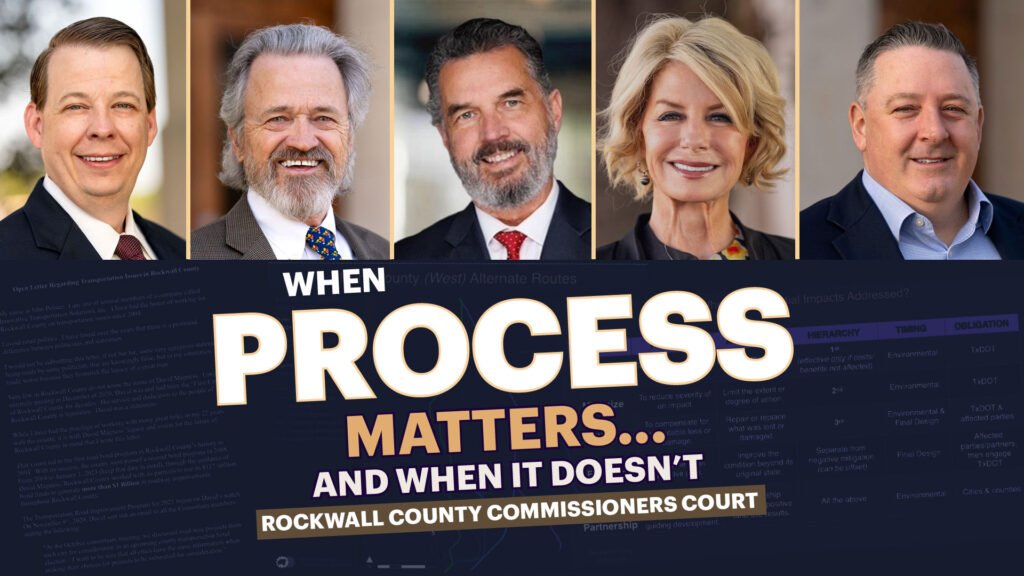
What One Rockwall County Commissioners Court Meeting Revealed About Leadership, Priorities, and Public Accountability
During the July 28 Rockwall County Commissioners Court meeting, one theme surfaced again and again: process. Whether commissioners were discussing a proposed county open space, the Outer Loop, road projects, or the County’s longtime transportation consultant, the conversation repeatedly returned to how decisions should be made—and whether those standards were being applied consistently.
Updates on Two Ongoing Lawsuits
Before turning to the day’s major discussions, County Judge Frank New provided brief updates on two ongoing lawsuits involving municipal utility districts.
The first involved Rockwall County Municipal Utility District No. 10, which serves the Horizon Lakes development, formerly known as Trilogy, in McLendon-Chisholm. Commissioners were scheduled to consider a proposed “walk-away” settlement, but Judge New announced the item had been tabled, so no vote was taken.
The Court also met in executive session to discuss the separate D.R. Horton litigation involving municipal utility districts. When commissioners returned to open session, Judge New announced that no action had been taken.
Both matters remain pending, and I’ll continue following them as new developments become available.
A $20,000 Vote That Raised Bigger Questions

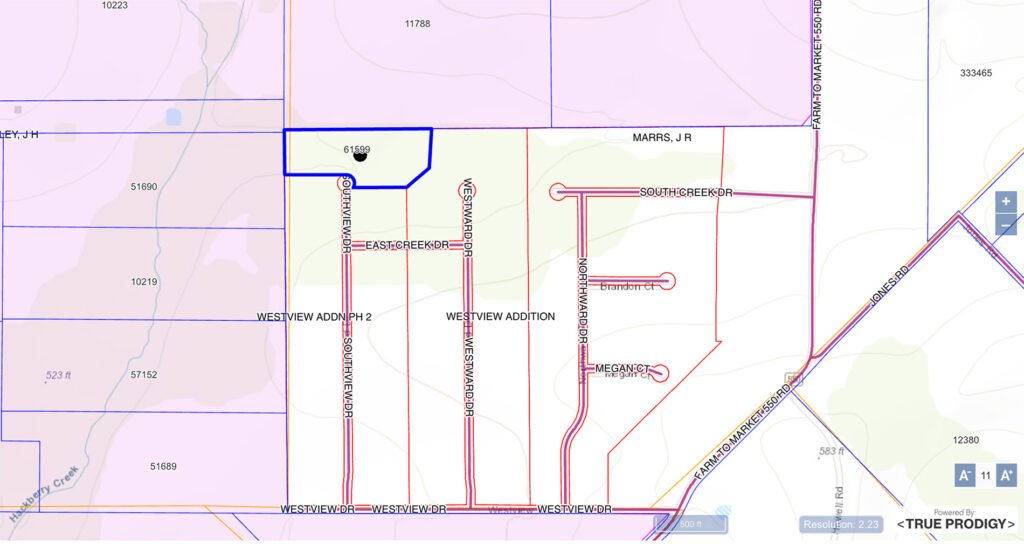
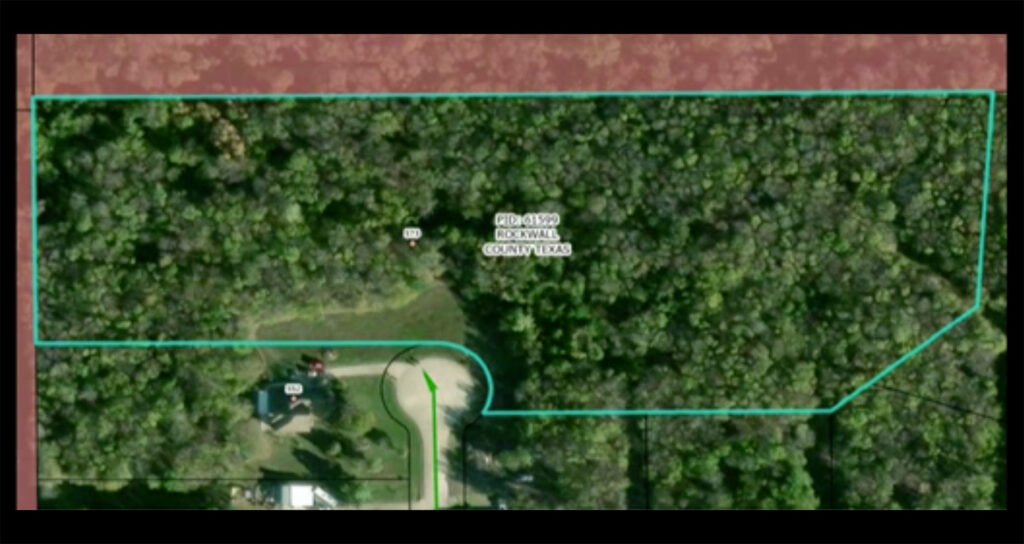
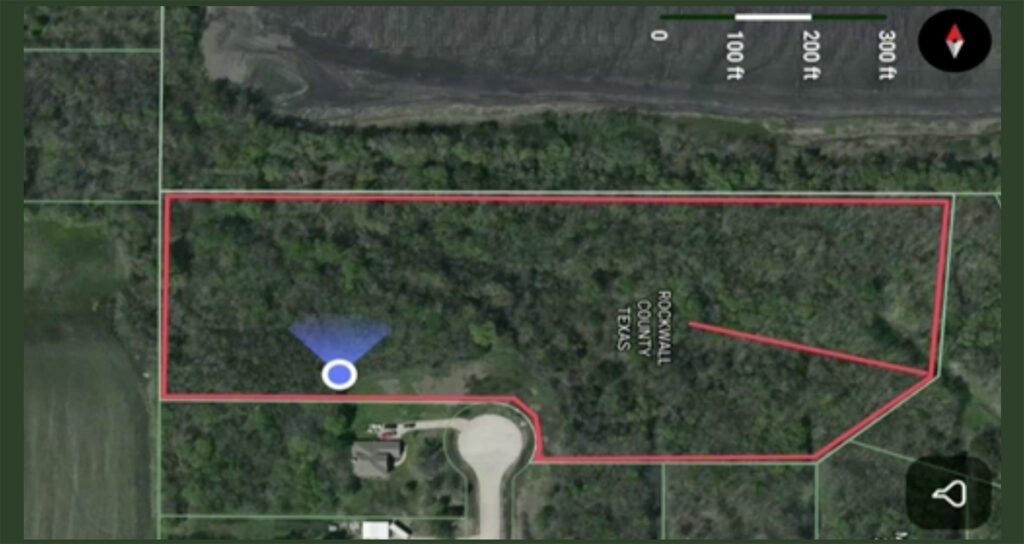
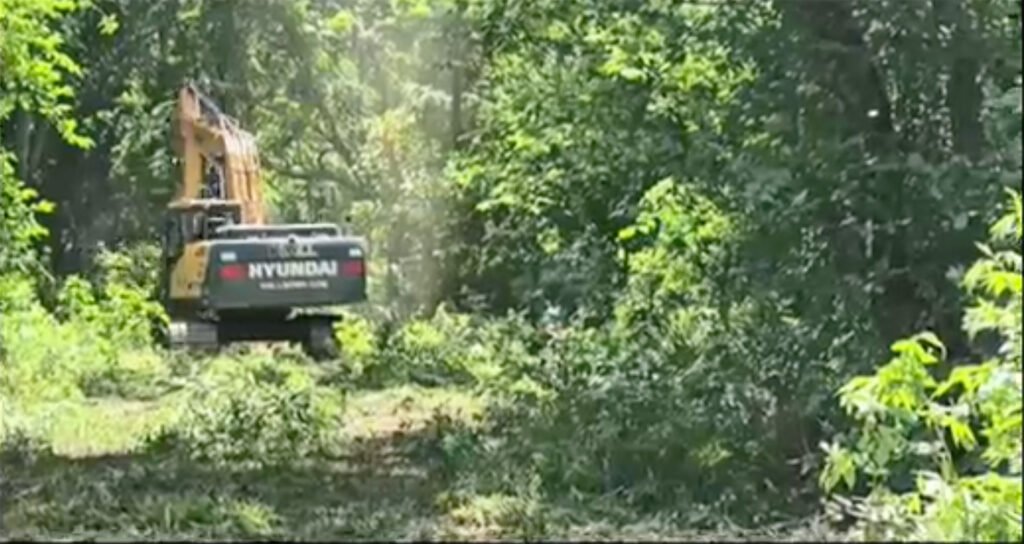
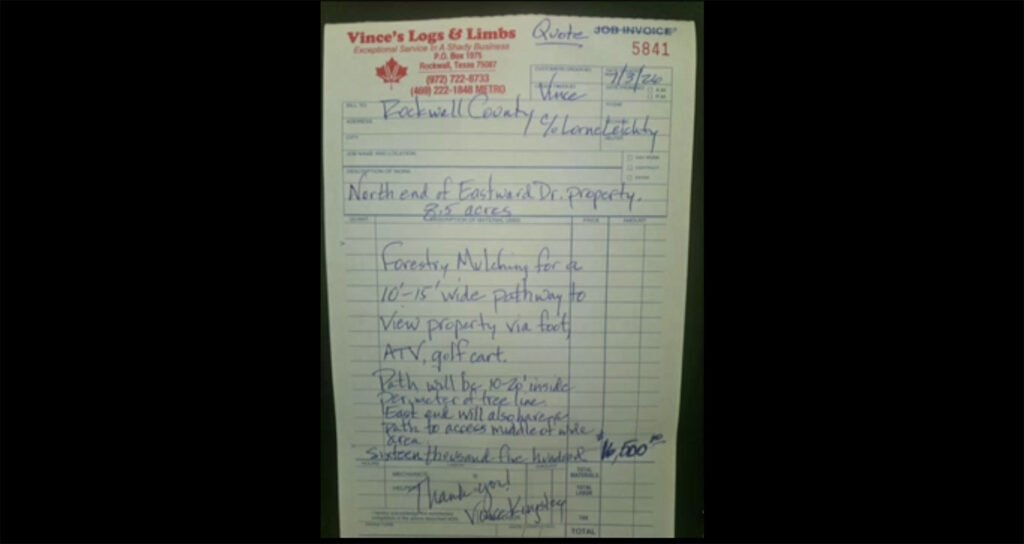
One of the first major discussions of the morning centered on 8½ acres of county-owned property in the Westview Addition.
The Commissioners Court voted 3-2 to authorize spending up to $20,000 to clear portions of the heavily wooded property so it could be evaluated for possible future recreational use.
Before anyone imagines playgrounds or walking trails, it’s important to understand what the Court actually approved.
The vote did not authorize a county park.
It approved limited site preparation so officials could access the property, evaluate its condition, and determine what opportunities—or challenges—it might present.
Commissioner Lorne Liechty explained that the property is so overgrown it cannot be adequately inspected without first creating access.
The discussion quickly shifted from clearing land to a broader policy question.
Commissioners John Stacy and Bobby Gallana questioned whether nearby homeowners should be surveyed first, whether drainage could be affected, whether the neighborhood even wanted a future park or trail system, and what long-term maintenance costs could eventually look like.
Those are reasonable questions.
Unlike many cities, Rockwall County does not currently operate a county parks system, meaning any future proposal would involve more than simply clearing land. It would require long-term planning, budgeting, and ongoing maintenance.
The Scope of the Work Became Clearer
Contractor Roger Hall explained that the proposal was not to clear the entire property. Instead, crews would create a 15- to 20-foot access path around portions of the site while removing debris that currently blocks natural drainage channels.
According to Hall, the work could actually improve drainage rather than create additional concerns.
Following that explanation, Judge Frank New suggested involving the County Engineer before work begins. The final motion was amended to require coordination with both the County Engineer and the Rockwall County Open Space Alliance before future recommendations return to Commissioners Court.
Why the Discussion Stood Out
What made this discussion noteworthy wasn’t the $20,000 expenditure.
It was the repeated emphasis on process.
Several commissioners argued that taxpayer dollars should not be spent until there was a clearer plan, additional public input, and a better understanding of the property’s long-term purpose.
As the meeting continued, that same word—process—would surface again and again in discussions about entirely different agenda items.
Questions Still to Be Answered
As this project moves forward, several questions remain.
- How will nearby residents be involved before future decisions are made?
- If a county park is eventually proposed, what additional costs will taxpayers be asked to fund?
- Should Rockwall County expand into owning and maintaining parks, or should that responsibility remain primarily with cities?
Who Serves on the Open Space Alliance?
The Rockwall County Open Space Alliance was repeatedly referenced as part of the evaluation process, it’s helpful to understand who serves on the organization.
According to the Alliance’s website, Commissioner Lorne Liechty and Alma McLintock, who is married to Commissioner Bobby Gallana, both serve on the Alliance.
Despite that connection, Gallana voted against the proposal, saying he wanted additional neighborhood input and a clearer long-term plan before taxpayer dollars were spent.
The Outer Loop: Process, Partnerships, and Long-Term Planning
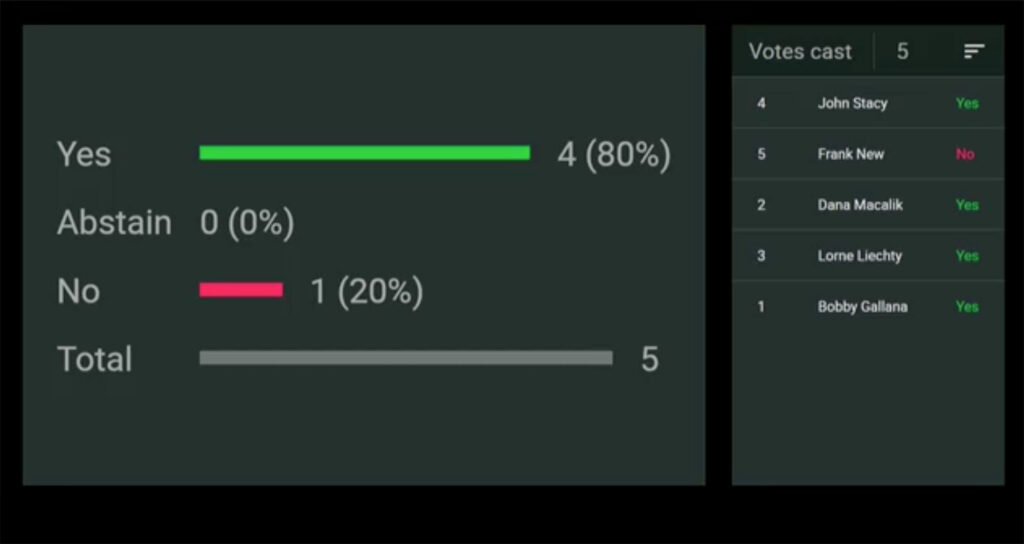
One of the most significant votes of the day involved Rockwall County’s relationship with the Regional Transportation Council (RTC) and the proposed southern segment of the Outer Loop.
The Commissioners Court voted 4-1 to approve a Memorandum of Understanding (MOU) with the RTC and Judge Frank New casted the lone dissenting vote.
Commissioner Lorne Liechty explained that months of negotiations resulted in nearly all of Rockwall County’s requested revisions being incorporated into the agreement. The MOU commits the County to participating in the environmental study—currently estimated at $7.5 to $8 million—while preserving Rockwall County’s opportunity to help shape the project’s final design through the environmental review process.
Liechty’s message was straightforward: if Rockwall County wants influence, it has to stay at the table.
Looking Back at the Public Record
To better understand this vote, it’s helpful to revisit an October 2025 Road Consortium meeting featuring Michael Morris, Director of Transportation for the North Central Texas Council of Governments.
Morris explained that relocating a roadway is only one of several planning tools available during a major transportation project. He also discussed minimizing impacts, mitigating impacts, enhancing communities, and partnering with local governments throughout the environmental process.
Related Coverage: What Rockwall County Needs to Know About the Outer Loop Project
Why the Environmental Study Matters
One of Morris’ central points was that the environmental study is where many of the improvements residents often request—such as sound walls, landscaping, access changes, and other mitigation measures—are evaluated.
Rather than being a procedural requirement, the environmental study is one of the primary opportunities for local governments and residents to influence the final design.
A Shift in the Conversation
Over the past year, much of the public discussion focused on whether the Outer Loop could follow an entirely different route.
This meeting reflected a different conversation.
Instead of debating whether the project should move, commissioners focused on how Rockwall County could remain actively involved in shaping decisions that still lie ahead.
That stood out to me because earlier in the meeting, several commissioners emphasized the importance of following the process before spending taxpayer dollars on the proposed county property.
Here, the environmental study represents a critical part of the transportation planning process itself.
That naturally raises the same question that echoed throughout the meeting:
Should the same emphasis on process be applied consistently across every major decision?
Kuban Road Repairs Followed a Familiar Process
The Commissioners Court unanimously approved issuing a Request for Proposals (RFP) to repair two sections of Kuban Road, totaling approximately 920 feet in southern Rockwall County near FM 548.
County Engineer Erica Bridges explained that the concrete roadway has experienced subgrade failures, causing significant cracking. Because the repairs involve concrete rather than asphalt, the County recommended hiring an outside contractor.
What stood out wasn’t the size of the project—it was the process.
Rather than selecting a contractor during the meeting, commissioners authorized the County Auditor to publicly advertise the project, allowing contractors to submit competitive proposals before any contract returns to Commissioners Court for approval.
It’s a relatively small road project, but it reflects the day-to-day work residents expect from Commissioners Court: identify a problem, seek competitive bids, and make decisions through a public process.
Reserved Parking Sparks a Practical Discussion
Before rumors begin circulating, it’s important to note what didn’t happen.
No parking spaces were approved.
No signs were authorized.
No parking policy was changed.
Instead, commissioners discussed the growing challenge of parking around the downtown courthouse and directed staff to gather additional information—including potential signage costs—before bringing the item back for future consideration.
Commissioner Bobby Gallana, who placed the item on the agenda, said commissioners often return from meetings and appointments to find the courthouse parking lot full. His proposal focused on reserving several spaces along the side of the building rather than using parking in front of the courthouse.
Judge Frank New and Commissioner John Stacy agreed that parking has become more difficult as downtown Rockwall continues to grow.
It’s a challenge many residents can relate to. Whether you’re attending a court meeting, meeting friends for lunch, shopping downtown, or visiting one of Rockwall’s local businesses, parking has become increasingly competitive.
The Consultant Debate Brought the “Process” Question Full Circle
The longest discussion of the meeting centered on whether Rockwall County should begin contract negotiations with HNTB Corporation to replace ITS as the County’s longtime Bond Program Management Consultant.
After more than an hour of discussion, the Commissioners Court voted 3-2 to begin negotiations with HNTB, potentially ending a professional relationship with ITS and its president, John Polster, that has spanned more than two decades.
Commissioner John Stacy argued that a change was necessary, citing project delivery, professionalism, and the need to pursue transportation funding through additional state, federal, regional, and local opportunities.
Not everyone agreed.
Commissioner Dana Macalik questioned whether the Court had enough information to make such a significant change without further evaluation. She also noted that the Commissioners Court itself did not begin issuing bond proceeds from the 2021 transportation bond until January 2026, suggesting that project timelines involved more than the consultant alone.
Commissioner Lorne Liechty acknowledged concerns about professionalism but argued that replacing a consultant with more than twenty years of experience deserved a deliberate evaluation process rather than a decision driven primarily by disagreement.
Who Sets Transportation Priorities?
Liechty repeatedly emphasized that transportation priorities are established by the Commissioners Court, while consultants provide technical expertise and recommendations.
That shifted the discussion from whether a consultant had failed to where responsibility for transportation progress ultimately rests.
If road projects have moved more slowly than residents expected, should responsibility lie with the consultant—or with the elected officials who establish priorities and approve projects?
Why the Debate Felt Familiar

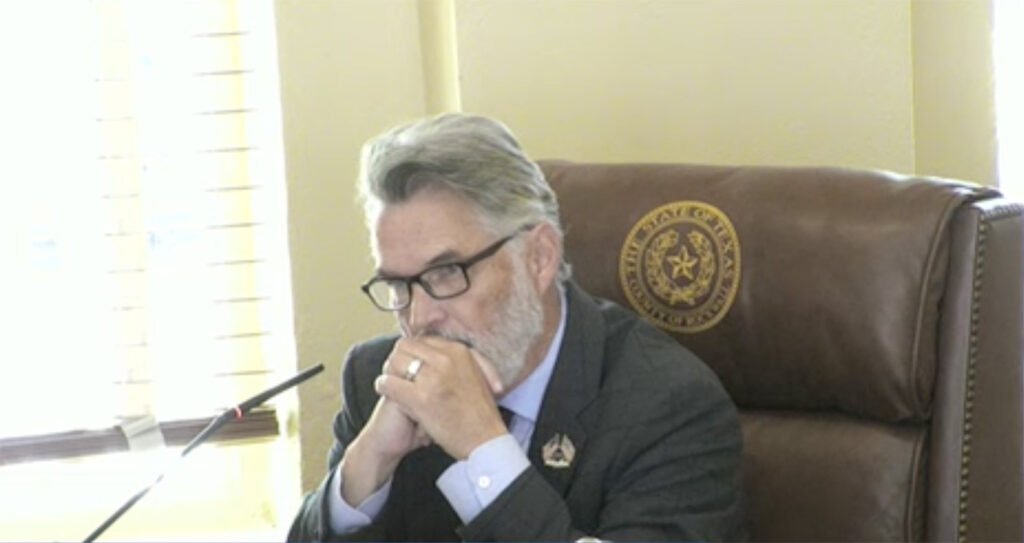
This wasn’t the first time the Commissioners Court has debated replacing a professional consultant while also discussing the importance of following an established process.
Earlier this year, I covered another meeting in “Rockwall County Commissioners Confront What Reckless Leadership Has Created,” where a similar discussion centered on whether professional services should first go through a formal Request for Proposal (RFP) process.
Readers may also find value in John Polster’s published open letter, where he responded to many of the same criticisms raised during this meeting by referencing transportation timelines, public records, and historical decisions.
Those earlier discussions are part of the broader context surrounding this vote.
Related Coverage
- Rockwall County Commissioners Confront What Reckless Leadership Has Created
- Open Letter from John Polster Addresses Rockwall County Transportation Bonds and SH 205 Timeline
The Bigger Question
Throughout this meeting, commissioners repeatedly emphasized the importance of process—whether discussing a proposed county open space, transportation planning, road projects, or professional services. That’s what made this meeting so interesting to follow.
As residents, we don’t all have to agree on every vote.
But we should expect decisions to be transparent, thoughtful, and grounded in a process that is applied consistently.
I’d love to hear your thoughts.
Do you think the same standards of process were applied consistently throughout this meeting?
Leave a comment below or send me an email. I read every message, and thoughtful perspectives help shape future coverage.
If you’d like to hear more of the discussion—including additional context and analysis—you can also listen to Episode 6 of The Adrienne Balkum Show: When Process Matters…And When It Doesn’t on YouTube.
Thank you for reading, and as always, thank you for being part of an informed and engaged community.