
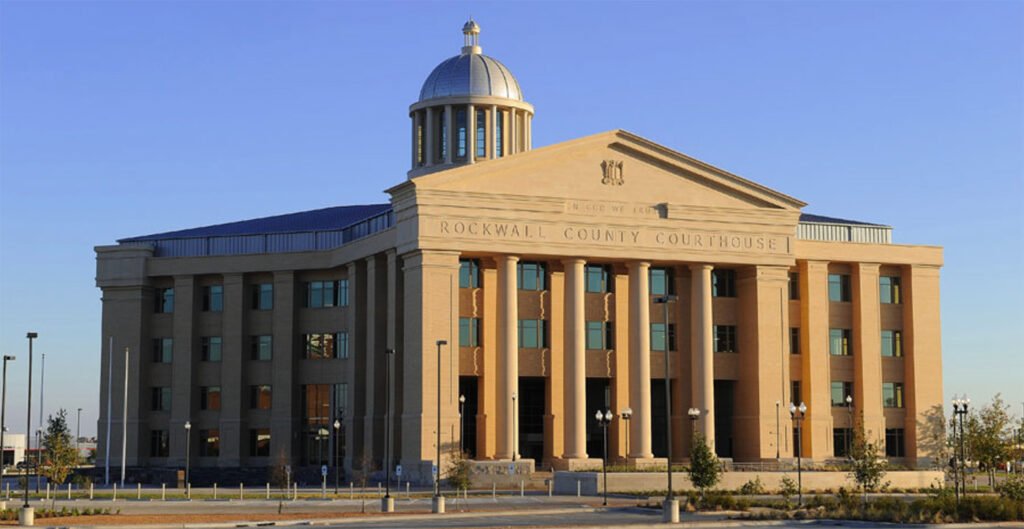


In the ongoing legal dispute between Rockwall County and developers DMDS Land Company and D.R. Horton, a recent 382nd Judicial District court ruling has been publicly framed by County officials as a significant victory. Following the court’s denial of the developers’ motion for partial summary judgment, County Judge Frank New described the decision as “monumental,” emphasizing the County’s authority to apportion infrastructure costs.
However, the ruling does not resolve the underlying case. Instead, it allows key issues to move forward, with factual disputes still requiring evidence, expert analysis, and potentially a full trial. As the litigation continues—including a separate federal case expected later this year—the question remains whether this moment represents a true legal win, or simply a procedural step in a much larger and still unresolved conflict.
Inside the Courtroom: What Happened Before the Ruling
No cameras or audio recordings were permitted inside the 382nd Judicial District courtroom during the February and March hearings, leaving those in attendance to rely on direct observation.
At the initial hearing on February 6, 2026, retired Judge Carolyn Wright made clear that jurisdiction—not the merits of the case—had to be addressed first. Both parties agreed. The Court emphasized that it could not consider the developers’ motion for summary judgment until jurisdiction was determined, noting that doing otherwise could create procedural issues and waste judicial resources.
With a jurisdictional plea still pending and not yet set for hearing, the matter was rescheduled. Attorneys for both sides agreed to return on March 6.
When proceedings resumed, both parties presented materials, including binders and printed exhibits, with arguments centered on Rockwall County’s subdivision regulations—particularly the provisions requiring developers to bear a portion of infrastructure costs as a condition of development approval.
During the hearing, Judge Wright raised questions about the scope of the County’s authority, including whether certain categories—such as trash services and costs associated with state roadways like FM 548—fell within that authority. The County cited general statutory provisions, while also drawing comparisons to how cities manage development-related costs.
Based on courtroom observations and the arguments presented, there appeared to be limited discussion supported by detailed engineering analysis for several of the infrastructure categories presented.
The County’s Position
In its own February 27, 2026 filing, Rockwall County defended its subdivision regulations as a lawful exercise of its authority under Texas law.
The County maintains that its apportionment policy ensures that growth does not place an undue burden on existing taxpayers. It also emphasized that D.R. Horton was not denied outright, but was instead subject to conditions tied to development approval—conditions it argues are consistent with regulatory practices.
County attorneys pointed to statutory provisions and referenced processes already available to developers, including appeals through the Commissioners Court. The County’s position reflects a broader interpretation of infrastructure, extending beyond roads and drainage to include services that support population growth.
What the Developers Argued
In a March 4, 2026 filing, D.R. Horton and DMDS Land Company outlined a narrower interpretation of what counties are legally allowed to require from developers.
While acknowledging that counties may impose certain infrastructure-related costs, the developers argue that Rockwall County exceeded that authority by applying 16 separate categories—many of which, they contend, fall outside what qualifies as “county infrastructure improvements” under Texas law.
The filing also raises concerns about how those costs were calculated. According to the developers, only roadway-related costs were supported by a professional engineer’s report, while other categories lacked the required technical justification. Additional challenges include fees tied to state-owned infrastructure and services that may fall beyond the County’s statutory authority.
At the center of the dispute is not whether developers should contribute to infrastructure—but whether those requirements are legally defined, properly supported, and applied within the limits of state law.
What the Court Requires—and What Remains Unresolved

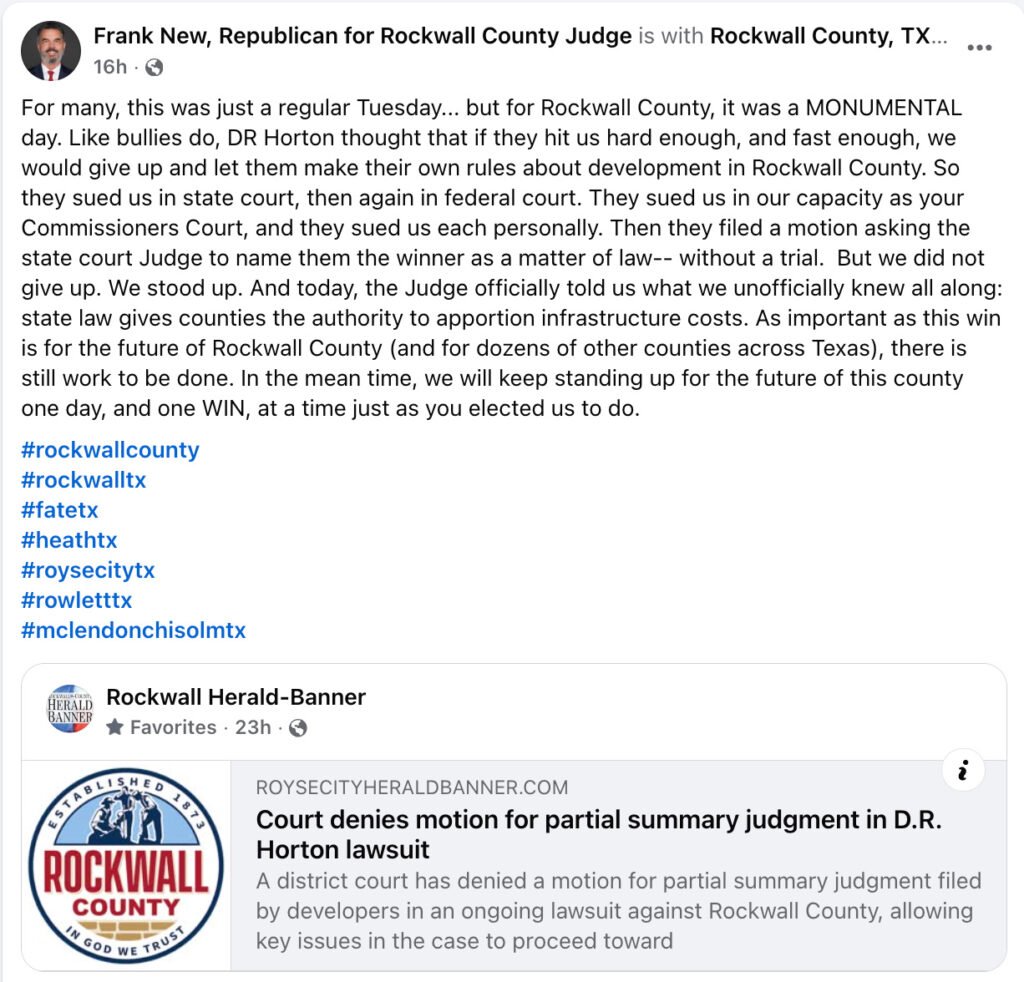

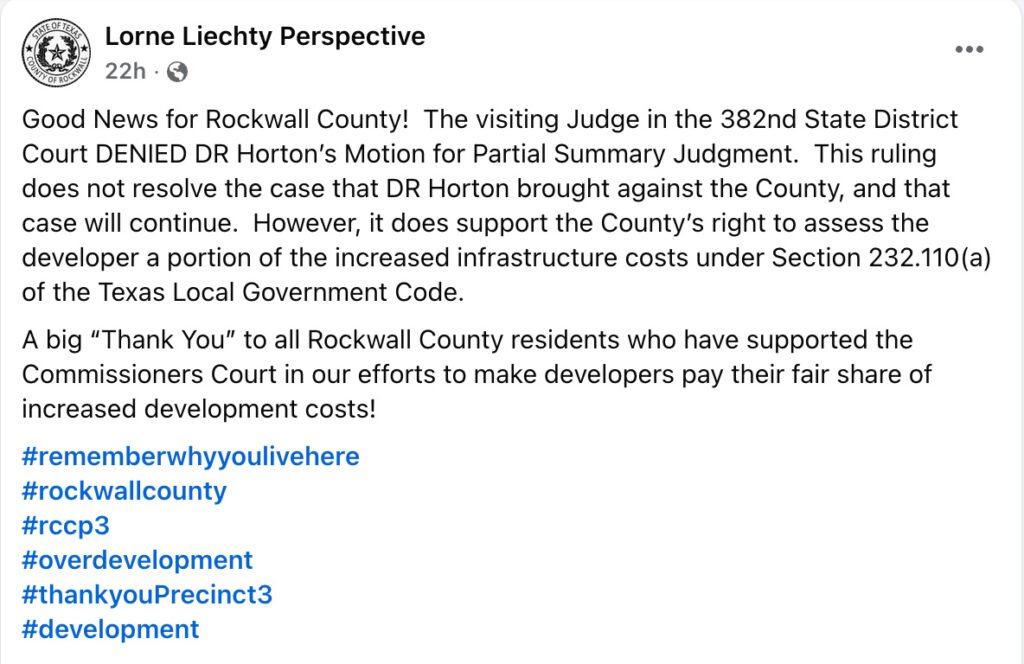

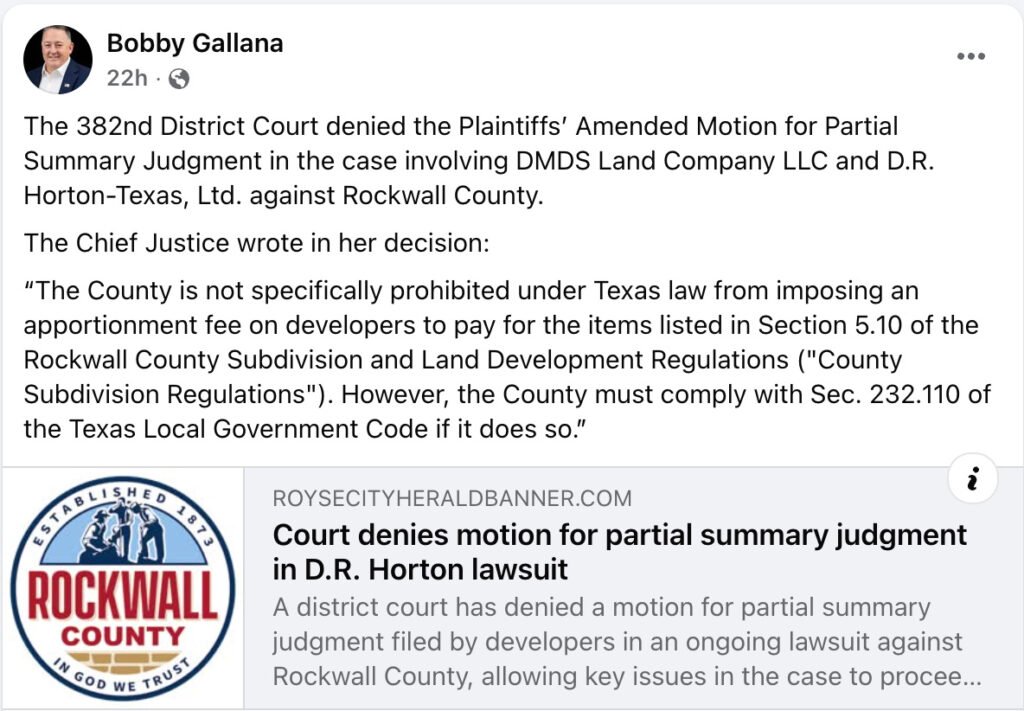
Public statements from County officials have focused on one key takeaway: that Texas law allows counties to require developers to contribute to infrastructure costs.
However, the Court’s order makes clear that this authority comes with limits.
While such authority may exist, the County must comply with Section 232.110 of the Texas Local Government Code when exercising it. That provision requires that infrastructure-related costs be supported—typically through professional engineering analysis—and tied directly to legitimate county infrastructure improvements.
Court filings suggest that standard has been applied unevenly. A professional engineer provided a proportionality analysis for roadway impacts, offering a specific cost tied to the development. However, similar engineer-supported analyses were not clearly presented for many of the remaining categories, including services such as law enforcement, dispatch, and animal control.
As a result, the central issue before the Court is not whether developers should contribute to infrastructure, but whether the County’s requirements meet the legal and evidentiary standards set by state law.
That question remains unresolved.
What Happens Next
Following the Court’s ruling, the case now moves into its next phase.
The parties have been directed to confer and agree on a mediator and submit an Order for Mediation. In addition, the Court has required a proposed Scheduling Order by April 20, 2026, which is expected to outline key deadlines, including discovery, designation of expert witnesses, and a potential trial setting.
These next steps signal that the case is moving beyond procedural arguments and into a phase where evidence, expert analysis, and legal standards will be more fully tested.
Questions for Readers to Consider
As this case continues, it raises broader questions about growth and decision-making in Rockwall County:
- Should decisions be based on what people prefer—or strictly on what the law allows?
- If developers are expected to help pay for infrastructure, what’s fair—and how should those costs be proven?
- Is this debate really about the law, or about opinions on home sizes, pricing, and density?
- If the development moves forward no matter what happens in court, what does a “win” actually look like?
- Do you support the County using lawsuits to address development issues?
If you would like to stay informed on Rockwall County developments, you may subscribe for updates. Readers are also welcome to share respectful thoughts in the comments or reach out by email.
As the case moves forward, the outcome may ultimately shape not just this development, but how growth is governed across Rockwall County in the years ahead.