
Editor’s Note: This article is part of The Water Chronicles, an investigative series on water rates, infrastructure and accountability in Rockwall County and neighboring communities.
Three days after RCH Water Supply Corporation announced that its long-awaited direct connection to the North Texas Municipal Water District was complete, customers were already doing the math.
On September 18, RCH announced that the connection was operating, all samples had passed and Stage 3 restrictions were ending. Chief Executive Officer Robin Mayall wrote: “Today, we have the water, we have the connection, and we have the infrastructure in place to support our future.”
The water had arrived.
The financial questions had not.
Why are RCH customers still paying what they are paying—and what do the corporation’s own financial statements, contracts and court records reveal about how its money has been collected, spent and documented?
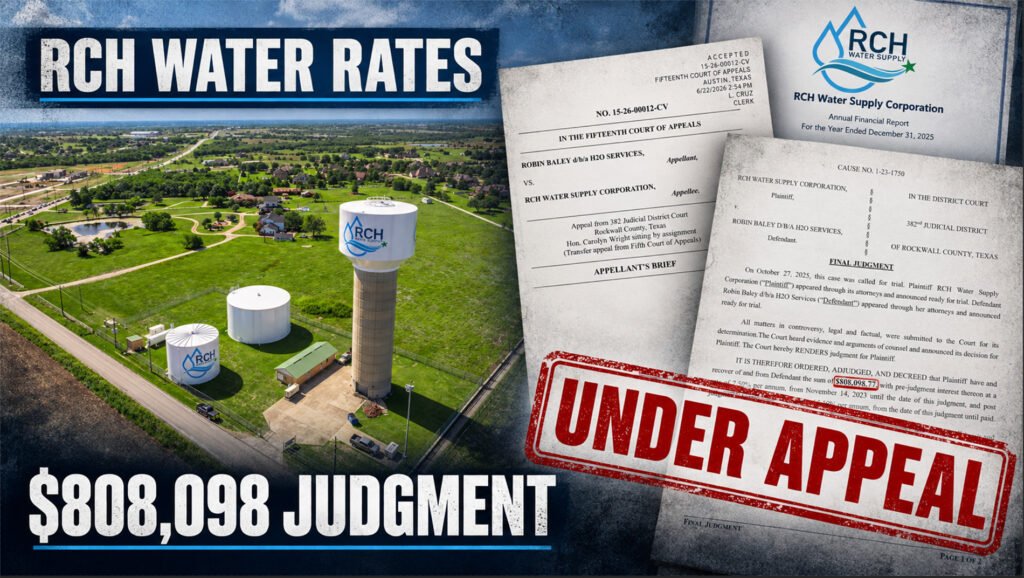
To examine that question, I reviewed RCH’s published rates and 2025 financial audit, the trial court’s $808,098 judgment against former manager Robin Baley, her 74-page appellate brief, a 2005 H2O Services agreement, video of a document handoff at the May 3 board meeting and emails identifying where Baley said RCH’s financial records were being kept—materials that provide context missing from RCH’s public announcement about the judgment.
They do not decide Baley’s pending appeal. They do show that the story behind RCH’s money is more complicated than either a Facebook debate over rates or a victory announcement about a lawsuit.
The Rate Question Is Bigger Than Facebook
A recent customer post compared RCH’s usage tiers with those charged by the cities of Rockwall and Rowlett and warned neighbors to expect much higher bills as water use increases.
The post captured a real concern. But a three-provider comparison cannot tell the entire story. Cities, special utility districts and nonprofit water supply corporations can have different base charges, meter sizes, sewer costs, debt obligations and rate structures.
That is why, in July, I reviewed the published residential rate schedules for 11 local water providers across Rockwall and Kaufman counties. The comparison showed how dramatically neighboring households can pay for the same essential service—and how costly RCH’s escalating usage tiers can become.
RCH’s current published schedule lists a $46.50 monthly base charge for a standard residential meter, plus a $5.14 monthly McLendon-Chisholm legal surcharge. Usage is billed at $7.50 per 1,000 gallons through 8,000 gallons, then increases through higher tiers until it reaches $45 per 1,000 gallons above 60,000 gallons.
RCH says those rates are necessary to cover operating expenses, debt service, reserves and a five-year, $48.5 million capital plan. According to its October 2025 rate announcement, that plan included the NTMWD connection, the Highway 205 project, storage and distribution improvements, and digital meters.
That is the corporation’s explanation.
The financial records provide the next layer—and raise questions that a rate schedule alone cannot answer.
What the Audit Shows—and What Members Still Cannot See
The question of who receives RCH’s money surfaced directly beneath the customer’s rate comparison.
After another commenter suggested that employees might “line their pockets,” David Box responded, “there are only a handful (3 or 4) of employees and their salaries are disclosed to the members. All Board members are volunteers”
Whether board members volunteer is not the question raised by that statement. The question is where members can find the individual salary disclosures Box referenced.
The only individual compensation figure I have been able to document through an employment agreement is Chief Executive Officer Robin Mayall’s October 2023 contract, which set an annual salary of $170,000 plus bonus opportunities.
When I requested bank check registers, employment contracts and related financial records to identify additional employee and contractor payments, RCH estimated that the broader request would cost more than $2,100 to fulfill. I documented that exchange in Following the Questions Behind Your Water Bill.
RCH’s 2025 Annual Financial Report provides totals—but not the names behind several of its largest spending categories.
The report lists:
- $6,091,171 in operating revenue;
- $5,524,507 in operating expenses;
- $751,672 in salaries and related expenses;
- $1,120,901 in professional services;
- $263,468 in administrative services;
- $2,009,520 in water purchases;
- $526,575 in developer equity buy-in fees; and
- an outstanding note balance of $18,611,684 at the end of 2025.
- It also reports $11,931,549 in construction in progress and
- $11,695,943 in fixed-asset purchases during the year.
Those figures reveal the scale of RCH’s finances. They do not identify each employee’s compensation, the vendors included in the $1.12 million professional-services category or the recipients of the $263,468 reported as administrative services. Nor does the aggregate report allow members to trace the source and use of funds connected to every land or infrastructure transaction.
The independent auditor issued a clean opinion that RCH’s financial statements fairly presented the corporation’s financial position in all material respects. That is meaningful—but the scope of the opinion matters.
The report also states that the auditor considered RCH’s internal controls when designing the audit procedures but did not express an opinion on whether those controls were effective. A clean financial-statement opinion therefore should not be confused with transaction-level transparency or an independent certification that every internal control operated effectively.
The audit establishes the totals. It does not identify the people and companies behind several of the largest categories.
If those individual salaries and payments are already disclosed to members, where can members find them?
The $808,098 Judgment Is Under Appeal
On November 24, 2025, RCH announced that it had won a judgment against former manager Robin Baley, doing business as H2O Services.
Following a bench trial that began October 27, the trial court signed a final judgment on November 21 ordering Baley to pay RCH $808,098.77, plus prejudgment and post-judgment interest.
The court found that Baley had a fiduciary relationship with RCH because of her longtime management role and check-signing authority. It also found that she breached that duty through 40 checks written to herself between 2020 and 2022 totaling $808,098.77 without adequate supporting documentation.
RCH called the judgment “an important step in holding prior management accountable.”
That was the trial court’s ruling. It was not the end of the case.
Baley filed a notice of appeal on December 17, 2025. Her attorneys filed a 74-page appellant’s brief on June 22, 2026, asking the Fifteenth Court of Appeals to reverse the judgment. The brief states that Baley filed a supersedeas bond suspending enforcement while the appeal is pending.
RCH’s own 2025 audit reflects that unresolved posture. The audit states that RCH had collected none of the judgment as of December 31, 2025, and did not recognize the award as a gain because it remained subject to appeal.
RCH prevailed in the trial court. Baley is challenging that ruling in the Fifteenth Court of Appeals. The appellate court has not decided whether the judgment will be affirmed, reversed or otherwise changed.
Review the records:
- Read Baley’s 74-page appellant’s brief.
- Read RCH’s second request for additional time to file its appellee brief.
- Read the trial court’s final judgment.
What the Appeal Actually Disputes
Baley’s 74-page appellate brief is advocacy, not a ruling. It identifies what she is asking the Fifteenth Court of Appeals to reverse.
Although RCH originally sued under several legal theories, the judgment on appeal rests on breach of fiduciary duty and disgorgement. It is a civil judgment—not a criminal theft conviction.
Baley argues that she was an independent contractor rather than an employee or fiduciary. She also contends that the trial court improperly required her to prove the reimbursement transactions were fair and ordered repayment of the checks’ full value without determining RCH’s actual loss or crediting expenses RCH allegedly agreed to reimburse.
The trial court rejected that account and found her testimony about supporting vouchers not credible.
The case involves two types of payments. The first was Baley’s meter-based compensation: $5 per meter each month until April 2022, then $7.50. The court’s adopted findings list W-2 compensation of $145,465 in 2021 and $197,402.50 in 2022 and state that RCH did not dispute those salary payments.
The lawsuit concerned 40 additional checks Baley wrote to herself as reimbursements. She argues that each was supported by an itemized invoice reviewed or received by RCH’s board and that copies remained with RCH’s records at the pump station.
The dispute is not whether the checks existed, but whether they were authorized and adequately documented. The trial court found Baley’s explanation not credible. The appellate court must decide whether reversible legal error occurred; it is not conducting a new trial.
The 2005 Agreement—and the Expenses It Does Not Explain
Baley’s appellate brief says she provided services to RCH for approximately 28 years without a written contract. A two-page document David Naylor provided during the May 2023 transition complicates that claim.

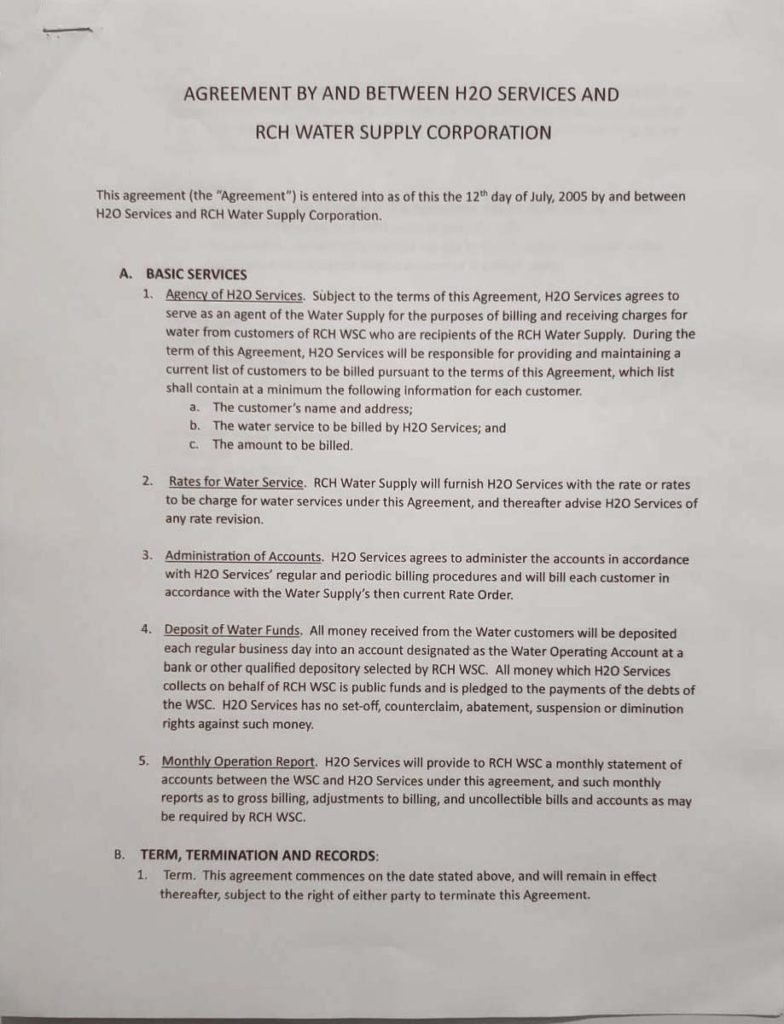


Agreement By and Between H2O Services and RCH Water Supply Corporation. Dated July 12, 2005, the document identifies H2O Services as RCH’s agent for billing and collecting water charges.
The document required H2O Services to deposit collected funds into RCH’s operating account daily and provide monthly reports of amounts billed and collected. It permitted either party to terminate the arrangement with 30 days’ written notice and required modifications to be written and signed by both parties.
The two pages I received contain no signatures. They do not specify Baley’s meter-based compensation, authorize reimbursement checks payable to herself or address the expenses at the center of the lawsuit.
Those claimed expenses were substantial.
Baley’s brief says RCH paid the entire $4,600 monthly rent for H2O Services’ office for approximately a decade—even though H2O reportedly served five water-company clients. It also identifies $2,500 per month for website hosting and maintenance, along with utilities, telephone service, mileage, insurance, employees, office supplies, printing, inspections, meter reading and lockout work.
The document sets out written terms for part of the relationship. It does not explain those payments.
Was it signed and approved by RCH’s board? Was it still operative when the disputed checks were written? Were there amendments covering compensation or reimbursements?
Why was RCH charged the entire office rent? How were shared expenses allocated among H2O’s other clients? What services were included in the $2,500 monthly website charge?
If the charges were unauthorized, the records should demonstrate that. If RCH knowingly approved and paid them for years, records supporting that position should also exist.
The missing documentation is not a side issue. It is at the center of the $808,098 judgment.
What the 2023 Transition Records Show
According to Baley’s appellate brief, David Naylor had no previous involvement with RCH before his wife encouraged him to run for the board because she believed he could help the corporation. He was elected in March 2023 and became board president the following month.
Naylor began requesting audits, balance sheets and other financial records. Those requests preceded the examination of Baley’s reimbursement checks and the lawsuit now on appeal.
At the May 3 board meeting, longtime maintenance supervisor and licensed operator Dwight Lindop resigned. Baley then told the board she could no longer continue in her role.
The trial court’s adopted findings describe Baley’s departure as abrupt and connect it to Naylor’s financial inquiries. Baley’s brief emphasizes that Lindop resigned first and that she responded by saying she could no longer do the job.
Video and emails from the transition provide additional context about what followed.
[VIDEO: May 3, 2023 documents and key handoff.]
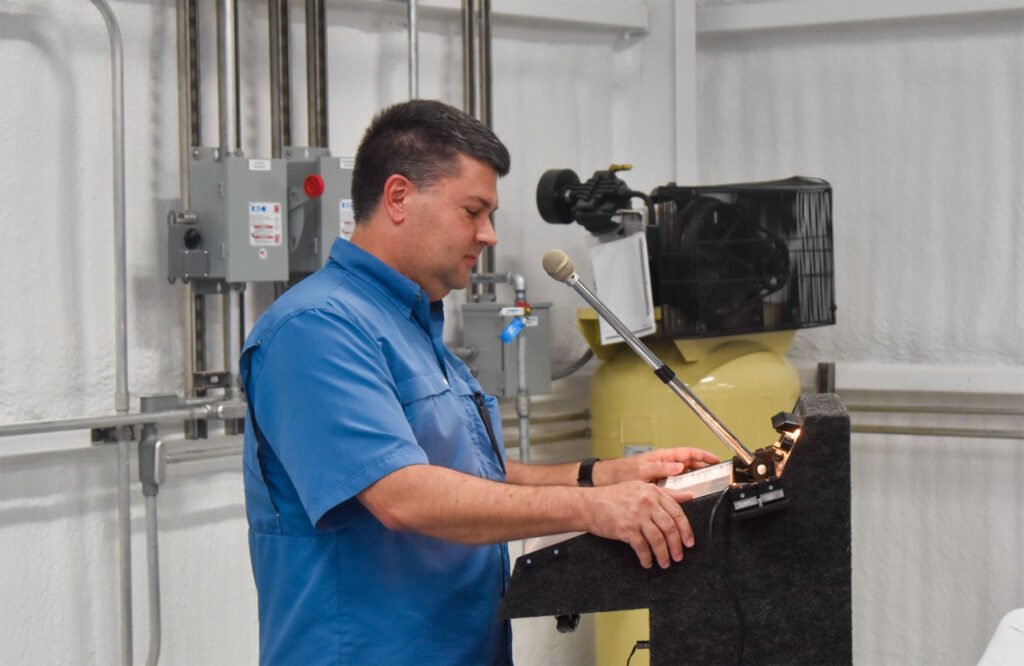
Video I recorded at the May 3 meeting shows Lindop moving a substantial stack of documents across the table toward Naylor. I also witnessed Lindop give Naylor a list of telephone numbers for people who could assist and the keys to the RCH pump station.
The video does not reveal what every document contained. It does document a physical handoff.
Five days later, Baley responded by email to Naylor’s questions about RCH’s operations and records. She wrote that Master Meter data could be placed on a jump drive, meter-reading sheets were ready for pickup and previous years’ financial information was at the pump station. She said the most recent two months of financial information remained at the H2O Services office.

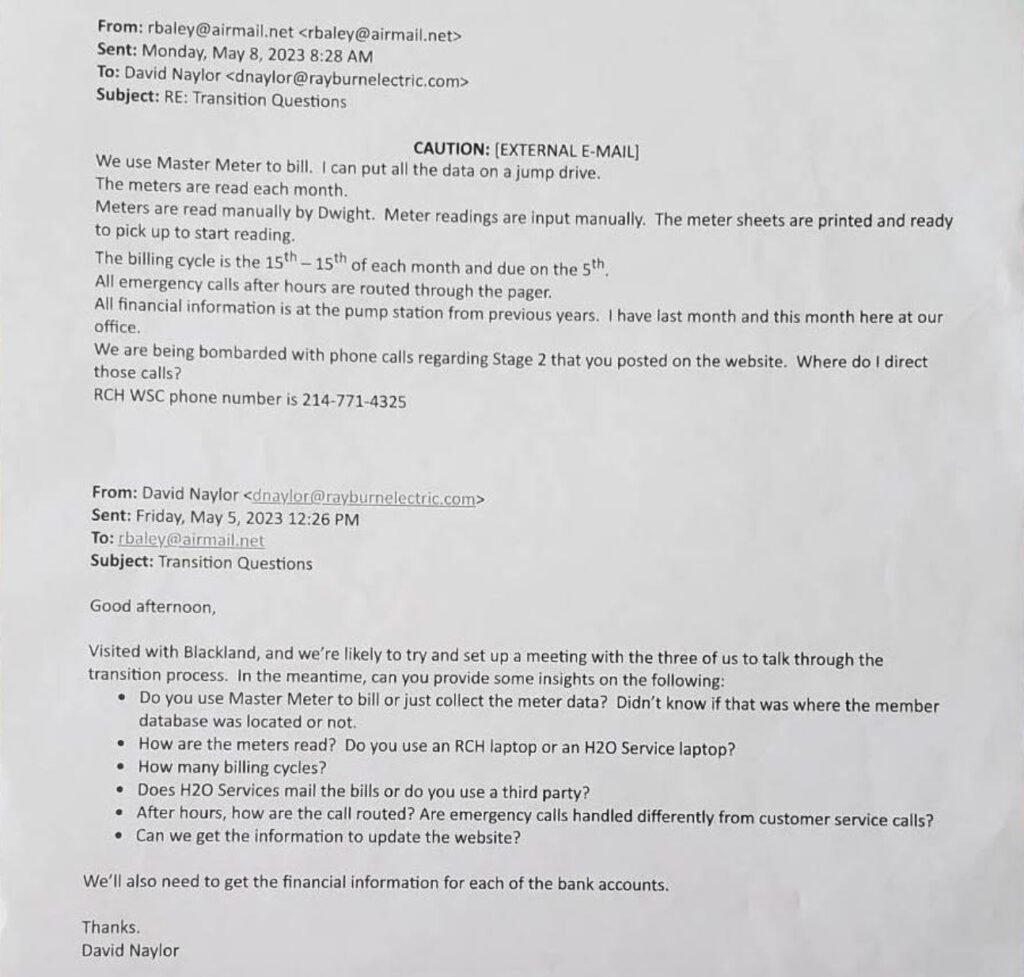
The email does not prove that the disputed invoices were among those records. It does show that Baley identified where she said RCH’s financial information was being kept—and that Naylor had access to the pump station.
On May 19, I sent city officials a same-day written account of my meeting with Naylor. According to that email, Naylor said the jump drive was “essentially useless,” although the paper records contained meter readings and account-location information. I also recorded that Naylor said he had not signed checks payable to H2O Services and had been told Baley received $7.50 per meter each month.
The email memorializes what Naylor reportedly told me. It is not an audit finding or verbatim transcript.
Official Blackland Water Supply Corporation minutes add another piece. They state that Blackland’s board discussed helping operate RCH “on a short temporary basis” and voted unanimously on May 25 to end that assistance effective June 8, 2023.
After the transition, Whitley Penn examined RCH’s bank activity. Baley’s brief characterizes that work as a “cash audit” that reconciled deposits and withdrawals and generated a profit-and-loss statement. According to the brief’s account of the trial testimony, the accounts balanced and the work was “not a forensic audit.”
The trial court’s adopted findings describe the investigation as “forensic.”
That distinction requires precision. Reconciling bank activity can show that deposits and withdrawals were accounted for. It does not necessarily establish that every payment was authorized or adequately documented.
A review of RCH’s bank records identified the disputed reimbursement checks payable to Baley. The trial court found the supporting documentation inadequate and held that the payments constituted a breach of fiduciary duty. Baley disputes both the legal basis for that ruling and the award of the checks’ full value.
Taken together, the video, emails and official minutes do not prove that every disputed invoice was transferred. They do establish that documents, operational information and physical access changed hands—and that Baley identified where she said additional RCH financial records were being kept.
Accountability Cannot Stop With Baley
RCH presented the $808,098 judgment as an achievement in holding prior management accountable. Its announcement left unanswered questions raised by the seriousness of its allegations.
Did RCH refer the matter to the Rockwall County Sheriff’s Office, Rockwall County District Attorney, Texas Rangers or another law-enforcement agency for an independent criminal investigation?
I found no public record confirming such a referral. That does not prove none occurred. If RCH made one, members should be told which agency received it, when and with what result. If not, RCH should explain why it pursued civil recovery without requesting a criminal investigation into conduct it characterized so seriously.
Another question remains: What exactly did Whitley Penn examine?
Calling the work “forensic” does not define its scope. Which bank accounts and date ranges were reviewed? Did the firm independently contact financial institutions to identify every RCH account, or examine only the records provided? Did it investigate transactions beyond the disputed checks?
Those questions do not diminish the trial court’s judgment. They test whether RCH’s public description matches the work performed.
The same standard should apply to current leadership. RCH’s published audit does not show:
- where members can find the individual salary disclosures referenced by David Box;
- which employees, contractors and vendors received the amounts reported as salaries, professional services and administrative services;
- what funded RCH’s 2024 land purchase from Denise Wang and how the transaction was recorded;
- what money, land and infrastructure RCH received through Sonoma Verde; or
- what happened to the planned elevated-storage project and the land conveyed for it.
My earlier reporting documented the planned storage site, the 2019 land conveyance and approximately $1.3 million in developer-funded water infrastructure. RCH’s 2025 audit separately reports $526,575 in developer equity buy-in fees.
Those figures should not be conflated. They should be reconciled through the underlying records.
RCH had every right to announce its trial-court victory. But the same demand for documentation must apply when members ask about current salaries, vendors, property purchases, developer contributions and the scope of RCH’s financial investigation.
Accountability cannot operate in only one direction.
The Water Arrived. The Questions Remain.





RCH’s direct connection to the North Texas Municipal Water District is a significant accomplishment—one accompanied by construction costs, debt and the continuing expense of operating a growing water system.
Delivering a new water source does not close the books on how customers’ money is collected, spent and documented.
The Fifteenth Court of Appeals will decide whether the judgment against Baley stands. RCH need not await that decision to identify its current salaries, vendors and contractors; explain its property and developer transactions; or disclose the scope of the investigation it describes as forensic.
Accountability is a present-tense obligation.