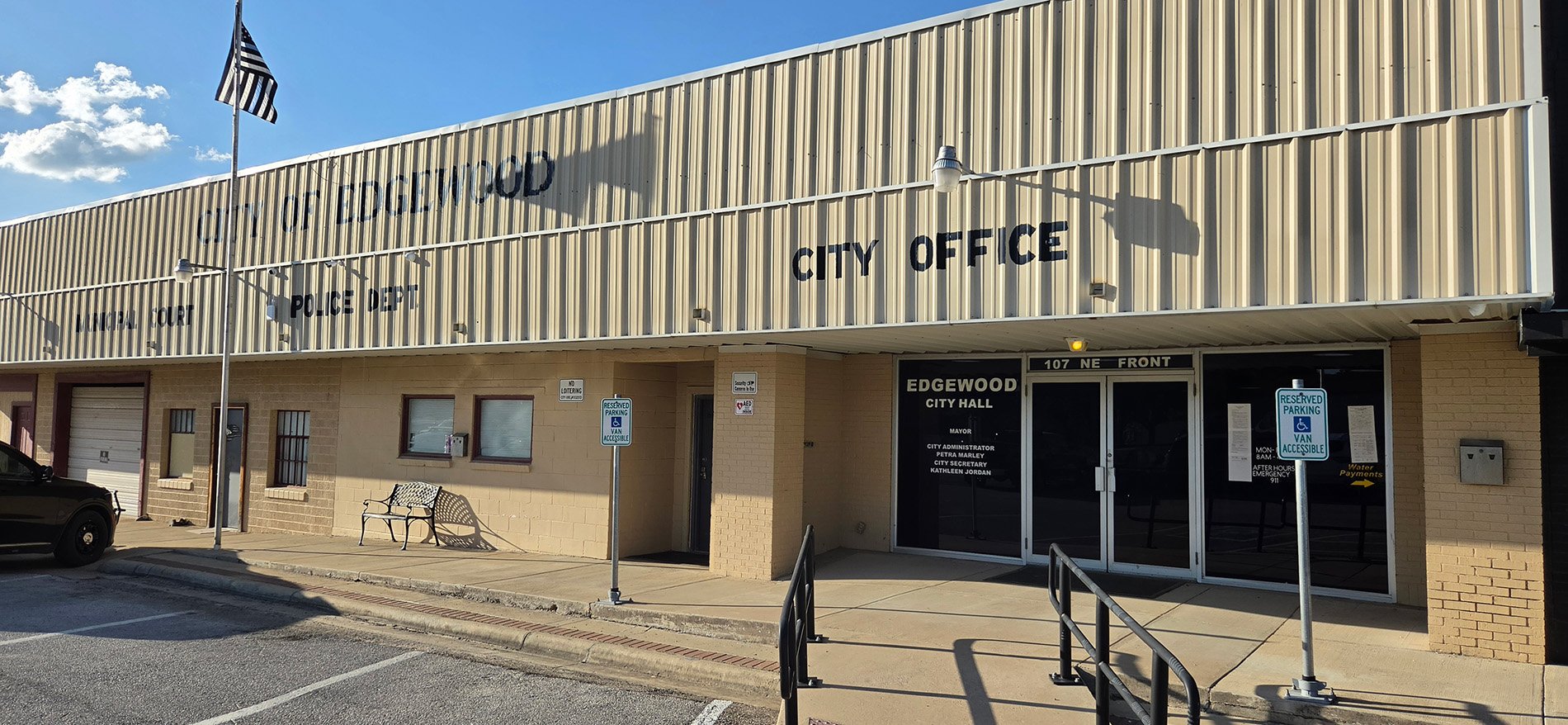

For nearly two and a half months, residents in Edgewood, Texas, have been dealing with brown water, unpleasant odors, stained clothing and growing frustration over what they say has been a lack of consistent communication from the City.
On Monday, September 14, I traveled to Edgewood to attend and record the City Council meeting myself.
Residents had a lot of questions.
And while the meeting covered everything from the property tax rate and City Council iPads to purchasing policies, budget amendments and employee job descriptions, it was clear that several people sitting in the room were there for one reason:
They wanted answers about their water.
Residents Came Prepared With Questions
The water concerns began during citizen comments near the beginning of the meeting.
Edgewood resident Stacey Hawkins, who told Council she works in the water industry, approached the issue differently than someone simply coming to complain.
She came prepared with a three-page document containing 29 questions and distributed copies around the room.
“I just want to offer up some questions that I think the citizens deserve answers to.”
Hawkins also offered to help connect Edgewood officials with people in the water industry, telling Council she believes water systems benefit from networking, education and sharing information.
“I think we’re all better together and maybe we can come up with some solutions.”
I will include Hawkins’ complete list of questions below so residents can read them for themselves.
[READ STACEY HAWKINS’ 29 QUESTIONS HERE]
Then Jackie Young stepped forward.
Young became emotional while describing what it has been like repeatedly finding brown water coming from her faucets.
She told Council she wants to grow old in Edgewood but has become fearful of drinking the water and even bathing in it.
“I just want some safe, clean, clear drinking water I can bathe my grandkids in. I can give it to my dogs. I don’t think that’s too much to ask.”
Young said the problem wasn’t coming from her water heater. As recently as 5:15 that evening, she said she had a bathtub filled with brown water coming directly from the cold water line.
Then Becky Baugh addressed Council with photographs and a prepared statement.
Baugh said residents had been dealing with brown, foul-smelling water for roughly two months and repeatedly calling the City looking for answers.
But her biggest concern wasn’t only the discoloration.
“What I want to talk about tonight is not just the water. It’s the lack of communication.”
Baugh described ruined clothing, concerns about bathing her grandchildren and the financial impact on families already paying their monthly water bills.
She also said an August 17 Facebook post was not enough communication for a problem affecting something as essential as drinking water.
Her request to Council was straightforward, “We deserve clean, reliable water, but also we deserve honest, consistent communication from the people we elected to serve our community.”
Then Residents Waited
After citizen comments, Council moved through its regular business.
And there was a lot of it.
The Council worked through 18 agenda items before reaching departmental reports, covering matters including the tax rate, sanitation and bulk water pricing, City policies, City Council iPads, the Senior Center, a logo rebrand, budget amendments, employee job descriptions and digital agenda packets.
There was nothing inherently improper about Council conducting the business on its agenda.
But it is important context.
Residents who had come looking for answers about what was coming from their faucets sat through the rest of the City’s business before the meeting finally reached the Water Department report near the end.
By then, frustration in the room was becoming much easier to understand.
Petra Marley Explains What Happened
Outgoing City Administrator Petra Marley, who is retiring after 14 years with the City, delivered the Water Department report herself.
Marley began by acknowledging the unusual length of the problem.
“This has been the longest we have had an issue with the water at any time. It’s been two and a half months.”
According to Marley, the problem began in mid-July when the City’s pumps were moving less than half of the water needed for the system.
Initially, City staff believed there was a major leak.
Marley said crews spent approximately three weeks searching, including using drones and physically examining the route between the Lake Tawakoni intake and Edgewood.
Eventually, they determined there was no major leak.
Instead, Marley said, there was a restriction in the raw water line near the treatment plant.
That created another problem.
The City had already begun its annual chlorine burn. Marley explained that flushing would normally occur during that process, but Edgewood did not have sufficient water available to flush the distribution lines while also trying to maintain water in its tanks.
“We didn’t have water to flush. We just didn’t have the water.”
After repairs were completed and the City’s tanks began filling again, Marley said officials discovered manganese in the water.
What followed, according to Marley, was repeated flushing, adjustments to treatment, changes involving pH, and eventually a chemical treatment intended to coat the lines.
Marley said that treatment briefly appeared to make matters worse.
“The water was already clearing up, and we did their suggestion of adding the chemical to coat the lines and for some reason that weekend it turned everything brown again.”
Marley said TCEQ later spent a day in Edgewood after receiving complaints and after media coverage brought additional attention to the problem.
She told Council the City received correspondence from TCEQ on September 4 concerning elevated manganese and treatment recommendations.
Importantly, Marley told the audience, “We didn’t get any violations. We have no violations on it.”
That statement should be understood as Marley’s account to Council. I am continuing to review the regulatory records surrounding the City’s water issue rather than treating any characterization of TCEQ’s findings as the final word.
City Says Tanks Are Now Clear
Marley said the licensed water operator had told her that the clear well, ground storage and water tower were clear as of the day of the meeting.
She told residents that any remaining discoloration should be residual material still sitting in portions of the distribution system.
“No one should be having any brown water right now.”
Yet people sitting in the meeting had already said they were.
Marley acknowledged that even she had experienced dramatically discolored water while someone living a street behind her had not.
She described attempting to put water into her swimming pool only to see it come out “as dark as this desk.”
Her explanation was that a series of problems had compounded: the raw-water restriction, inability to flush normally during the chlorine burn, manganese, treatment adjustments and a pH problem.
“It just happened. It dominoed on us and it got away from us.”
“That Was on Facebook”
Communication quickly became another point of contention.
One resident asked how the City’s voluntary water-conservation notice had been distributed because she never received it.
Marley answered, “That was on Facebook.”
She added that Facebook was the only way to reach everyone at once.
That answer did not sit well with everyone in the room.
The resident explained that she had repeatedly called the City, paid approximately $200 for an alternative water system, lost light-colored clothing to staining and had taken children elsewhere to bathe all while continuing to receive a City water bill.
Her frustration was not simply that something went wrong with the system.
It was that she didn’t feel residents were being kept informed while it was happening.
She said phone calls often seemed to end with residents being told to attend the September 14 meeting if they had questions.
That is an area where Edgewood can improve immediately.
A Facebook page can be useful.
It should not be the only meaningful communication channel during an extended drinking-water problem affecting an entire community.
Where Was Edgewood’s Licensed Water Operator?
Then came one of the most important exchanges of the night.
A resident asked Marley directly, “You’re not over the water plant, right?”
Marley answered, “No, our water operator is.”
The resident followed with the obvious question.
Where was he?
Marley’s response surprised some people in the room.
“I didn’t think I needed him tonight because he’s done everything he’s needed to do. I mean, what would you ask him? He would get up and say exactly what I said.”
The resident pushed back.
She pointed out that people had specifically been told to come to this meeting with their water concerns. If the licensed operator is the person overseeing the technical operation of the plant and distribution system, she believed he should have been there answering those questions himself.
And Marley had already acknowledged during her explanation that the technical chemistry of the situation was not her expertise.
That is a fair point.
Residents weren’t merely asking administrative questions.
They were asking about manganese, chemical treatment, flushing, pH, treatment processes and whether the water coming into their homes was safe.
Those are precisely the kinds of questions where hearing directly from the licensed professional responsible for operating the system could provide confidence.
Who Is the Class A Operator?
After the meeting, I spoke with Marley off camera specifically about Edgewood’s licensed water operator.
Marley told me she had personally seen his credentials and described him as having approximately 40 years of experience and holding a Class A water operator license.
But I was not given his name.
That leaves a very simple follow-up question, Who is Edgewood’s licensed water operator?
This does not need to be mysterious.
TCEQ licenses water operators, and licensing information can be independently verified.
If Edgewood has an experienced Class A operator overseeing its drinking-water system, identifying that individual and allowing residents to verify his current credentials could actually provide some of the reassurance people have been asking for.
That is something I intend to follow up on.
Could Residents File an Insurance Claim?
Just as the Mayor began moving the meeting to the next departmental report, another resident stopped the discussion.
“So did we move on? Are we done with the water?”
The Mayor answered yes.
But the resident wasn’t finished.
She said people had lost clothing, stained toilets and showers, purchased drinking water and paid for other alternatives while continuing to pay their City water bills.
She wanted to know whether the City intended to offer customers any kind of accommodation or credit.
Marley said she did not believe there was much the City could do and suggested that even a $20 credit for everybody would not begin to cover some residents’ losses.
Then she offered another possibility, “You might could file against our insurance. Make an itemized list and file against the City’s insurance.”
That may be worth exploring for residents who believe they suffered documented financial losses because of the water problem.
Marley did not announce a City reimbursement program, and she did not guarantee that an insurance claim would be paid.
But she did raise the City’s insurance as a possible avenue.
Anyone considering that option may want to contact the City directly and ask:
What is the formal procedure for submitting a claim against the City’s insurance?
And it would be sensible to preserve whatever documentation is available—photographs, receipts, dates, water bills and records of communication with the City.
That is another subject I believe Edgewood officials should clarify publicly rather than leaving each affected resident to figure it out individually.
Senator Bob Hall’s Office Was in the Room
There was also someone else taking notes during Monday night’s meeting.
A representative named Chris from State Senator Bob Hall’s office attended.
I have been openly questioning what Senator Hall and other state officials are doing about drinking water problems occurring within Senate District 2, including here in Edgewood.
I cannot say what prompted Hall’s office to send a representative to this particular meeting. Whether it was recent public attention, constituent concerns, reporting on the issue or something else.
But I was glad to see someone from his office in the room listening.
Now the question is what happens with those notes.
I also did not observe any members of the Van Zandt County Commissioners Court in attendance Monday night.
Different levels of government have different responsibilities, and the City of Edgewood operates its own water system. But when residents are experiencing a prolonged problem involving something as fundamental as drinking water, I believe elected officials at every level should at minimum be paying attention.
Residents Still Want Answers
There is an important distinction here.
The City provided considerably more information Monday night than many residents said they had received during the preceding two months.
That matters.
Marley gave residents a timeline, described the raw-water restriction, explained why normal flushing couldn’t initially occur, discussed manganese and pH problems, and told the audience that the City’s storage facilities were now producing clear water into the distribution system.
But several questions remain.
• Who exactly is the licensed operator?
• Can the City publish his license information so residents can verify it?
• What testing is being performed now?
• Will results be made publicly available?
• How will the City communicate if conditions change again?
• What should residents still experiencing brown water do?
• And will Edgewood establish a clear procedure for residents seeking reimbursement or filing claims for documented losses?
Those are reasonable questions.
After nearly two and a half months, residents aren’t asking for perfection.
They are asking for clean water, competent operation and consistent communication.
Connect With Other Van Zandt County Residents
For residents wanting to stay connected with neighbors following this and other issues throughout Van Zandt County, visit the Heart of Van Zandt County Facebook community, managed by Laurie Anna Wilson:
Heart of Van Zandt County on Facebook
I will continue reviewing the records surrounding Edgewood’s water system, including the licensed operator information discussed after Monday night’s meeting.
And as always, the full meeting video is included above so you don’t have to rely solely on my account of what happened.
Watch it. Listen to the residents. Hear the City’s responses for yourself.
Because when it comes to something as essential as the water coming into people’s homes, accountability begins with having the information.
Have something to add to this story? Reach out to me.