
Editor’s Note: This is the second installment of The Water Chronicles.
Water doesn’t simply appear when we turn on the faucet. Behind every gallon is a system of people, infrastructure, agreements and decisions that most customers never see.
In the first installment of The Water Chronicles, comparing water bills raised a simple question: Why do neighboring communities pay so differently?
The more I searched for that answer, the more I realized the monthly bill wasn’t the biggest story. To understand the rates, I first had to understand who owned the system behind the tap.
Many customers have no idea whether their water comes from a city utility, a special utility district or a nonprofit water supply corporation—and until I began this review, neither did I appreciate why that distinction mattered.
The answer begins before many of today’s neighborhoods—or even the communities themselves—were built.
Why Rural Water Systems Were Created
Decades ago, many Texans living outside city limits didn’t have access to public drinking water. Families often relied on private wells, collected rainwater or hauled water from other sources to meet their daily needs.
As communities grew, nonprofit water supply corporations were created to bring safe, reliable drinking water to rural homes, farms and ranches that cities weren’t serving.
Texas law authorizes nonprofit water supply corporations to provide water and sewer service, while organizations such as the Texas Rural Water Association help support member utilities through training, technical assistance and other resources.
At the time, it was an innovative solution to a very practical problem.
Today, many of those once-rural communities look very different.
Texas Has Changed
Over time, those communities have experienced extraordinary growth. Communities once surrounded by farmland have become thriving suburbs, bringing new neighborhoods, schools, businesses and thousands of additional residents.
As those communities expanded, so did the demands placed on their water systems.
Infrastructure originally designed to serve scattered rural connections may eventually be expected to support dense subdivisions, commercial development and continued residential growth. That can require larger water lines, additional storage, expanded water supplies and long-term planning for the future.
As I continued my research, I discovered something else. Growth wasn’t the only difference between these systems. How they were organized mattered, too.
Not Every Water Utility Is Organized the Same
Across Texas, communities receive water service through several different models.
Some cities own and operate their own utilities. Others receive service through special utility districts, nonprofit water supply corporations or regional wholesale suppliers such as the North Texas Municipal Water District.
Some communities treat their own drinking water. Others purchase treated water from a regional provider. Still others are working toward becoming direct wholesale customers as their communities continue to grow.
None of these approaches is inherently better than another. Each developed to meet the needs of the communities it serves.
What matters for customers is understanding that each operates under a different ownership and governance structure—and those differences can shape how decisions are made, how infrastructure is managed and where accountability ultimately rests.
One Water System Can Involve Several Different Roles
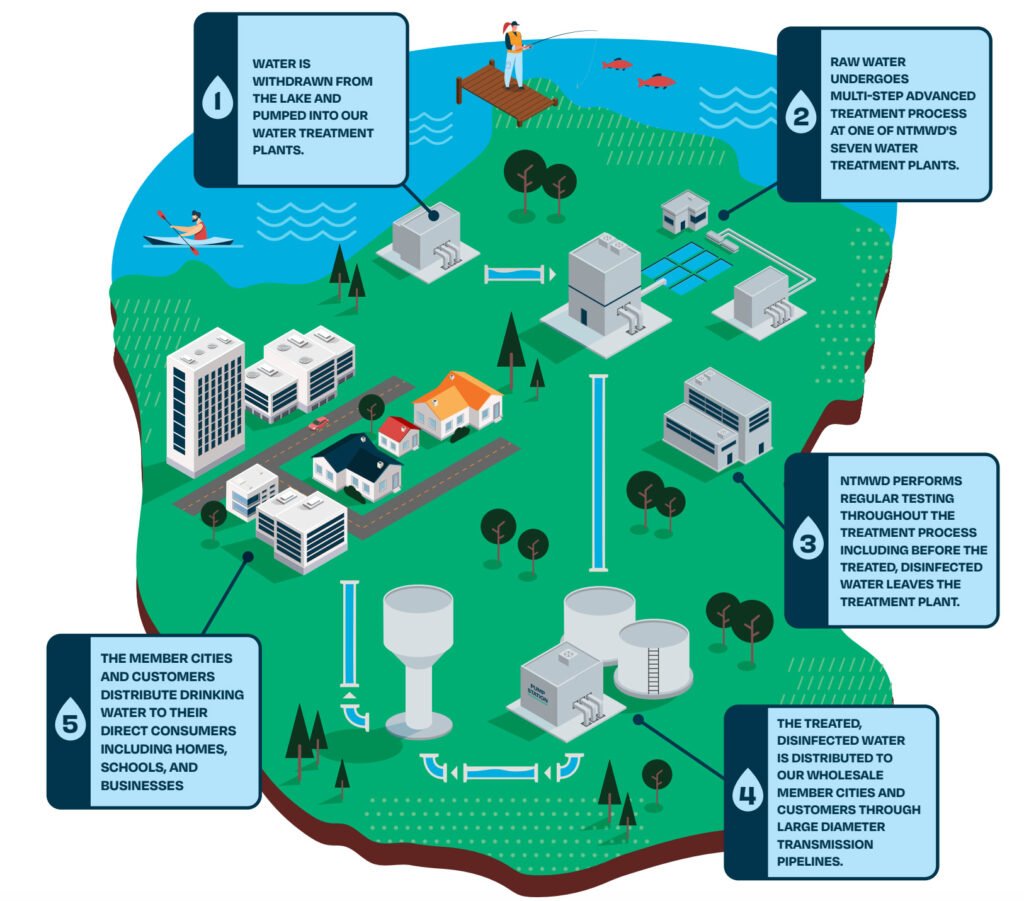
While every community’s water system is different, this illustration shows how multiple organizations can work together to deliver drinking water to homes and businesses.
At first glance, it may seem like one organization handles every step. In reality, those responsibilities are often divided among several different entities. The name printed on your water bill may represent only one part of a much larger system.
For example, one organization may treat and supply the water. Another may purchase that water and provide retail service to customers. A third may own the pipes, storage facilities and other infrastructure used to deliver it.
Those responsibilities generally fall into four categories:
- Wholesale supplier: Provides treated water to cities or other utilities.
- Retail provider: Bills customers and delivers water service within a designated service area.
- Infrastructure owner: Owns the pipes, storage facilities and other physical assets.
- System operator: Oversees the day-to-day operation and maintenance of the system.
There isn’t a single model that fits every community. That’s why understanding your own local system is so important.
That distinction becomes important because the name on your water bill doesn’t always tell you who owns the infrastructure, who plans future improvements or who is responsible for major decisions affecting the system.
Most families never need to think about those differences—until something changes.
A water main breaks.
Rates increase.
A major development is approved.
Questions suddenly arise about infrastructure, maintenance, long-term planning and who is responsible for answering them.
Understanding who performs each role makes it much easier to understand how your own water system works—and where accountability ultimately rests.
Why This Conversation Matters Today
As Texas continues to grow, so do the demands placed on local water systems.
Communities across the country face many of the same challenges: aging infrastructure, stricter environmental requirements, rising construction costs and the need to plan for future growth.
A recent water affordability report by NewGen Strategies & Solutions notes that utilities nationwide are balancing infrastructure investments, regulatory requirements and affordability concerns while many communities continue to experience rapid population growth.
Different types of utilities also operate under different governance structures. Municipal utilities are generally overseen by local governments. Investor-owned utilities are regulated by the Public Utility Commission of Texas. Nonprofit water supply corporations and special utility districts operate under their own legal and governance frameworks.
No matter which model a community uses, long-term planning matters. Water systems require continual investment, and many utilities regularly evaluate future infrastructure needs, customer growth and financial planning to help ensure reliable service for years to come.
Understanding who owns, operates and plans for your water system makes it easier to understand how long-term decisions are made—and who makes them.
Why Ownership Matters
At first glance, ownership may sound like a technical legal issue.
In reality, it influences far more than the name on a deed.
It shapes how infrastructure is managed, how revenue flows through the system and who is responsible for long-term investment.
In some communities, one organization performs all of those roles. In others, ownership, operations and customer service are divided among multiple entities.
Once you begin asking who owns the assets, who operates the system and who collects the revenue, you start to see how those responsibilities influence decisions about infrastructure, finances and long-term planning.
That realization became especially important as I examined Sonoma Verde’s water system.
In my previous investigation, “McLendon-Chisholm Water Infrastructure: When the Claims Don’t Hold Water,“ public records showed that Sonoma Verde’s system was established through multiple agreements involving the City, the developer and RCH Water Supply Corporation.
Those agreements also illustrate how infrastructure ownership and retail water service do not necessarily rest with the same entity.
Those distinctions helped answer one question from the first article: why understanding a water bill sometimes requires looking far beyond the monthly statement.
But another question remained.
If ownership, operations and responsibility can be divided among multiple organizations, how do customers know who is actually responsible for operating the system day to day?
Looking Beyond the Pipes
Many people naturally assume the organization providing their water service also owns every part of the system.
That’s not always the case.
Once I understood that different organizations can play different roles, the next step seemed obvious: start asking questions.
- Who owns the pipes?
- Who is responsible for replacing aging infrastructure?
- Who collects the revenue generated by the system?
- Who decides whether public assets should be sold?
- How do those decisions affect customers over time?
But those questions quickly led to even bigger ones.
How are decisions made?
What information is available to the public?
How does oversight work in practice?
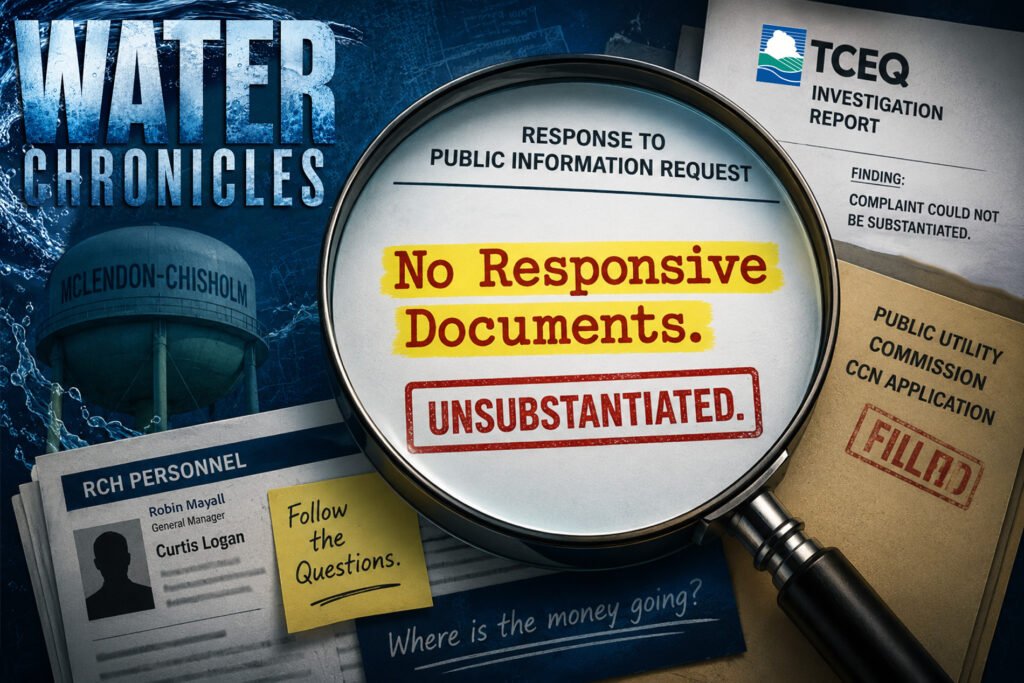
As I continued reviewing public records and requesting documents for The Water Chronicles, one difference became increasingly difficult to ignore.
Obtaining financial information from municipal governments was generally more straightforward because many records were available through public meetings, budgets, audits and public information requests.
Receiving comparable financial information from nonprofit water supply corporations often proved more challenging during my reporting.
Rather than answering my questions, it pointed me toward the next stage of the investigation.
The Investigation Continues
Join the Conversation
Water touches every home, every business and every neighborhood.
Yet most of us don’t think about how the system works until something changes.
Have you ever wondered who owns your community’s water system?
Have you ever tried to learn more about your local provider or request information?
Leave a comment below.
Your questions and experiences may help shape future investigations in The Water Chronicles.