
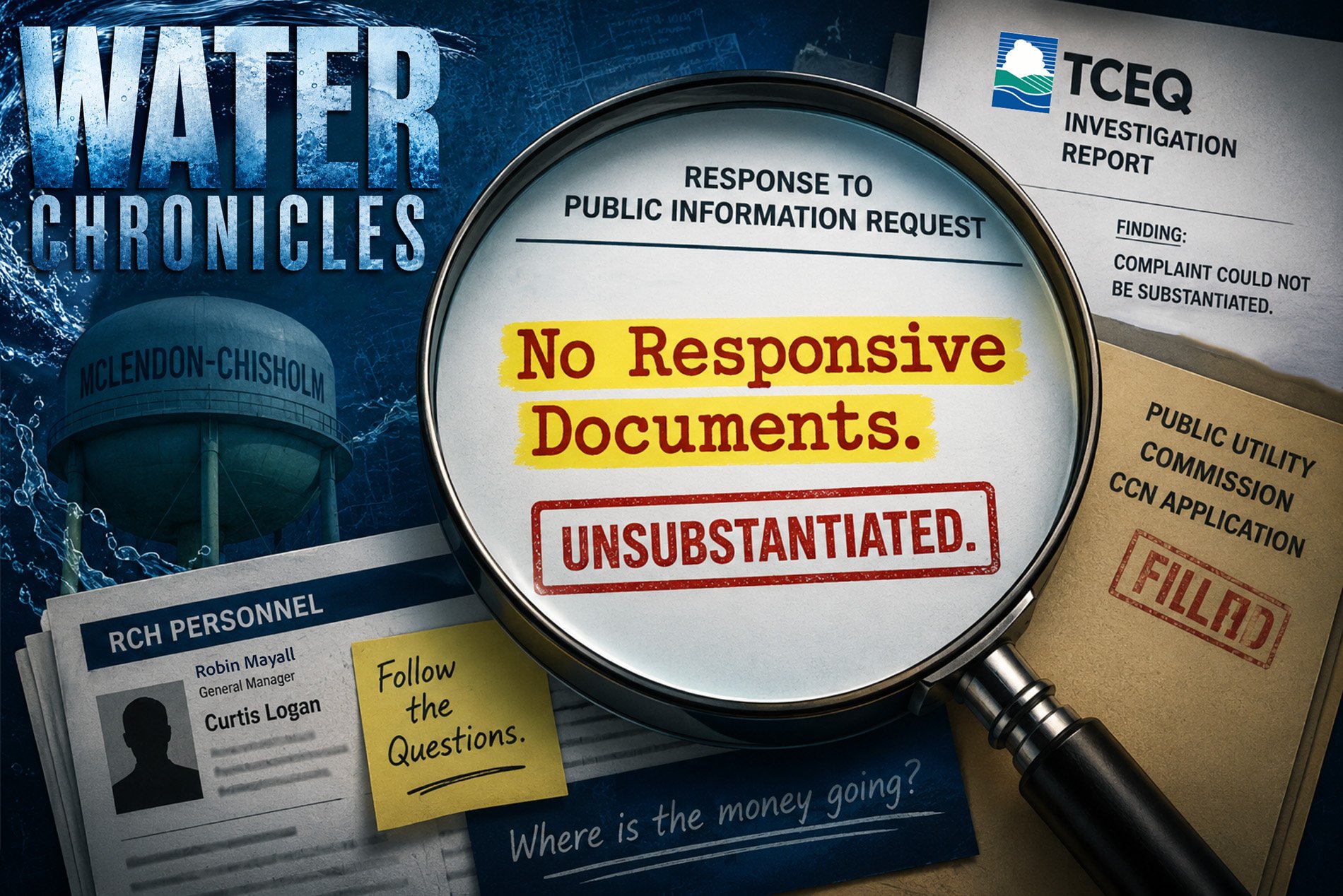

Editor’s Note: This is the third installment of The Water Chronicles.
What began as a simple question about a water bill uncovered bigger questions about transparency, public records, and the future of local water service.
Every month, customers receive a water bill. Most pay it without giving much thought to the people responsible for delivering safe drinking water or the decisions being made behind the scenes.
I started with one simple question.
Who was responsible for operating one of the public water systems serving Rockwall County?
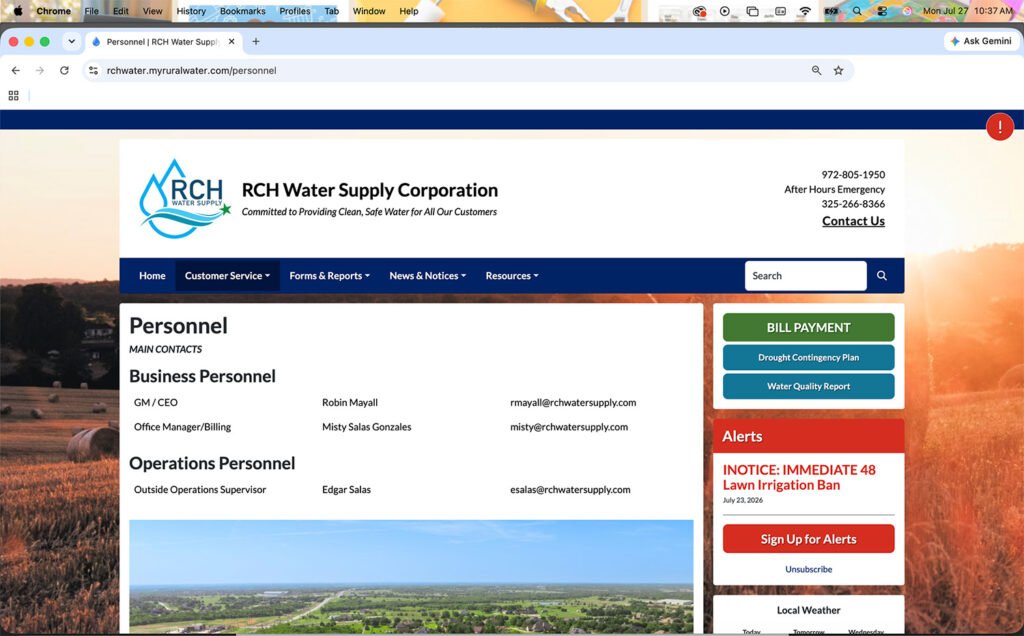
While researching RCH Water Supply Corporation, I noticed the company’s Personnel page identified Curtis Logan as its Water Systems Supervisor/Inspections.
Licensed operators play a critical role in protecting public health. They help oversee the daily operation of public water systems, ensuring drinking water is monitored, tested, and delivered in compliance with state requirements.
I wanted to know whether the state’s licensing records matched what RCH’s own website was telling customers.
I expected the answer to be straightforward.
Instead, it became the beginning of a much larger investigation.
Who Was Responsible for Operating RCH’s Water System?
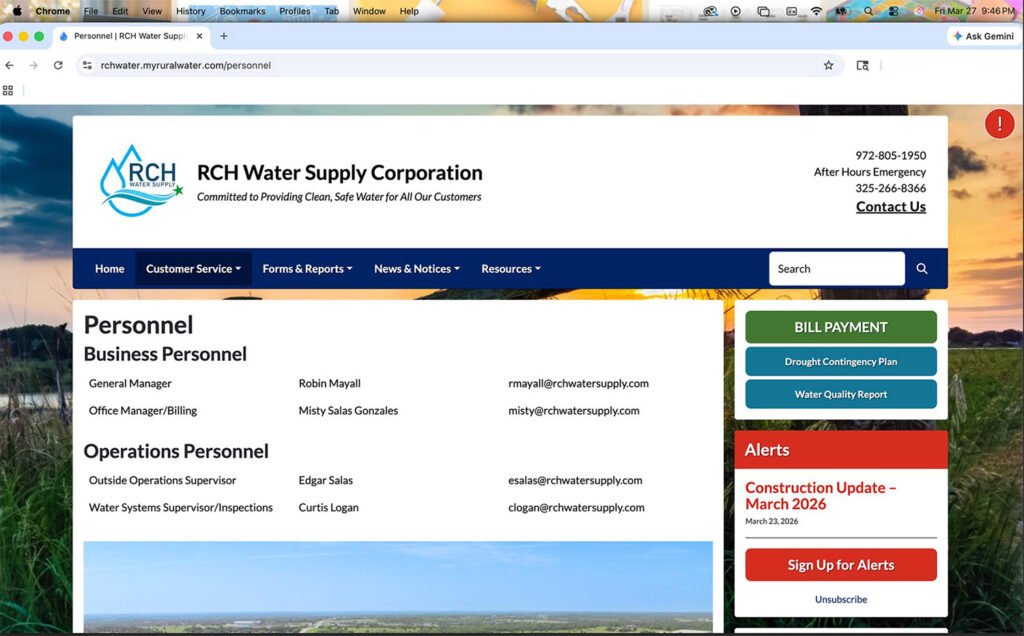
While researching RCH Water Supply Corporation, I compared the information published on the corporation’s website with records maintained by the Texas Commission on Environmental Quality (TCEQ). On March 3, 2026, I contacted TCEQ’s Occupational Licensing Section to determine whether Curtis Logan was the licensed operator responsible for RCH’s public water system.
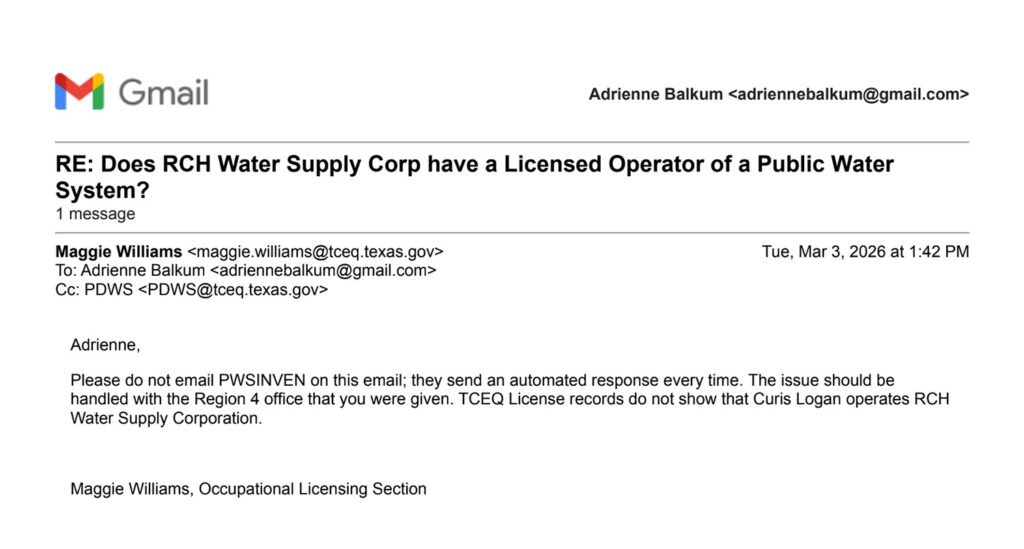
The response raised an obvious question.
If the state’s licensing records did not identify Curtis Logan as the licensed operator responsible for RCH, why was he publicly identified on the corporation’s website as its Water Systems Supervisor/Inspections?
I publicly asked members of RCH’s Board of Directors and sought clarification directly from the corporation.
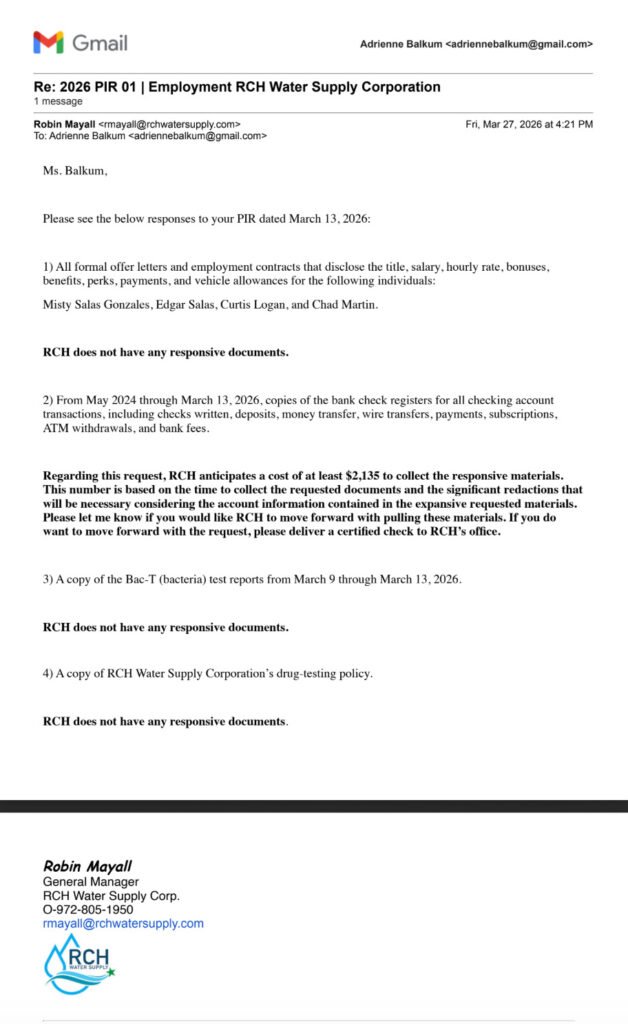
RCH later responded that it had no records responsive to my request regarding Curtis Logan’s employment.
Then another development caught my attention.
Shortly after TCEQ investigators visited RCH on May 27, 2026, the corporation quietly removed Curtis Logan’s name, title, and company email address from its Personnel page.
I expected to verify the identity of one licensed operator.
Instead, I found myself asking a much bigger question.
If the records didn’t align and the personnel page changed, who was actually responsible for operating the system—and why was it so difficult to get a clear answer?
That question became the foundation for the rest of this investigation.
Following the Paper Trail

By this point, I realized I was no longer trying to verify the identity of one licensed operator.
Every answer uncovered another question.
TCEQ’s records, RCH’s responses, and changes to the corporation’s own website all pointed in the same direction—they weren’t providing the clarity I expected.
If I wanted to understand what was happening, I needed to follow a different trail.
That trail kept leading back to the same name.
No matter which records I reviewed or which questions I asked, one name kept appearing.
Robin Mayall.
As General Manager of RCH Water Supply Corporation, Mayall quickly became the primary point of contact throughout my investigation. He responded to public information requests, represented the corporation, and was often the person answering questions as the investigation unfolded.
As detailed in my earlier article, How McLendon-Chisholm Was Undermined From Within, Blackland Water Supply Corporation ended its operational relationship with RCH following a May 2023 vote by its Board of Directors. My reporting documented that Robin Mayall continued assisting RCH after Blackland instructed employees they were no longer to provide operational support. Internal emails and invoices reviewed during that investigation documented his continued involvement. In October 2023, Mayall accepted RCH’s offer to become General Manager under an employment agreement that included an annual salary of $170,000 plus bonuses.
That earlier reporting also documented several other individuals involved in RCH’s operations, providing additional context for how the corporation’s management team evolved.
That earlier reporting provided important context, but this investigation was no longer about how RCH’s management team came together. It was about how the corporation was operating today.
One Answer Created Another Question
When I requested employment records for Curtis Logan and other individuals publicly identified by RCH, Mayall responded that “RCH does not have any responsive documents.”
But that answer created another question.
I wasn’t just trying to identify one employee anymore. I was trying to understand how the corporation itself was operating—and whether the information available to customers reflected what was happening behind the scenes. That meant looking beyond personnel records and following the documents wherever they led.
Why This Investigation Matters
The questions raised during this investigation extended well beyond one employee or one corporation.
While those questions remained unresolved, RCH was asking the Public Utility Commission to expand its Certificate of Convenience and Necessity (CCN) into Sonoma Verde and surrounding areas.
Those same neighborhoods are also at the center of ongoing discussions between the City of McLendon-Chisholm and RCH regarding the possible transfer of city-owned water infrastructure.
Together, those decisions could shape who provides water service to thousands of current and future residents.
That’s why transparency isn’t just important—it’s essential.
When public records, regulatory filings, and information made available to customers don’t appear to tell the same story, residents have every reason to ask questions before long-term decisions are made.
The CCN application also raised a broader question for me.
For years, Sonoma Verde remained outside RCH’s service territory because the City’s long-term vision was to develop its own retail water system. The pending CCN application and discussions about transferring city-owned water infrastructure raise questions about how that long-term vision aligns with decisions now under consideration.
As communities grow, residents deserve to understand not only who will provide their water service—but also how those decisions are being made. The next step was to examine the financial records and contracts that helped shape those decisions.
Following the Money
For many customers, the biggest question wasn’t about licensed operators or organizational charts.
It was much simpler.
Where is all the money going?
As water bills continued to rise, residents began contacting me with questions about how RCH was spending customer dollars. Some questioned executive compensation. Others wondered whether outside consultants or contractors were being paid to perform work customers assumed was being handled internally.
At that stage, those were questions—not verified facts.
The only way to answer them was to follow the records.
Rather than speculate, I requested bank check registers, employment contracts, and other financial records to better understand how the corporation was spending customer money.
Those records could have answered important questions, including:
- Who was receiving compensation from RCH?
- Were outside consultants being paid by the corporation?
- Who was responsible for email communications and marketing?
- How much was being spent on administrative salaries versus operating the water system?
- Were payments consistent with the services customers were told were being provided?
Instead of producing those records, RCH estimated the request would cost more than $2,100 to fulfill.
Without those records, many of those questions remain unanswered. But one thing had become clear: understanding who was operating the system also meant understanding how customer dollars were being spent.
What the Investigation Didn’t Answer
The Texas Commission on Environmental Quality ultimately concluded that my complaint could not be substantiated.
According to the investigation report, RCH provided the investigator with a list of two licensed operators and operating reports signed by one of them.
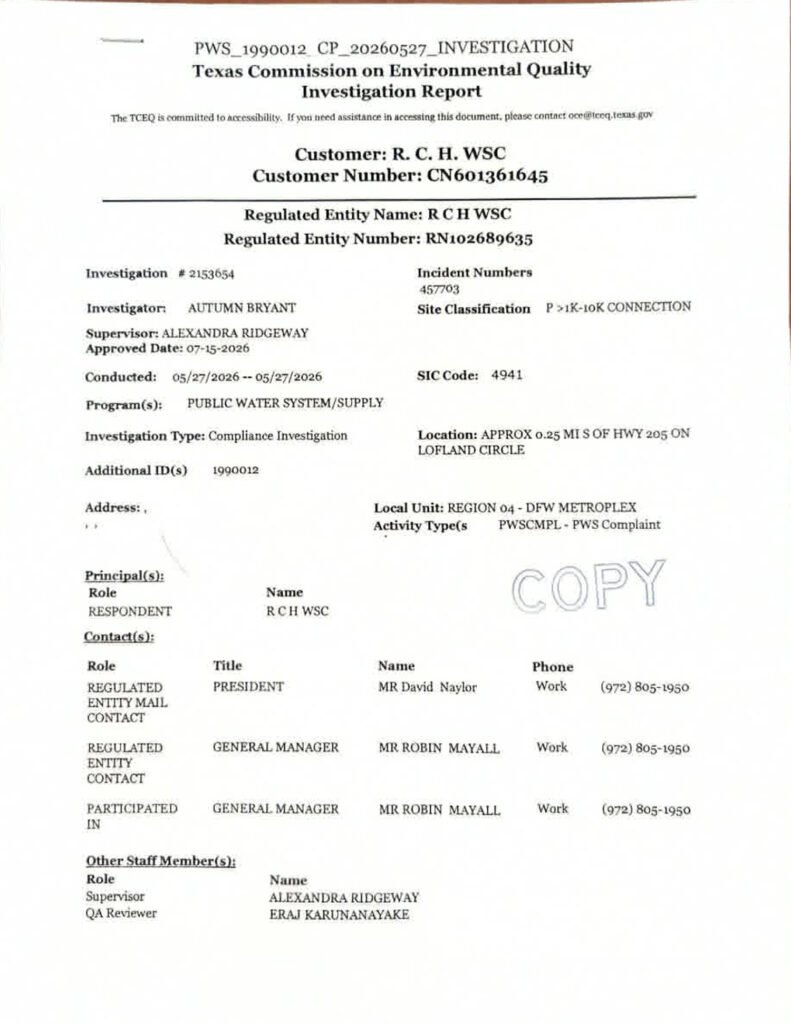
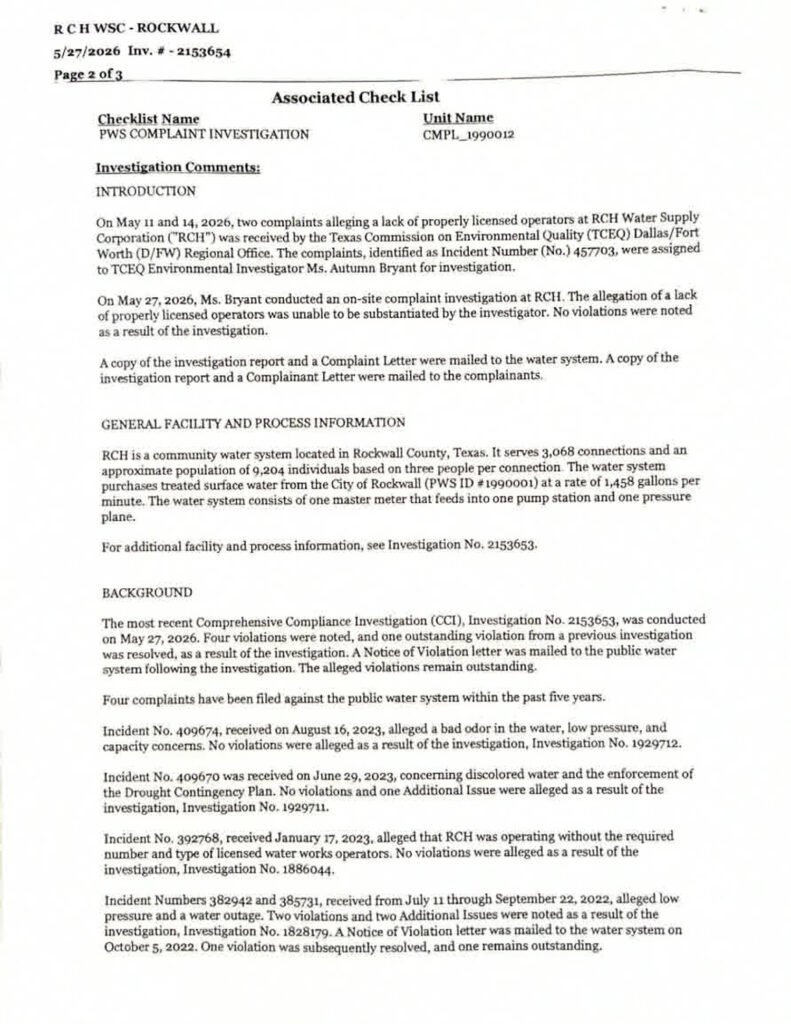
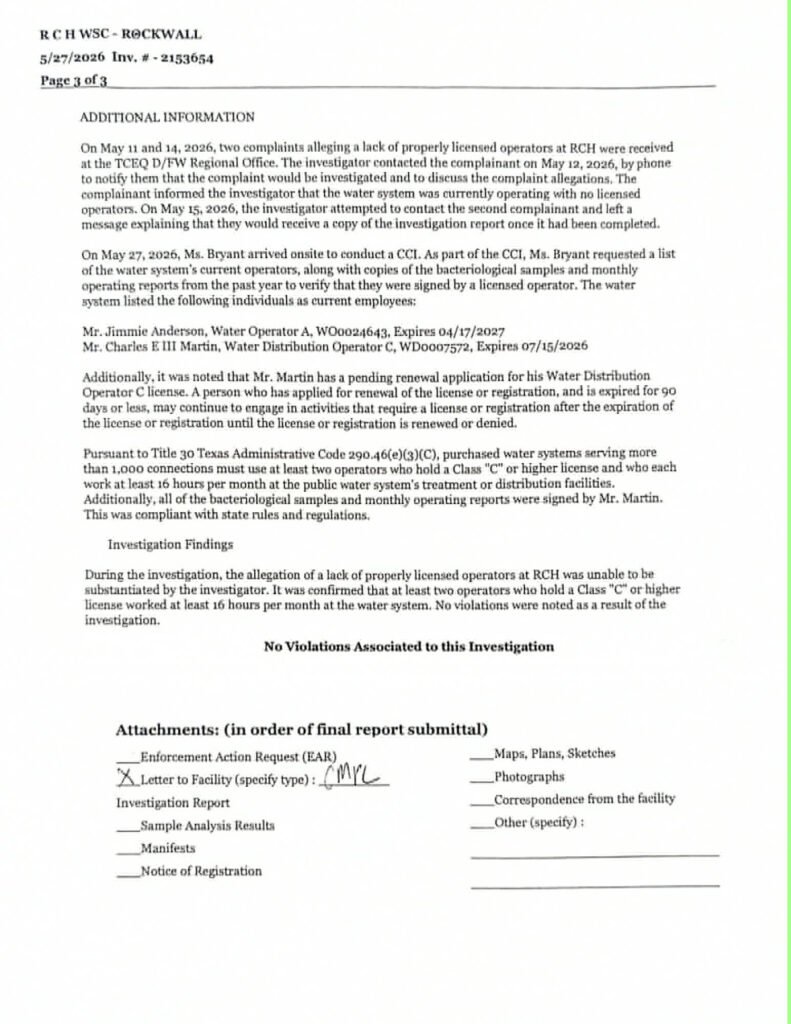
TCEQ Investigation Report – Complaint findings and summary.
From the agency’s perspective, the records satisfied the operator requirement.
For me, they raised a different question:
What steps, beyond reviewing the information provided by RCH, were taken to verify who was actually operating the system?
The report states that the investigator requested RCH’s operator list, reviewed operating reports and confirmed that the two individuals held the required licenses.
What it does not explain is whether the operators were interviewed, whether employment records or contracts were reviewed, or how responsibilities were divided among the people involved in the system’s operation.
The report also does not state whether either licensed operator was present during the inspection, even though TCEQ’s pre-inspection instructions directed that the licensed operator in responsible charge be present.
That distinction matters.
A professional license confirms that someone has met the state’s qualifications. It does not, by itself, show customers who is handling the system’s daily operations.
TCEQ found no regulatory violation. But the report left unanswered questions about how those responsibilities were documented and communicated to the public.
Looking Beyond the Report
The investigation had ended.
My questions hadn’t.
One licensed operator identified in the report worked in Anderson County, about 100 miles from Rockwall County. The other was employed by a waterworks supplier in Royse City.
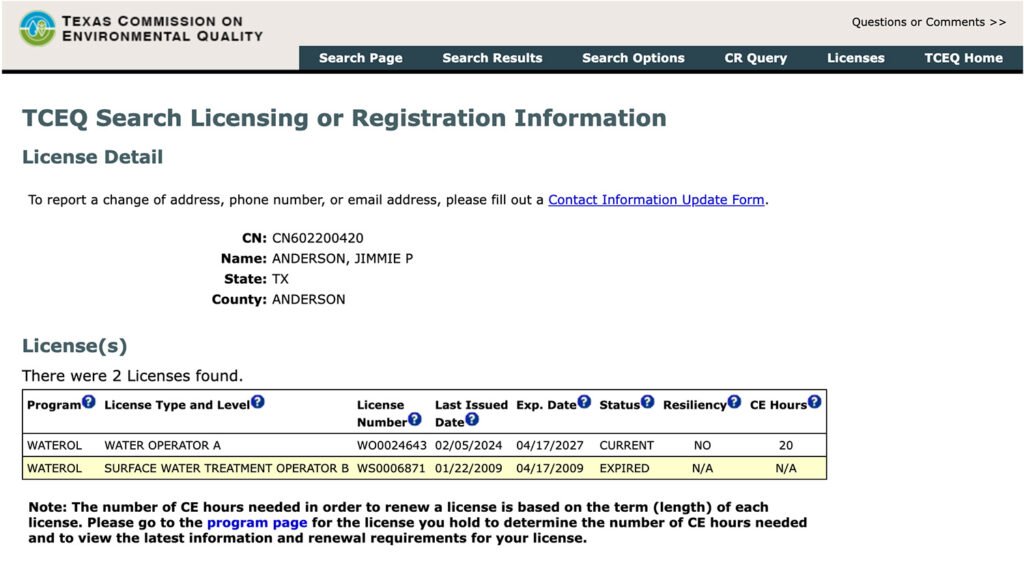
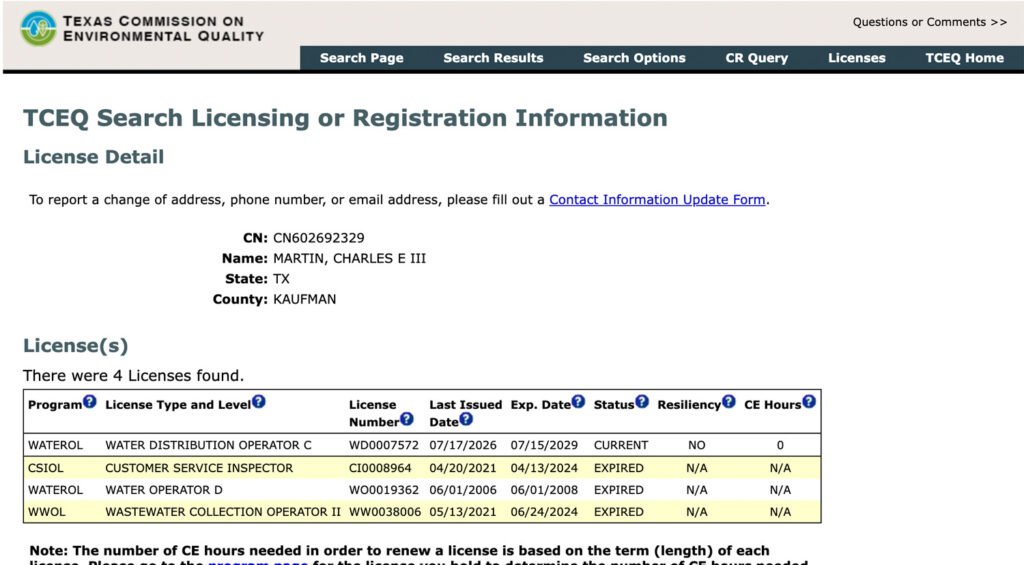
Those facts do not prove that either person was—or was not—providing services to RCH. Licensed operators may work under contract and may serve more than one water system.
To better understand the local operating environment, I contacted several licensed operators who regularly work in Rockwall County. I asked whether they were familiar with one of the operators named in the report. None recognized the name or recalled seeing him working on local systems.
That information is anecdotal. It is not proof that the operator was not working for RCH.
Then another record caught my attention.
In a June 11, 2026 email to the TCEQ investigator, RCH General Manager Robin Mayall requested additional time to complete a monitoring plan. He explained that he and Edgar Salas had been attending onsite meetings involving inspections and training for new systems and pumps as RCH prepared for its direct connection with the North Texas Municipal Water District.
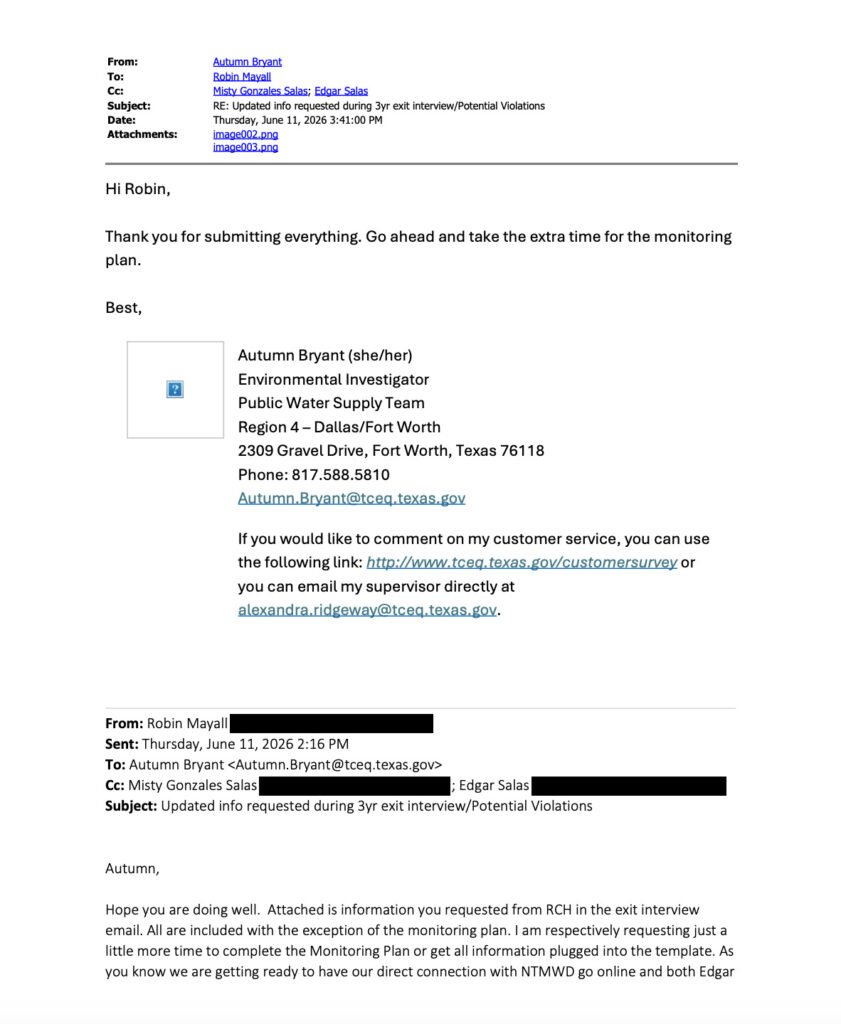
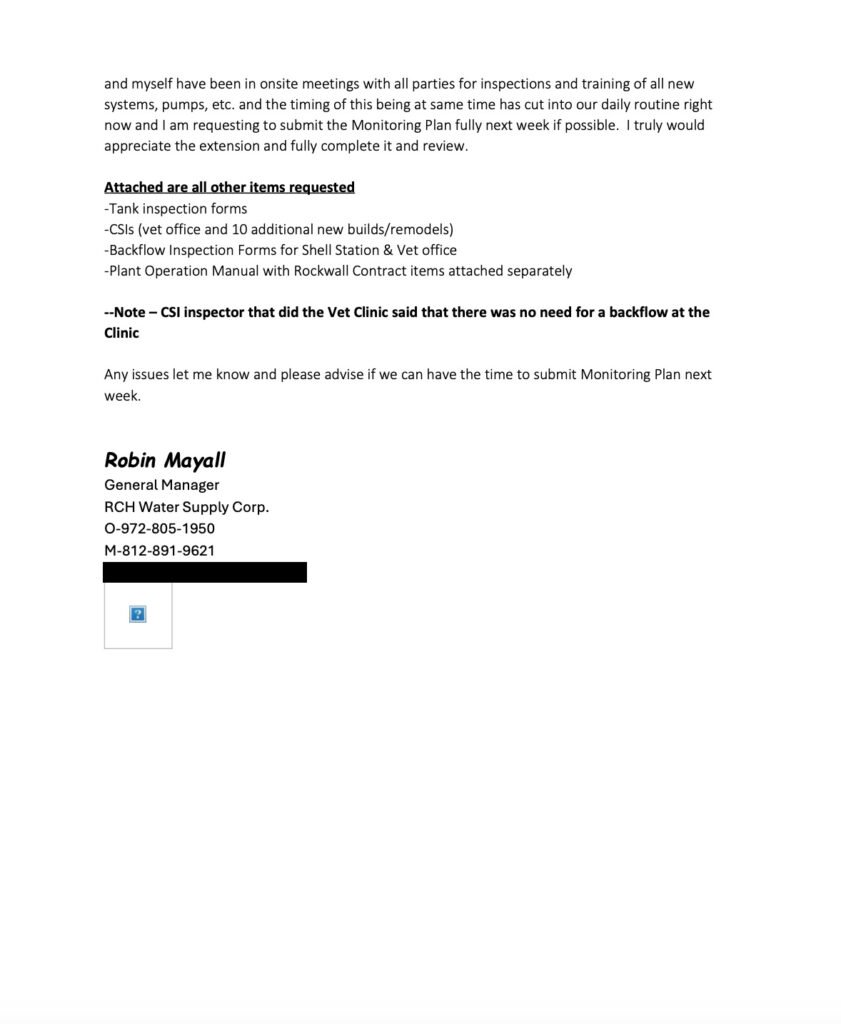
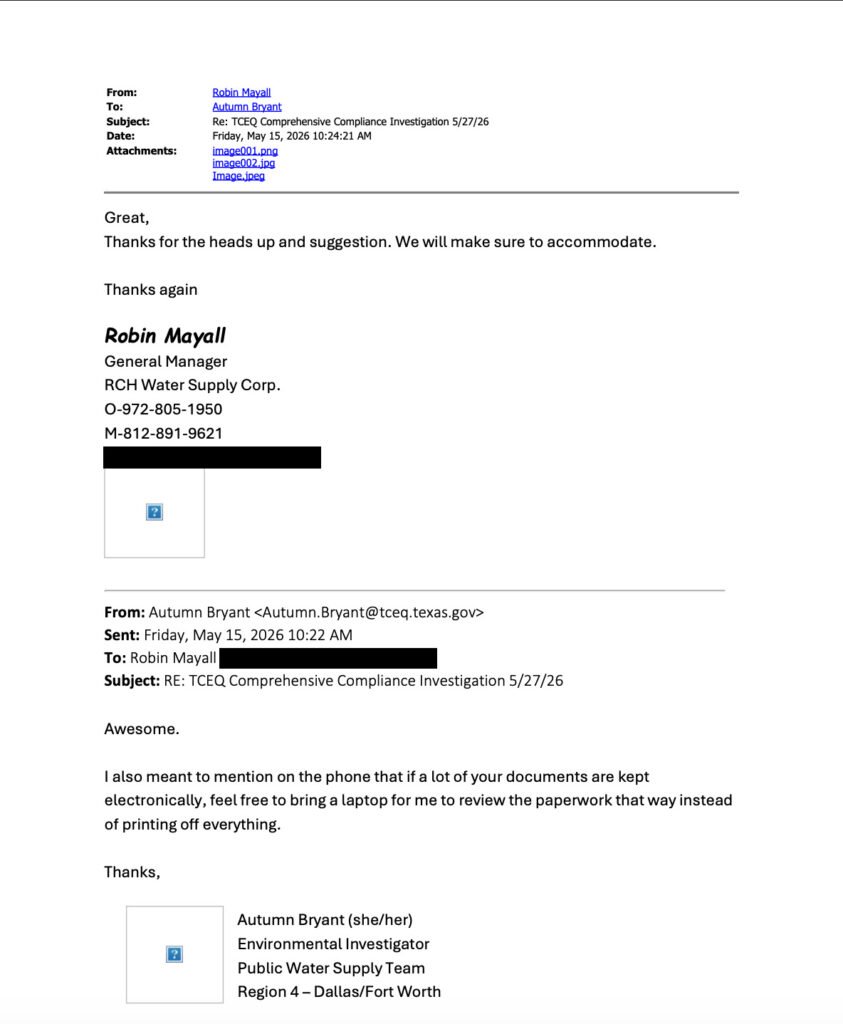
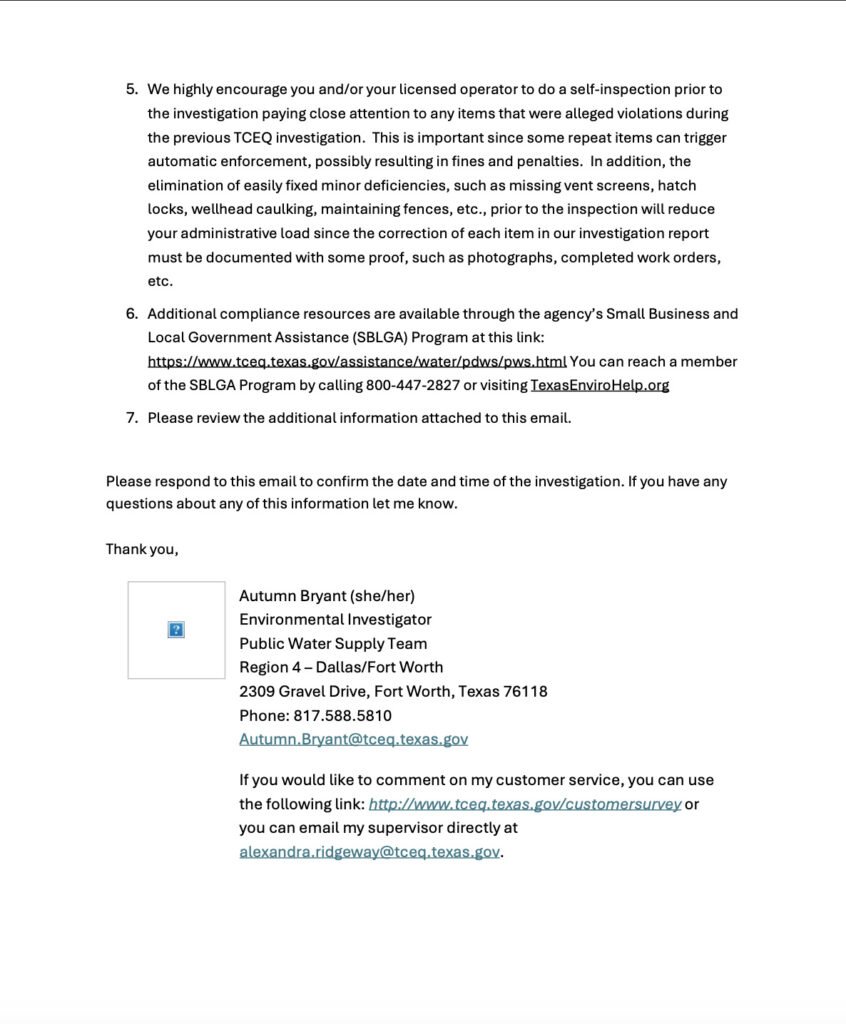
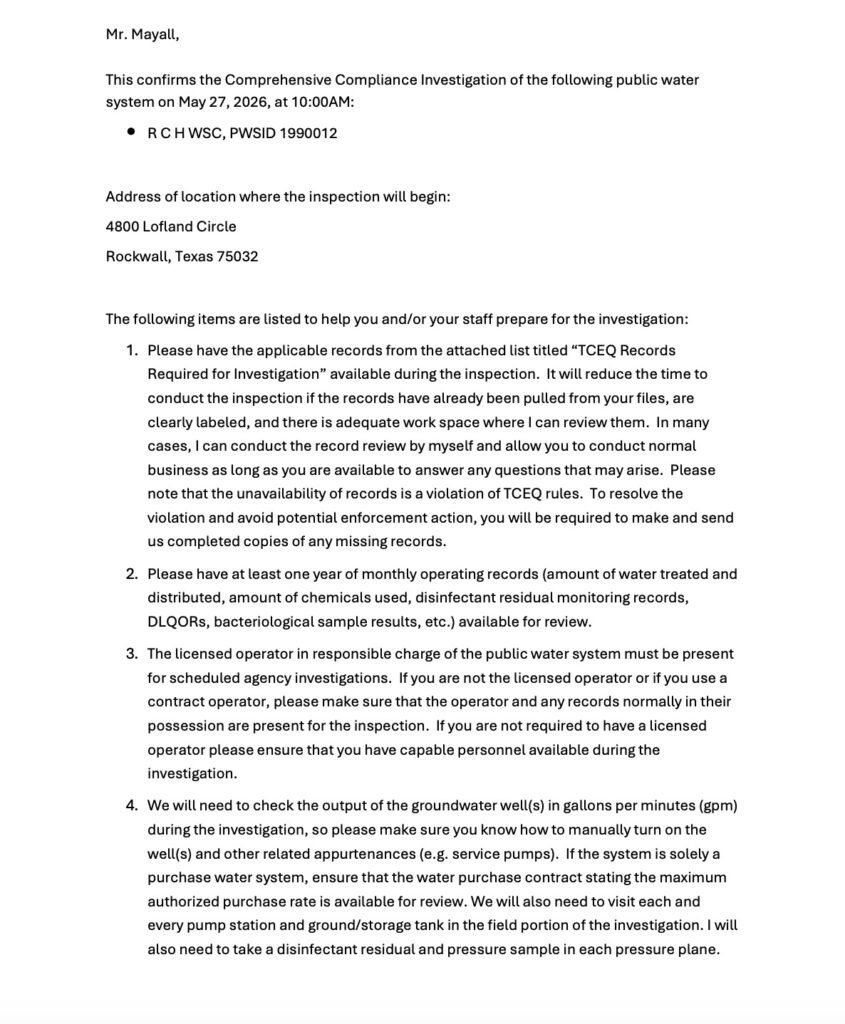
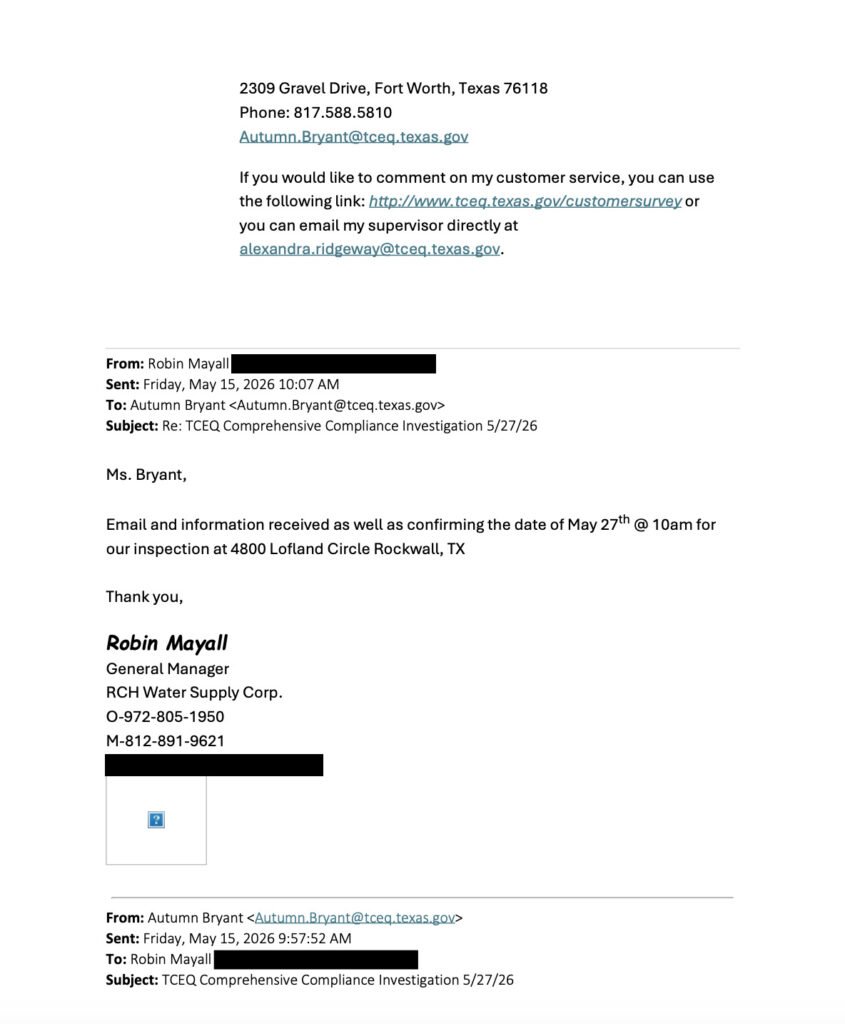
The email raised another question:
If the investigation centered on whether RCH had qualified licensed operators, why did the records describe management—not the licensed operators identified in the report—as attending inspections and training for new systems and pumps?
The documents do not explain how those responsibilities were divided.
The email does not prove that anyone acted outside a lawful role. But for customers paying RCH every month, it leaves a basic question unanswered:
Who was actually responsible for operating the system they were paying to maintain?
Before Any Decision Is Made
While many of these questions remained unanswered, RCH asked the Public Utility Commission to expand its Certificate of Convenience and Necessity (CCN) into Sonoma Verde and surrounding areas.

At the same time, the City of McLendon-Chisholm has been discussing the possible transfer of city-owned water infrastructure to RCH.
Together, those decisions could shape who provides water service to thousands of current and future residents.
That is precisely why transparency matters before—not after—major decisions are made.
As part of the Public Utility Commission’s review process, RCH published a legal notice informing affected landowners and other interested persons that they could comment on the application or request to intervene before the Commission reaches a decision.
For many Sonoma Verde residents, that notice may represent the only formal opportunity to participate before the application is decided.
During my review, I did not find a July RCH Board agenda item discussing the decision to pursue the CCN expansion or authorizing publication of the required notice. I also found no indication that a public hearing had been held before the notice was published.
Whether additional public discussion should occur is ultimately a policy decision.
But before decisions that could affect water service for years to come are finalized, residents deserve the opportunity to understand what is being proposed and why.
What Customers Deserve to Know
Water is one of the most essential services any community depends on. Customers shouldn’t have to guess who is operating their system, how important decisions are made, or where their money is being spent.
Water supply corporations were originally created to bring safe, reliable drinking water to rural communities that often had no other practical option. Many have fulfilled that mission for decades and continue to play an important role across Texas.
As communities like McLendon-Chisholm grow from rural towns into suburban neighborhoods, the questions naturally become bigger. Residents aren’t simply paying a monthly water bill. They’re relying on an organization responsible for infrastructure, public health, and decisions that could shape their community for decades.
No matter who provides the service, customers deserve more than a monthly bill. They deserve clear information, honest answers, and confidence that important decisions are being made transparently.
Water systems aren’t built overnight, and neither is public trust. For most families, turning on the faucet is something they rarely think about—until questions arise. This investigation was about following the questions behind a water bill and sharing what the public records did—and did not—answer.
Now I’d like to hear from you.
What information do you believe customers should expect from the organization providing one of our community’s most essential services? Leave a comment below and join the conversation.





1 comment