A Clear Look at Michael Morris’s Presentation — and the Tools the County Has Not Yet Used
Rockwall County residents have heard a lot of noise about the Outer Loop. Political statements, social media debates, shifting explanations, and months of delays have created real confusion about what the project actually is — and what it is not.
On October 15, 2025, one person offered something different: facts, engineering clarity, and 45 years of regional planning experience.


Michael Morris, Director of Transportation for the North Central Texas Council of Governments (NCTCOG) and Staff Director to the Regional Transportation Council (RTC), delivered a detailed presentation that cut through months of political rhetoric. His explanations — grounded in data, long-range planning, and real examples — revealed what Rockwall County needs to understand if this project is going to move forward responsibly.
Below is a clear, factual breakdown of what Morris shared, why it matters, and how Rockwall County can make informed decisions for its future.
Morris’s Role: Planning for 2050, Not Next Month
Morris began by clarifying his legal responsibility: he must plan 20 years into the future, not two weeks ahead. His work is guided by federal requirements that compel regional planners to anticipate:
• Projected population growth
• Employment and workforce trends
• Traffic demand and future travel volumes
• Infrastructure needs
Today, the region has 8.4 million people. By 2050, Morris projects 12.4 million — a 50% increase.
“No one calls to ask if they can move here,” he said. Growth is coming whether counties prepare or not.
This long-term view is why the Outer Loop exists at all — it is part of a 2050 regional mobility vision, not a short-term political project.
The Purple Route: Why It’s the Regional Baseline

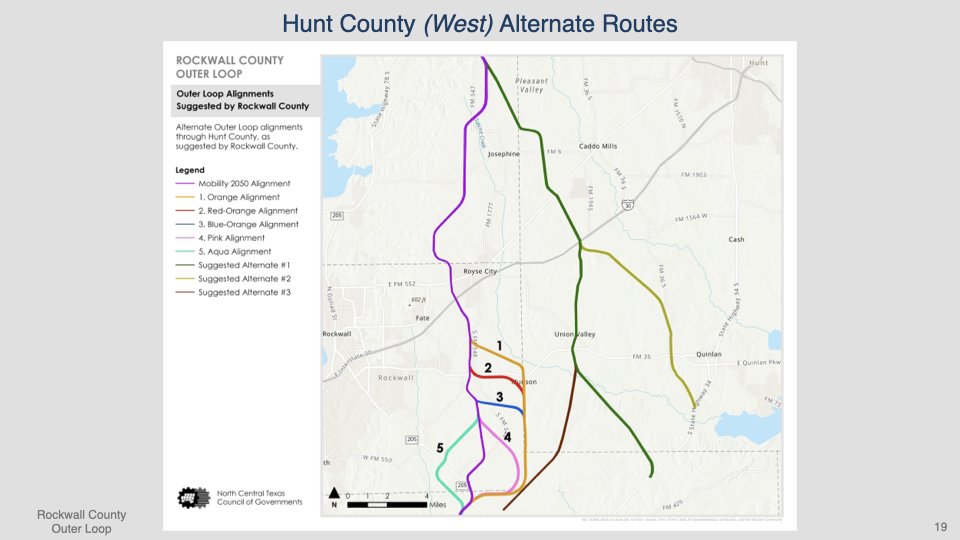
Michael Morris emphasized a point that has been consistent across nearly two decades of planning: the Purple Route is the Mobility 2050 alignment because it is the only route that works regionally, technically, and economically.
This alignment is not new. It has been part of adopted long-range plans for years:
• Rockwall County identified its preferred Outer Loop corridor in 2007.
• Collin County adopted its complementary corridor in 2010.
• TxDOT finalized the IH-30 interchange location in 2019, designed specifically to connect to this alignment.
Moving the alignment now would require undoing decisions that have already been vetted across multiple counties, agencies, and engineering teams. “That is the Mobility 2050 alignment,” Morris said, pointing to the map. “It was built deliberately to interface with the rest of the region.”
But Slide 20 made it clear that the Purple Route is not only the original route — it is also the most functional route based on current data and future projections.
Shifting the Route Creates Major Technical Conflicts
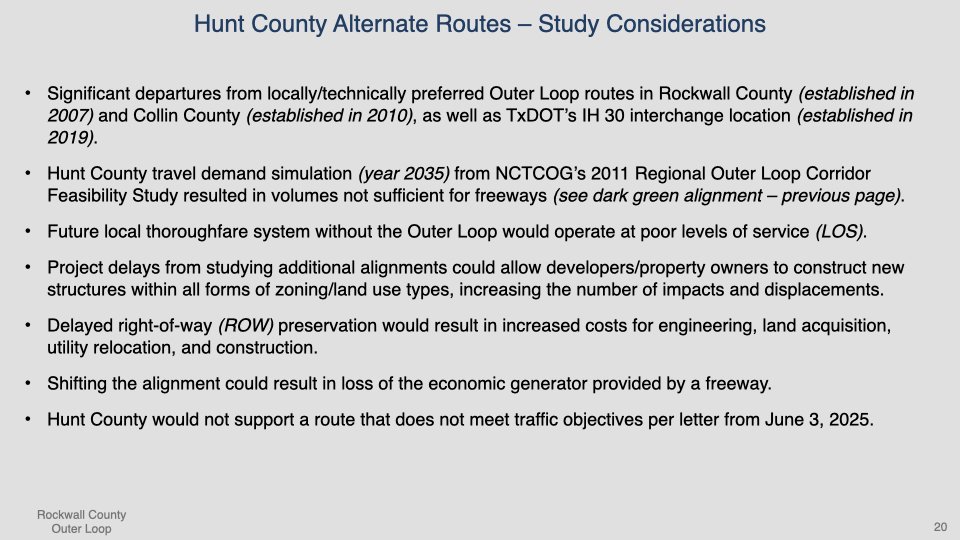
Moving the Outer Loop substantially east or west would create significant departures from the routes established in Rockwall and Collin counties, and it would break compatibility with the IH-30 interchange engineered specifically for the Purple alignment. “These aren’t arbitrary lines,” Morris reminded the room. “They were coordinated across multiple counties and agencies.”
Traffic Modeling Shows the Purple Route Performs Best
NCTCOG’s 2035 travel-demand modeling — conducted as part of the 2011 feasibility study — showed that the far-east (dark green) alignment lacked the traffic volumes needed to justify a freeway. In practical terms: drivers would not use the eastern routes, pushing traffic back onto local roads.
Without the Outer Loop, or with an underperforming alignment, the region’s thoroughfare system would operate at poor levels of service (LOS) as population growth accelerates through 2050.
Route Delays Create Development Pressure and Right-of-Way Risks
Morris pointed to Slide 20, which warns that continuing to study alternate alignments carries real risks. As the slide noted:
“Project delays from studying additional alignments could allow developers or property owners to construct new structures within all forms of zoning and land-use types, increasing the number of impacts and displacements.”
Every month spent re-evaluating routes gives developers more time to build inside the potential corridor. That increases the number of homes, businesses, and improvements the county would eventually have to acquire or relocate — resulting in higher displacement, higher cost, and fewer viable options.
Shifting the Alignment Also Weakens Economic Opportunity
The Outer Loop is more than a mobility corridor — it is also an economic generator. Alignments that depart from the established Purple route risk diminishing long-term commercial potential, weakening regional connectivity, and reducing the tax base benefits tied to a properly placed freeway.
Counties Must Agree — and Hunt County Already Has
Morris noted that Hunt County’s June 3, 2025 letter made their position clear: they will not support a route that fails to meet traffic objectives. A misaligned Outer Loop wouldn’t just affect Rockwall County — it would create mismatched, inefficient corridors across the eastern region.
Why the Purple Route Endures
Taken together — the planning history, traffic models, land-use realities, regional connectivity, economic factors, and right-of-way protection — the conclusion becomes clear:
The Purple Route is the only alignment that meets regional goals, local needs, and long-term traffic performance through 2050.
“It is in your best interest,” Morris said, “to environmentally clear a route and get the right-of-way protected. That lowers the pressure all of you feel.”
What the Alternate Routes Revealed
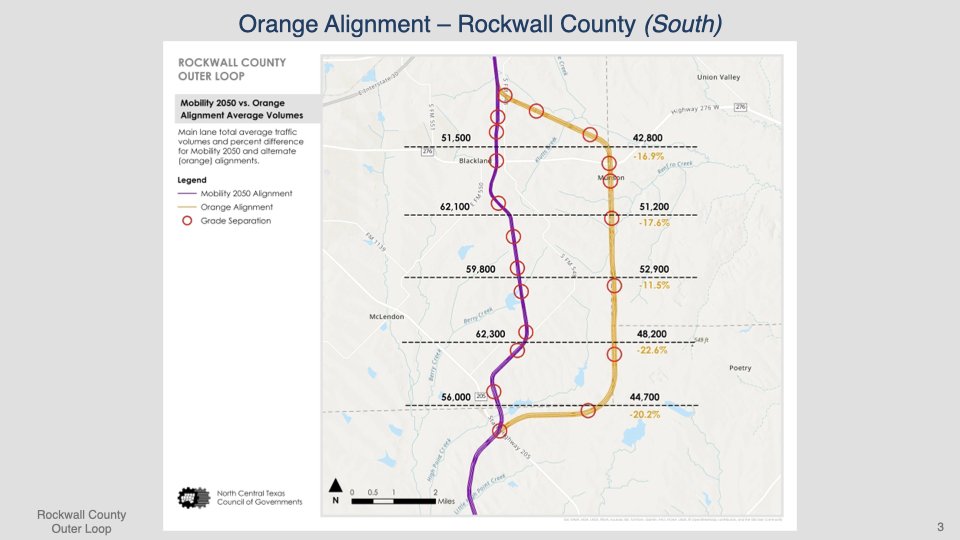
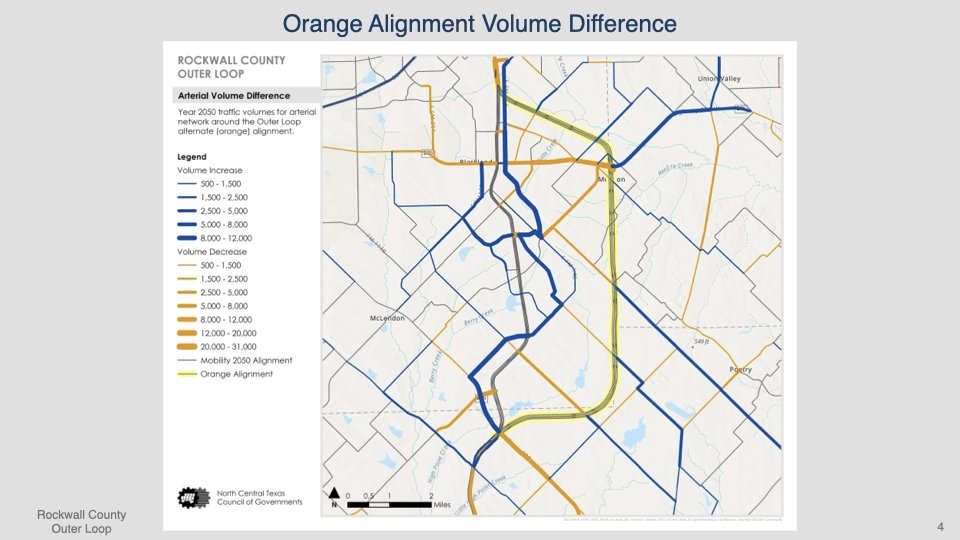
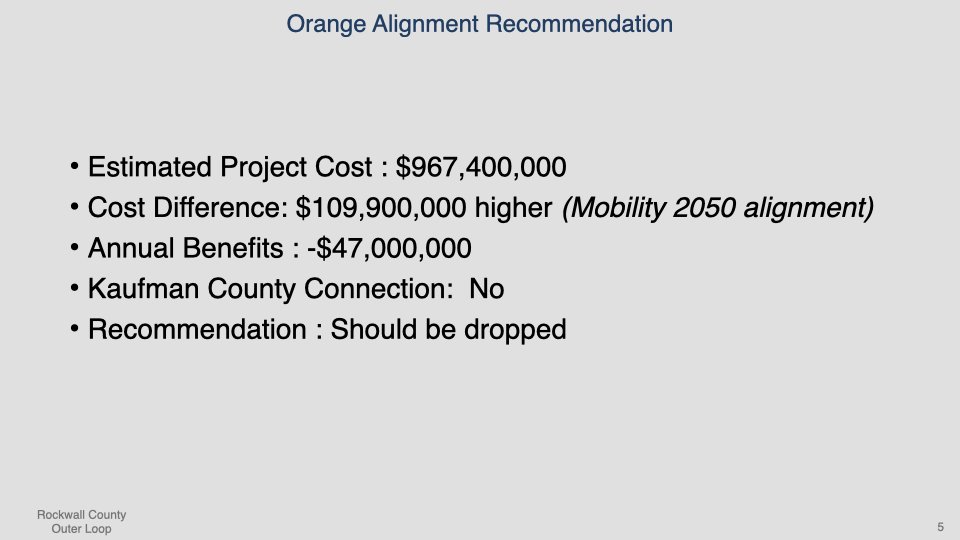
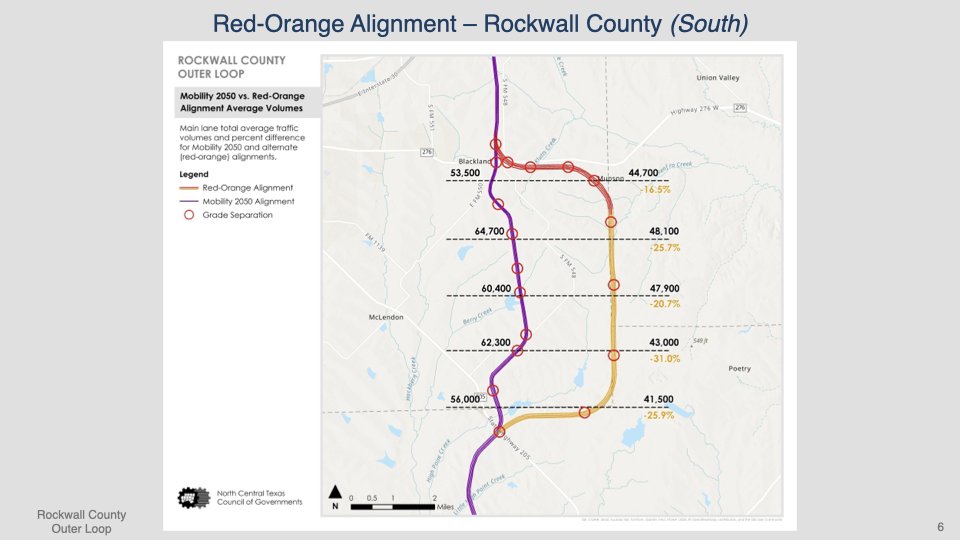
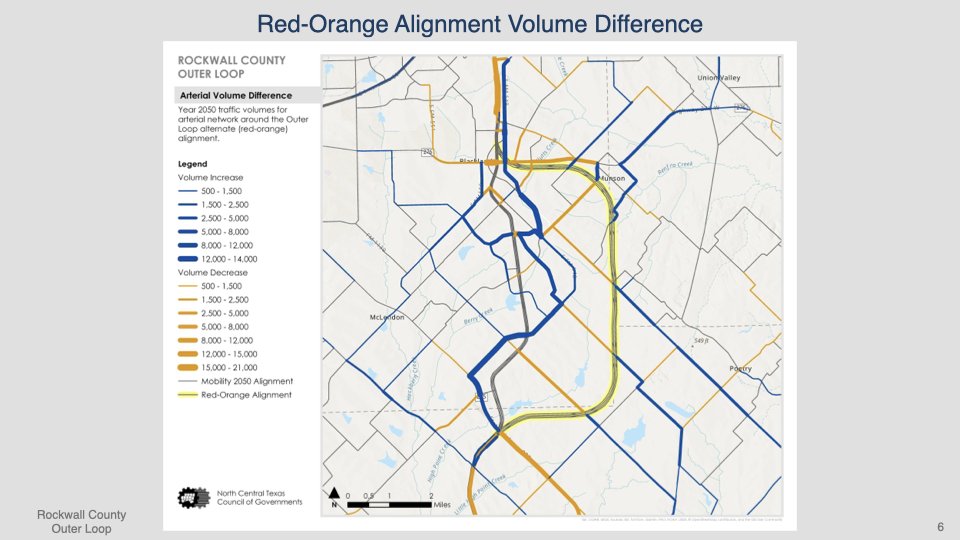
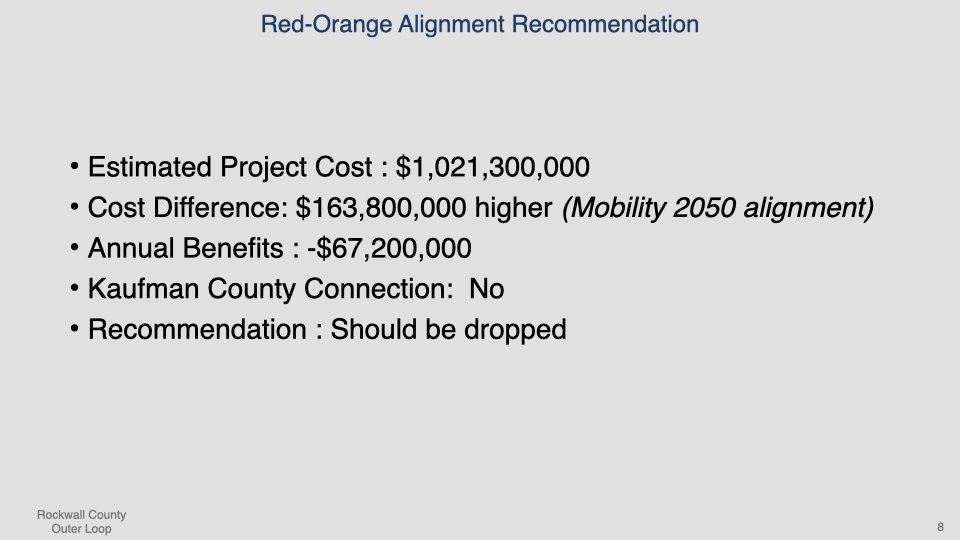
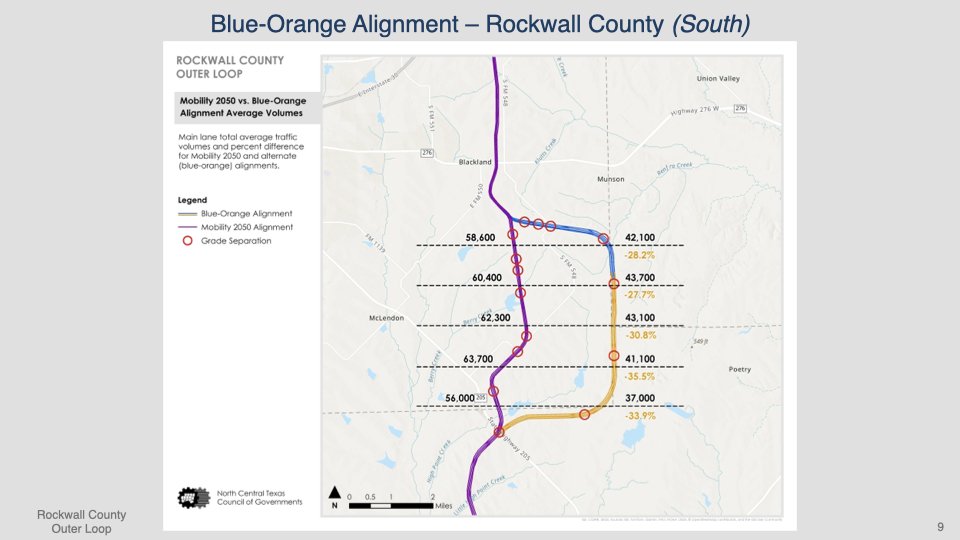
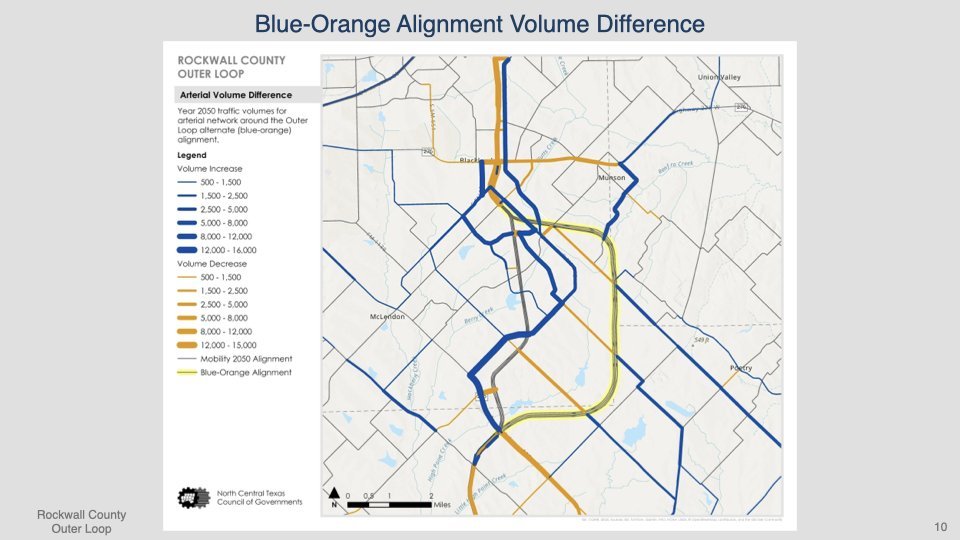
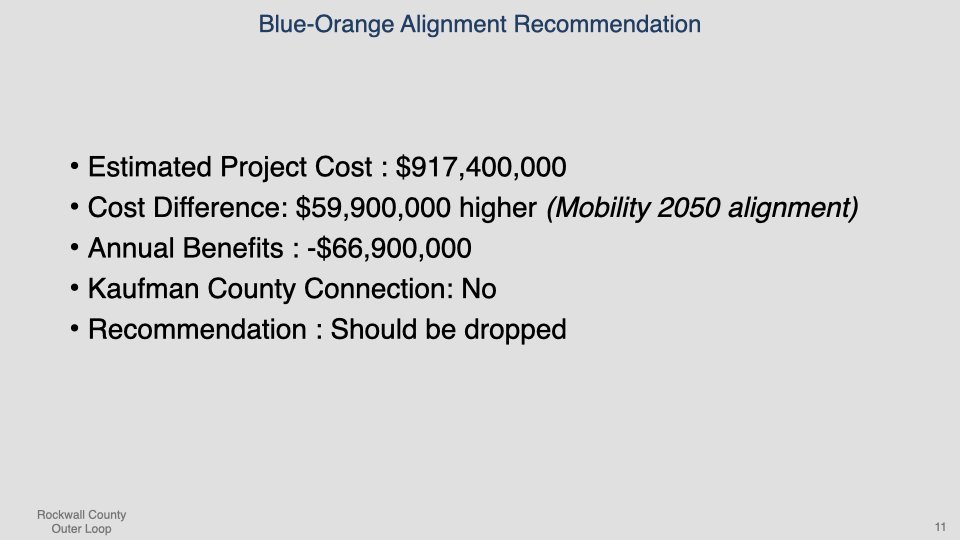
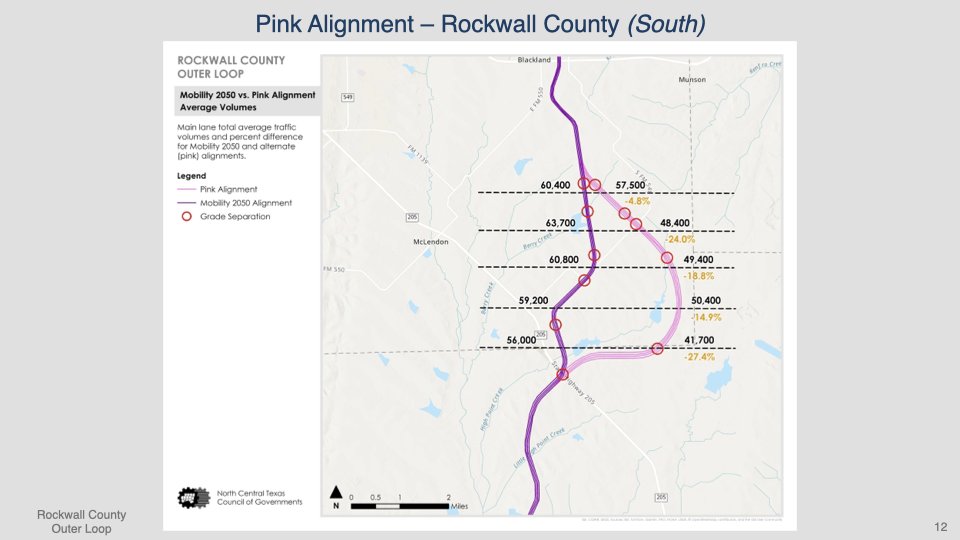
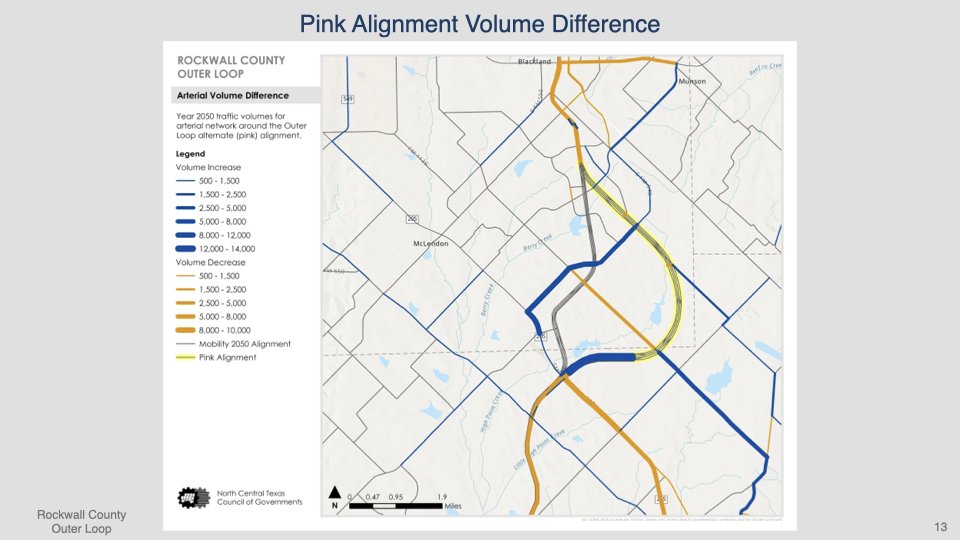
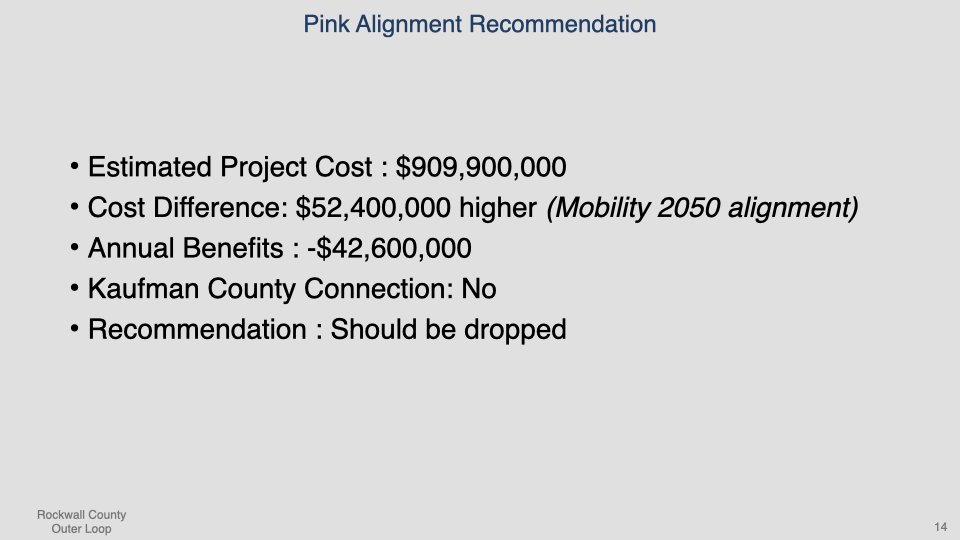
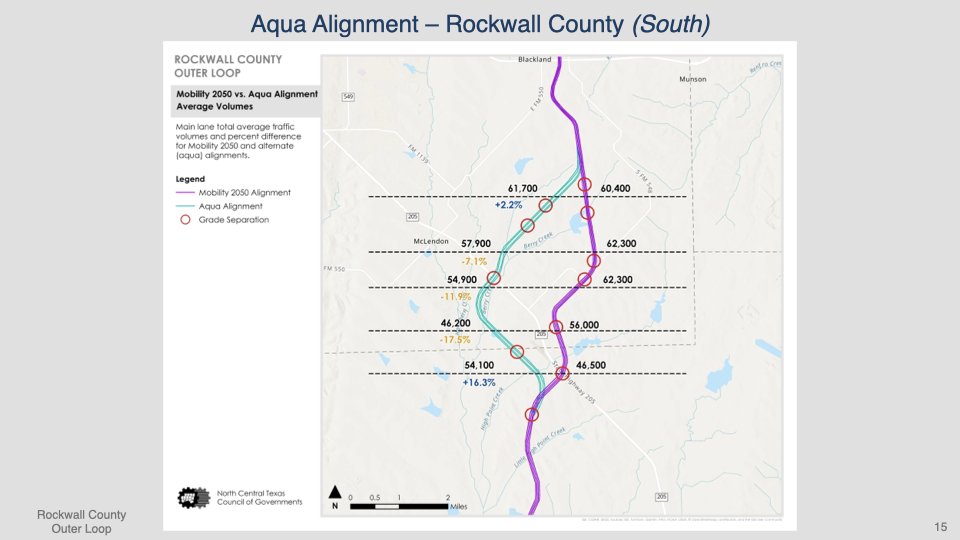
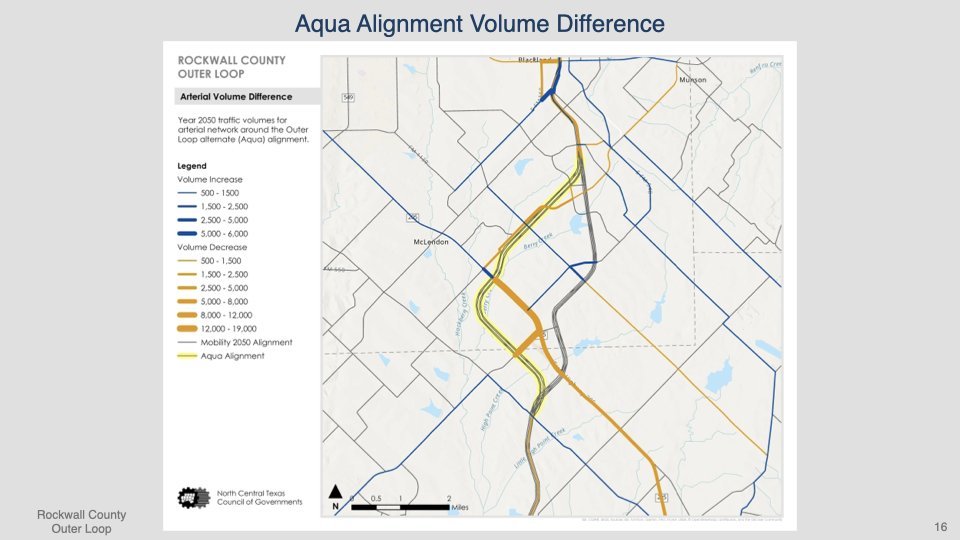
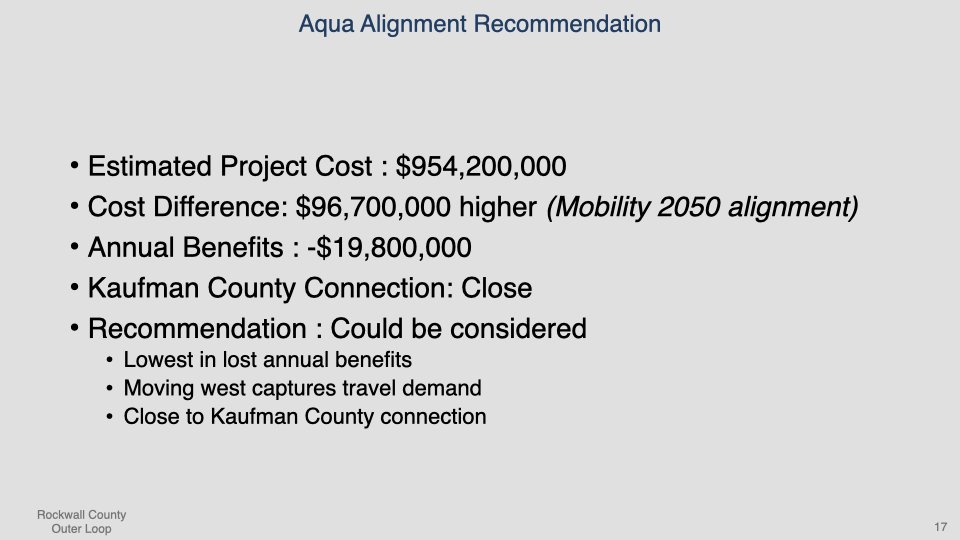
16 slides from the presentation appear above, showing each alternate alignment and its performance.
After reviewing these routes slide by slide, Morris walked through what the data revealed — and the pattern was unmistakable. The Orange, Red–Orange, Blue–Orange, and Pink alignments all performed worse than the regional Purple Route. Each added tens of millions of dollars in cost, weakened traffic performance, broke established county-to-county connections, or pushed drivers back onto local roads. Even the Aqua alignment, which Morris described as the least problematic of the alternatives, still raised construction costs and reduced overall efficiency compared to the Mobility 2050 baseline.
In short, after months of analysis, every deviation from the Purple Route created more problems than it solved.
As Morris summarized, the county could continue examining ideas, but not at the expense of progress or public clarity. “You can continue to look at options,” he said, “but you must add the other tools to the process, because it isn’t fair to the public to try to solve this with only one tool — you need to use all five.”
The Real Issue: Rockwall County Has Been Using Only One Tool
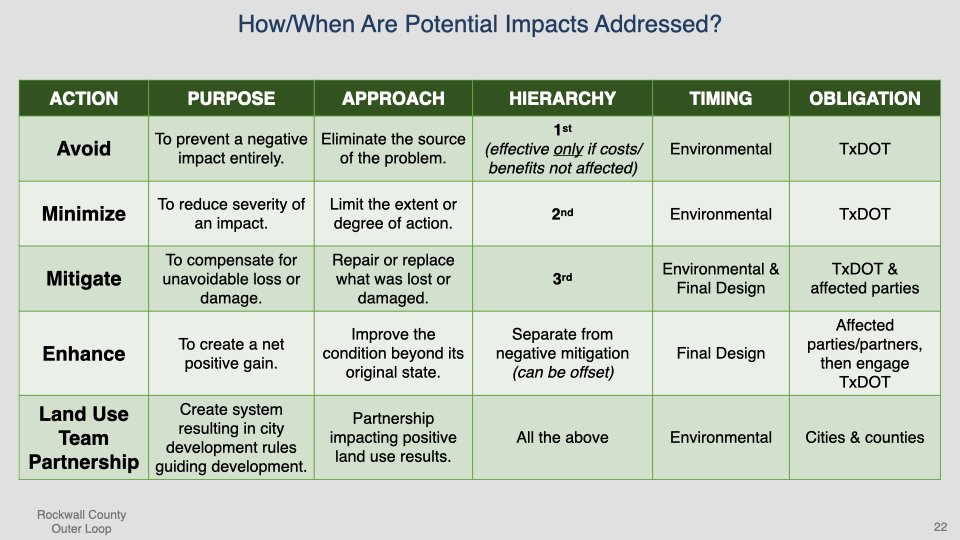
Slide 22 introduced what Morris called the most important point of his entire presentation: Rockwall County has been relying almost exclusively on one approach — “Avoid.”
The five federally recognized tools for major corridor planning are:
• Avoid
• Minimize
• Mitigate
• Enhance
• Land-Use Team Partnerships
Morris explained that Rockwall County has focused solely on Tool #1 — shifting the route to dodge impacts — while ignoring the four tools necessary to actually solve the problem. He then walked through each tool using real-world examples from across the region.
1. Avoid
Avoidance is legitimate and often the starting point for any large transportation project. But Morris stressed that it cannot stand alone. Rockwall County has spent all of its energy trying to move the route — an approach that delays planning but doesn’t solve growth pressures or infrastructure needs.
2. Minimize (US 380 – McKinney)
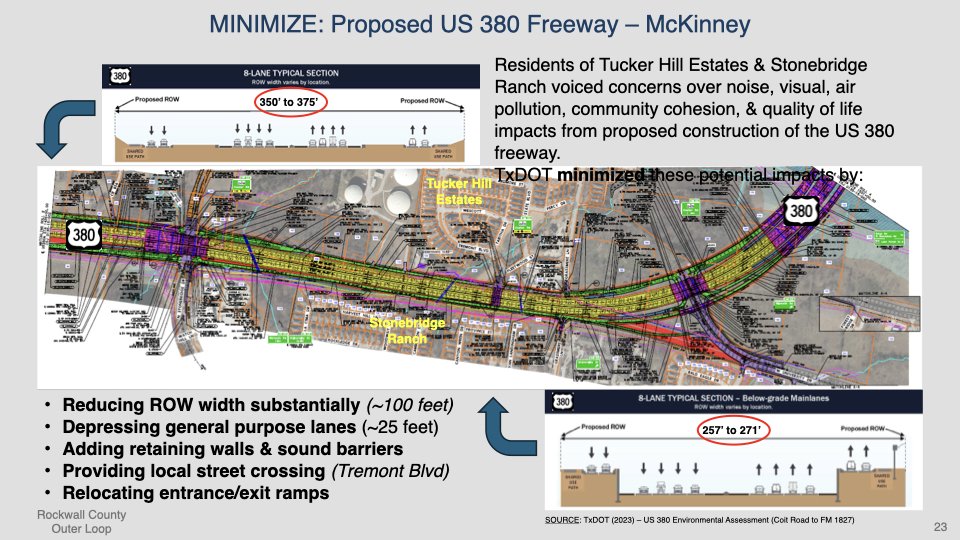
Minimization strategies reduce impacts without abandoning the corridor. Engineers can:
• depress freeway lanes,
• add sound walls early,
• shrink right-of-way widths,
• relocate entrance and exit ramps,
• redesign interchanges to support desired land uses.
Morris described how, on LBJ East, sound walls were built four years early at the public’s request — the first time Texas had ever accelerated this kind of impact-reduction measure.
3. Mitigate (US 380 – Princeton)
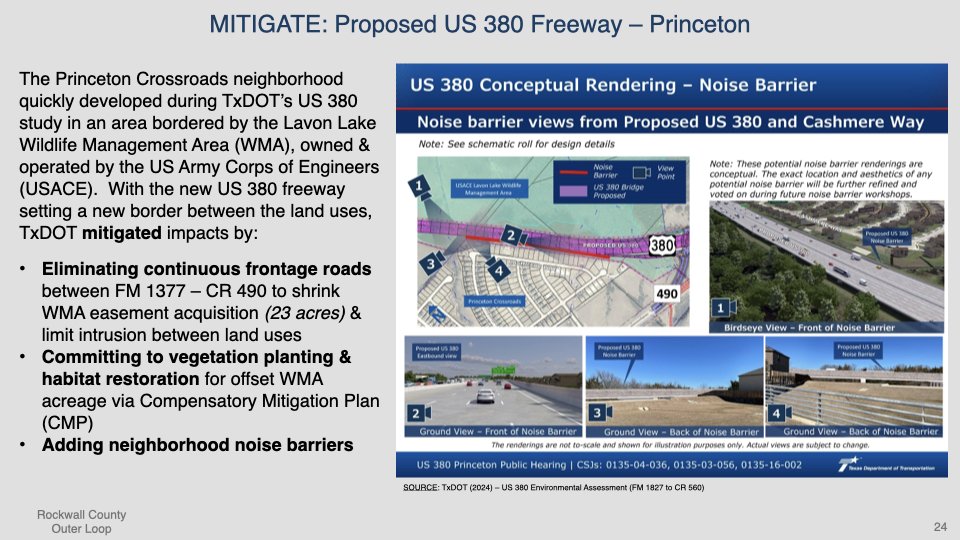
Mitigation provides solutions when impacts cannot be avoided.
On US-380, Morris worked directly with the U.S. Army Corps of Engineers to avoid purchasing newly built homes — a complex outcome that emerged only through collaborative problem-solving.
He warned that delays in Rockwall County make future mitigation more difficult and more expensive, because additional development reduces flexibility and increases the number of properties affected.
4. Enhance
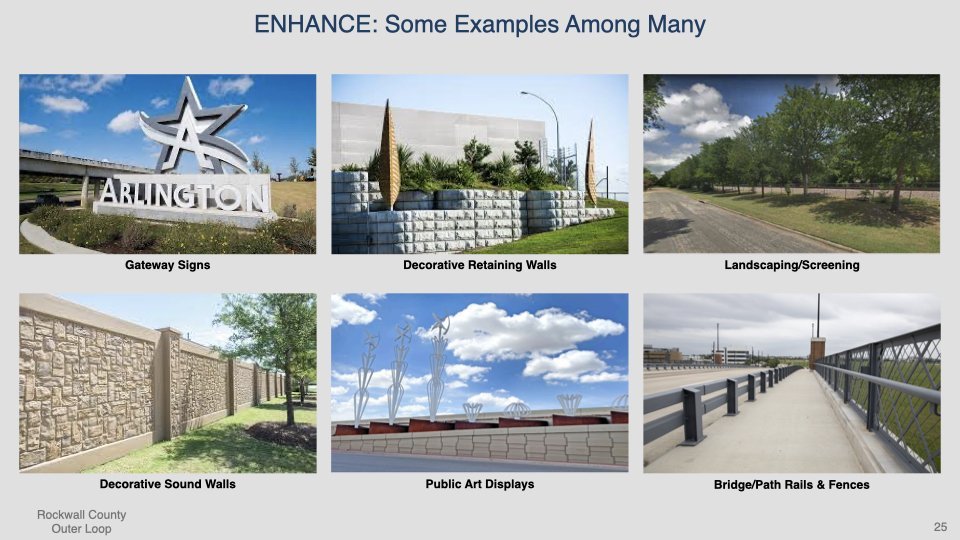
Enhancements improve community identity and quality of life around major corridors. These may include:
• green space and landscape buffers,
• trails and pedestrian pathways,
• context-sensitive concrete or bridge designs,
• aesthetic features,
• neighborhood-scale amenities.
Cities across DFW have used enhancements to shape how freeways blend into existing or future neighborhoods.
5. Land-Use Team Partnerships
This was Morris’s strongest—and most urgent—message. Cities have zoning authority. Counties do not. And developers know this.
Without partnerships:
• developers seek out unincorporated land,
• install package plants,
• create dense subdivisions without adequate services,
• overwhelm emergency response capacity,
• and bypass city standards entirely.
Morris put it bluntly:
“There’s no communication plan that really communicates what’s there because you’re sitting on your hands.”
With real city–county collaboration, Rockwall County could:
• steer development into areas with existing infrastructure,
• prevent package plants,
• attract commercial tax base rather than runaway rooftops,
• protect neighborhoods,
• and reduce congestion before it forms.
Right now, he said, these conversations “do not exist” in Rockwall County.
Loop 9: The Model Rockwall County Should Study
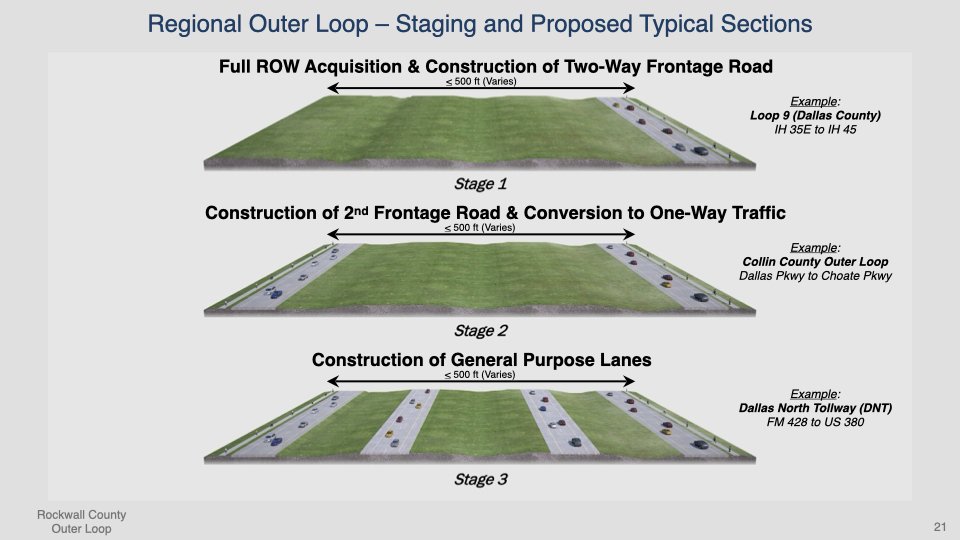
Morris urged every Rockwall County official to personally drive Loop 9, describing it as the modern template for how the Outer Loop should be built.
Loop 9 was developed by:
• purchasing right-of-way early,
• constructing frontage roads first,
• operating both directions on frontage roads initially,
• delaying main-lane construction until travel demand justified it,
• and preventing development from encroaching on the future freeway footprint.
This method:
• protects residents,
• controls long-term cost,
• guides development responsibly,
• and avoids rushed construction later.
Rockwall County can take the same approach — but only if it moves forward with environmental clearance and stops delaying decisions that allow development to fill in the corridor.
Key Questions Morris Answered
Common Misconceptions Addressed

Residents and officials raised several important questions during the meeting — questions that reflected months of public confusion and competing political narratives. Morris addressed each one directly, often clarifying misconceptions that have circulated throughout Rockwall County.
Q: Can cities place utilities in the corridor without buying more land?
A: Yes. The parkway can be designed as a “smart parkway” with utility vaults for sewer, electric, and broadband.
Q: Does removing frontage roads really encourage residential development?
A: According to Morris, frontage roads are a deliberate planning tool. Along certain sections of President George Bush Turnpike, frontage roads were intentionally omitted to encourage residential development. Where frontage roads do exist, it is because a city specifically requested them to support commercial development. The principle is straightforward: frontage roads attract commercial uses; their absence encourages residential.
Q: Have these tools been available the whole time?
A: Yes. Rockwall County could have been using them a lot earlier, rather than relying solely on avoidance.
Planning Tools and County Authority
Q: Will the County actually have influence during the environmental process?
A: Absolutely. Morris emphasized that the tools become formal commitments inside the environmental document — but only if the county instructs its consultant to use them.
Q: How does the County control development in unincorporated areas?
A: Through structured partnerships with cities — not through inaction. Morris warned that without collaboration, county leaders are “sitting on [their] hands” and letting developers determine land use, density, and timing.
Q: Does the Outer Loop cause developers to come here?
A: No. Developers are coming because state law gives them more freedom in unincorporated counties, not because a freeway is planned. Not building the freeway would lead to more development pressure, not less.
Q: Does the Outer Loop happen no matter what residents want?
A: No. Morris emphasized that public input, environmental review, and open collaboration shape the final design. The project is not predetermined — but progress cannot occur if the county refuses to engage in the process.
When the Conversation Turned Political — Morris Recentered the Facts
What Rockwall County Has Been Missing

As Judge Frank New shifted the discussion toward litigation, ETJ disputes, and frustrations with developers, Michael Morris redirected the conversation back to the central issue: development pressure is not caused by the Outer Loop — it is caused by state loopholes that allow rapid building in unincorporated areas.
Morris reminded the consortium that all 16 counties in NCTCOG’s region face the same challenge. Developers routinely target unincorporated land, even in counties where no freeway project is planned at all. “Picture you’re not doing anything,” he said. “Don’t build a freeway. Does it change the developers coming to your county? No.” In fact, he cautioned, refusing to plan the corridor would result in more development, not less, because the land that could be preserved for a future freeway would instead be consumed by subdivisions and commercial projects.
He then underscored a critical gap in Rockwall County’s approach: unlike other fast-growing counties, Rockwall has not established a city–county partnership model to guide growth, protect right-of-way, or influence land-use decisions. Without collaboration, he said, every acre of land remains vulnerable to development; without environmental clearance, the county cannot use any tools beyond simple avoidance.
The result is predictable: developers — not elected leaders — control density, timing, and land consumption. By contrast, Morris explained, staged right-of-way gives the county leverage. Frontage roads can be built first, development can be steered rather than chased, and the county — not developers — can determine when main lanes are needed. “How are you going to move anybody,” he asked, “if you don’t have a transportation project?”
Why Partnerships Matter
He urged commissioners to imagine a coordinated system in which the county works with every city to expand development choices, guide infrastructure, and offer multiple viable sites rather than forcing projects into only one city with one available location. Rockwall County, he noted, is small and compact enough that such planning is actually easier here than in larger counties.
The message was clear: political frustrations cannot substitute for structured planning, regional partnerships, or preserving the land needed to move people safely and efficiently in the future.
What Comes Next for Rockwall County
Morris urged Rockwall County to move forward by advancing the environmental study, returning to the Purple Route as the working alignment, and protecting right-of-way before development consumes the remaining corridor. He emphasized partnering with city governments on land-use planning so the county is no longer relying on a single tool or reacting to developers after the fact. He also encouraged adopting a Loop 9–style staging plan — building frontage roads first, preserving the footprint for future main lanes, and allowing the county to control project phasing rather than developers.
Throughout the discussion, Morris reiterated that NCTCOG stands ready to assist — and reminded the consortium that successful innovations on US-380, LBJ, and other major corridors were all achieved through collaboration, not political standstills.
Conclusion: Planning for 2050 Starts Now
Morris’s presentation offered something Rockwall County has lacked for years: a factual roadmap grounded in engineering, economics, and long-range regional planning rather than political spin.
The Outer Loop is not simply a road. It is a 2050 mobility corridor capable of shaping growth, protecting neighborhoods, supporting emergency response, guiding development, and preserving the quality of life residents expect.
But those benefits can only be realized if Rockwall County uses every tool available, rather than relying on a single strategy or reacting to development after it occurs. Residents deserve transparency. Cities deserve genuine cooperation. And the county deserves a plan resilient enough to withstand decades of growth.
Morris laid out the tools and the path forward. Now, it is up to county leadership to use them.
🎥 Watch the Full Road Consortium Meeting (October 15, 2025)
(Hosted on the Rockwall County website)
Subscribe if you’d like to stay updated on Rockwall County developments. You’re welcome to email me or share your thoughts in the comments.