
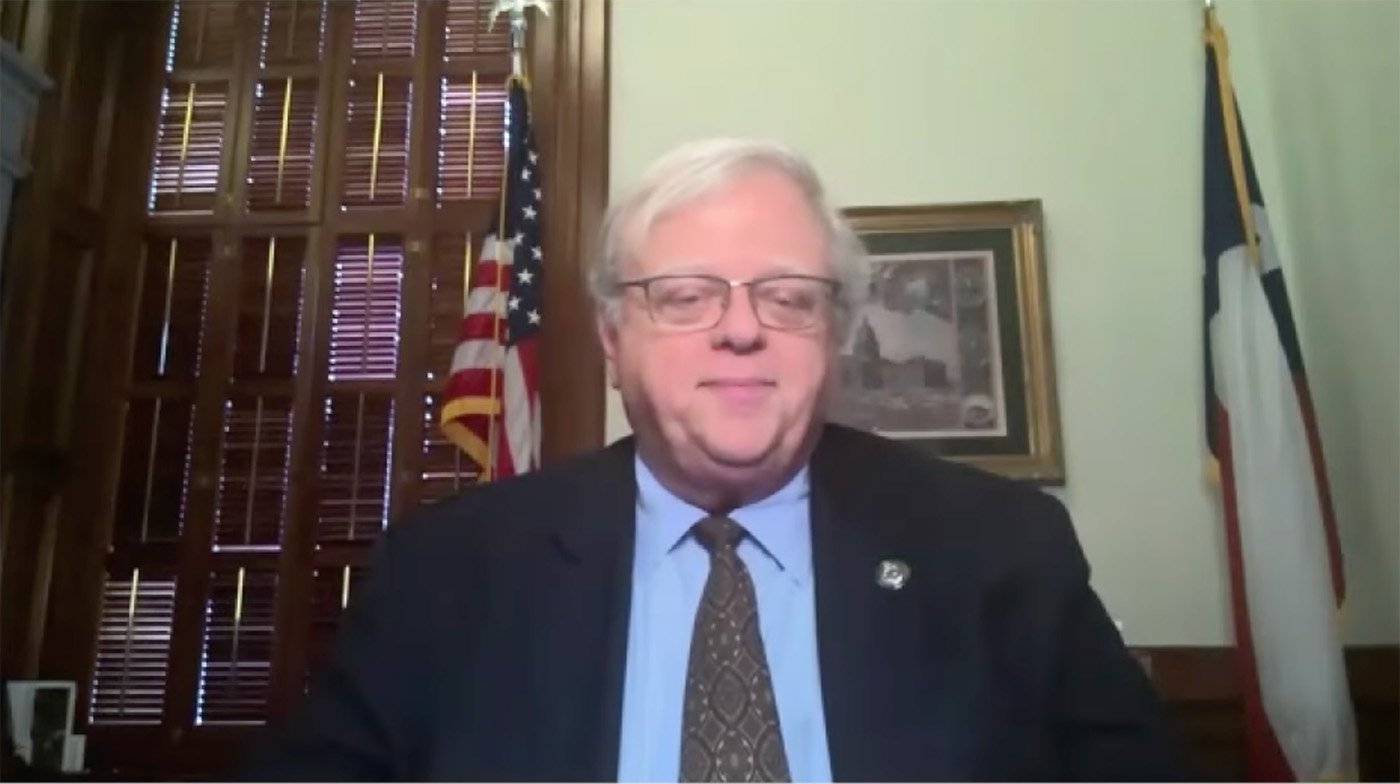
In a WFAA report examining Rockwall County growth concerns, State Senator Paul Bettencourt expressed disagreement with economic warnings raised by Rockwall County Judge Frank New regarding a proposed high-density residential development in southern Rockwall County.
SB 2038—the law allowing landowners to opt out of a city’s extraterritorial jurisdiction (ETJ)—was authored and advanced by Bettencourt. When WFAA reporter Cole Sullivan asked the senator about Judge New’s claim that large-scale development could overwhelm county resources, Bettencourt responded plainly:
“I disagree with the economic analysis of the judge.”
Bettencourt framed growth not as a fiscal threat, but as a necessity for local governments.
“I don’t think the (Rockwall County) judge is understanding that this is going to happen anyway. Once the forcible annexation is gone, the growth is going to occur…and the county is going to get revenue—like lots of revenue.”
What the County Is—and Isn’t—Responsible For


During the interview, Judge New reiterated a core concern he has raised repeatedly:
“Property taxes will take care of maintenance and operations. It doesn’t take care of the infrastructure costs.”
Bettencourt’s response highlights a distinction that is often blurred in public discussion.
County budgets are designed to fund law enforcement, courts, roads, and essential services—including sheriff’s deputies and patrol vehicles. Those costs are supported by county property tax revenue, which increases as development and assessed values grow.
Public schools, by contrast, are not a county responsibility. They are governed and funded by independent school districts, which levy their own taxes, issue bonds, and plan campuses based on enrollment growth over time—not in a single development phase.
The WFAA segment also did not suggest that more than 6,300 homes would be constructed at once. Large master-planned communities typically build out over many years, allowing infrastructure, staffing, and services to scale gradually rather than materialize overnight.
Regulation Didn’t Disappear—It Shifted
When asked whether SB 2038 removed safeguards previously imposed through ETJs, Bettencourt rejected that characterization.
“Well, no, it’s still regulated. You’ve got state codes. You’ve got county codes. What you don’t have is city regulation.”
He criticized municipal oversight as unpredictable, arguing that cities can impose “arbitrary and capricious” requirements that delay or derail projects indefinitely. Under the current framework, landowners may opt out of an ETJ—but must still work with another governmental entity, such as a county or a municipal utility district, to make a subdivision function.
Housing Supply as the Core Policy Goal
When asked how SB 2038 affects housing affordability—a central concern as Texas continues to grow—Bettencourt framed the issue in economic rather than regulatory terms.
He argued that increasing housing supply is the most effective way to lower costs, noting that constrained development limits choices and drives prices higher.
“The number one thing you can do is increase supply of homes,” Bettencourt said. “When you have more homes, you’ve got less cost associated with it and a competitive market to buy them.”
Water Infrastructure: Not the County’s Obligation
The most significant infrastructure investment—water—is not the responsibility of Rockwall County, City of McLendon-Chisholm, or residents outside the DR Horton’s MUD district.
DR Horton’s Municipal Utility District (MUD) is authorized by the Texas Commission on Environmental Quality (TCEQ) and carries the legal obligation to finance and construct water infrastructure for the development.
That system alone is estimated to cost $40 million to $90 million and will connect to infrastructure operated by the North Texas Municipal Water District (NTMWD), located outside Rockwall County. Developers do not construct infrastructure of that scale before receiving preliminary plat approval—the very step Rockwall County has reportedly denied six times.
Why the DR Horton Lawsuit Matters in Rockwall County Growth Concerns
In the WFAA segment, viewers briefly saw the cover page of DR Horton’s lawsuit against Rockwall County, introduced as part of a broader discussion about growth and infrastructure. While the report highlighted competing perspectives from state officials, local leaders, developers, and residents, it did not examine the legal substance of the lawsuit itself. It also did not address the specific actions that led to the case.
That omission matters, because the lawsuit is not centered on whether infrastructure must be built. That responsibility is widely understood—and largely undisputed—to fall on the developer.
The more consequential question is why the county is being sued at all.
At the core of the case is a tension between infrastructure responsibility and approval authority. While DR Horton’s MUD is legally obligated to finance and construct water infrastructure and related utility facilities, Rockwall County retains preliminary plat authority. In practice, the dispute before the courts focuses less on infrastructure funding and more on whether the county can condition, delay, or deny plat approval beyond what state law permits.
Judge New has publicly framed the lawsuit as a fight over infrastructure costs. A closer review of the record suggests the disagreement is more accurately about due process, timing, and control—specifically, how and when a development is allowed to move forward once statutory requirements are met.
Documentation Submitted During Preliminary Plat Review

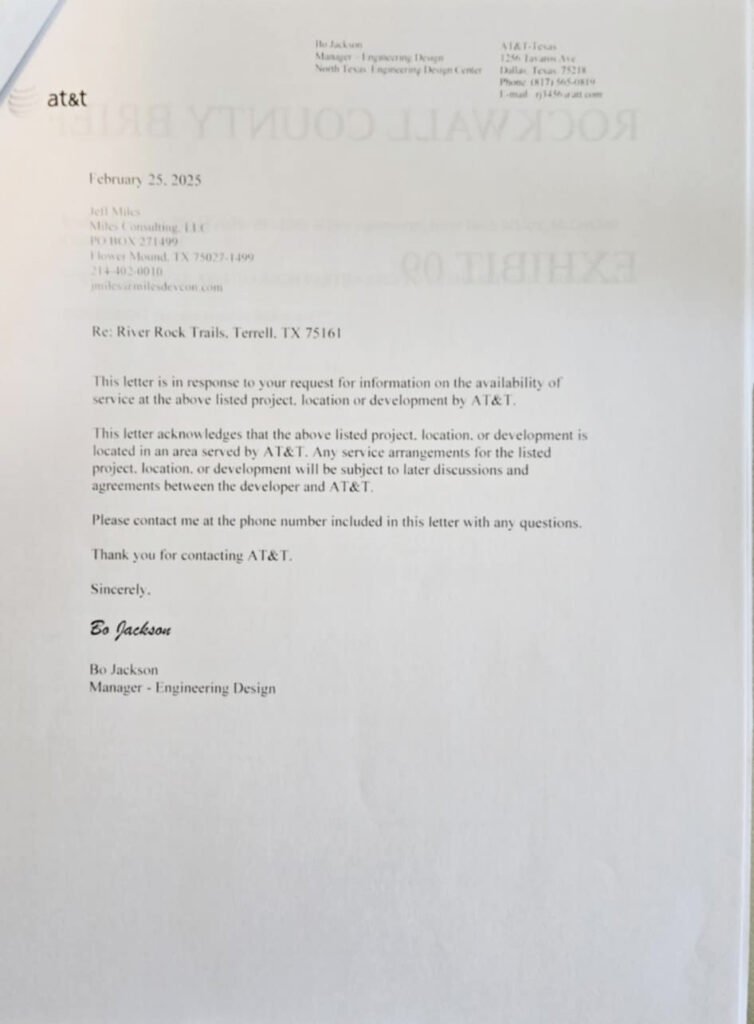
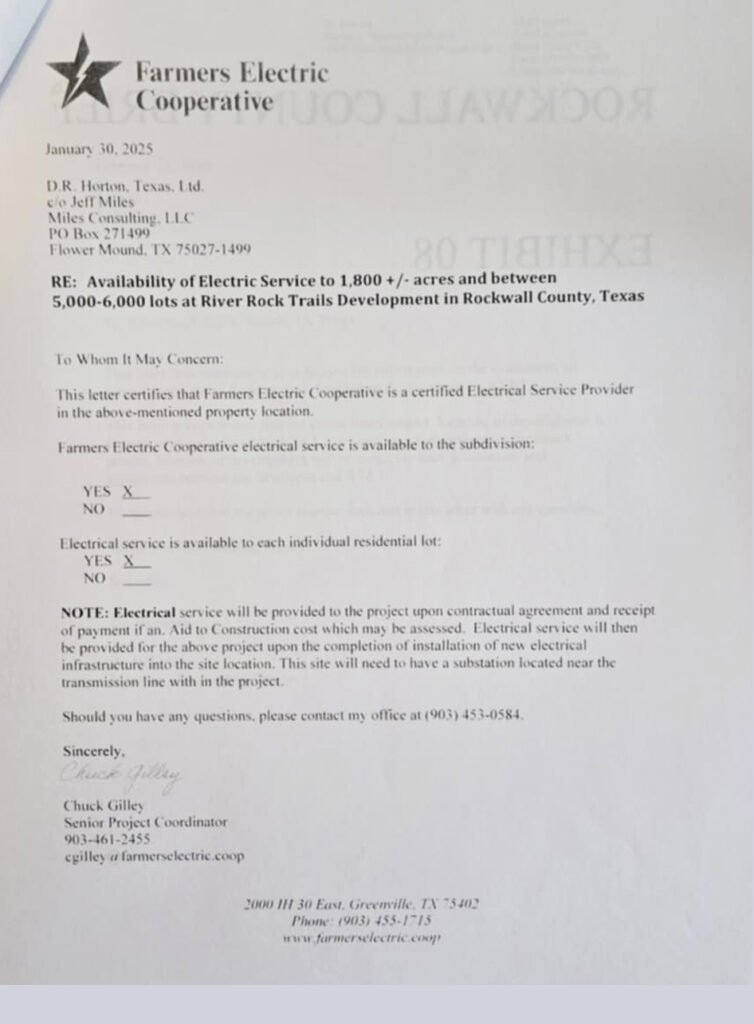
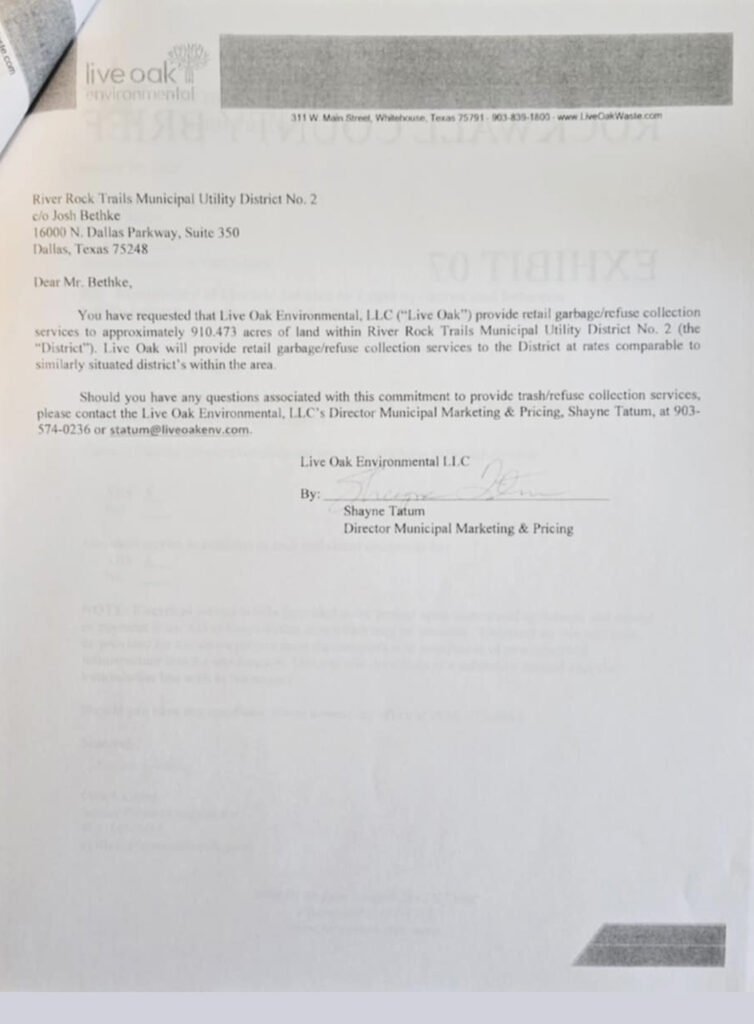
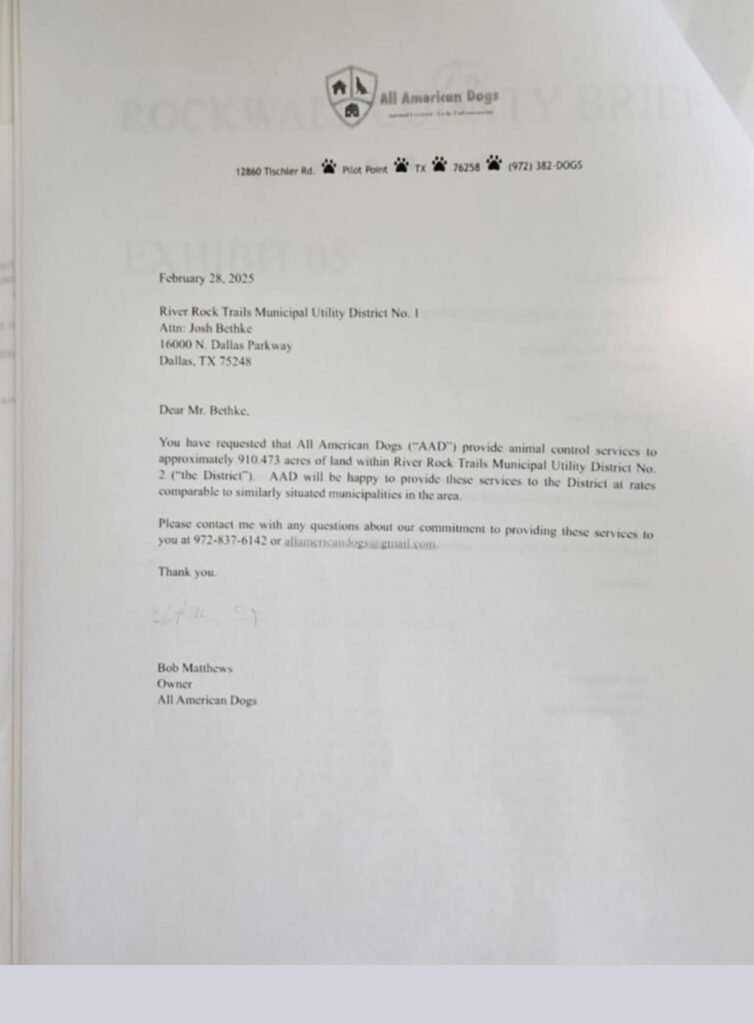
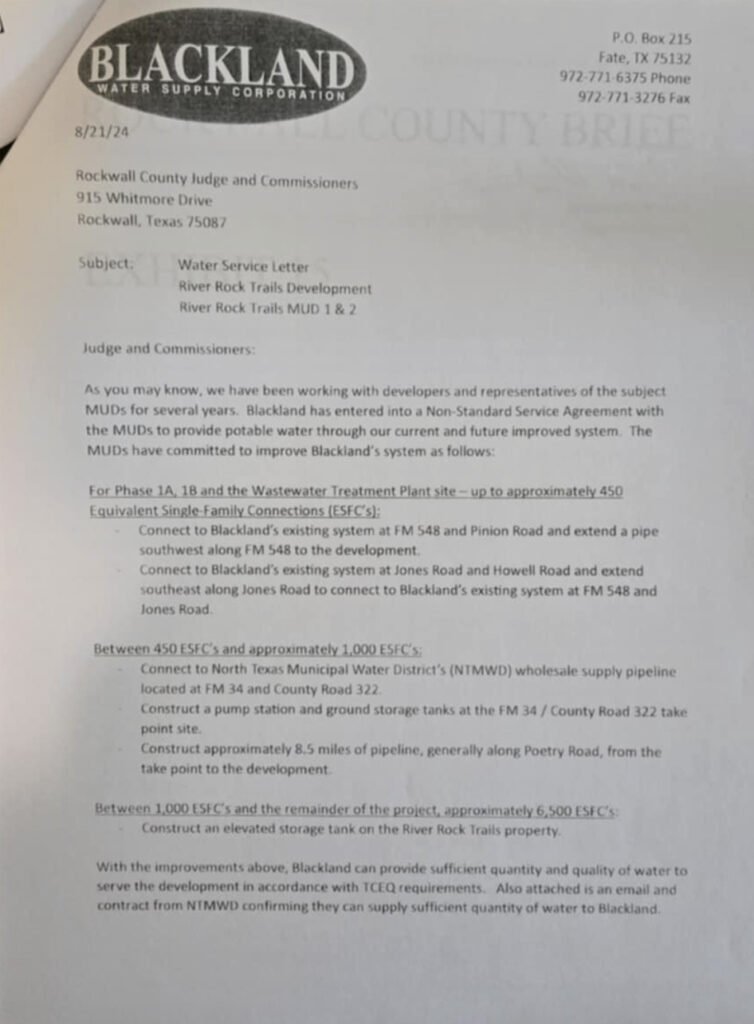
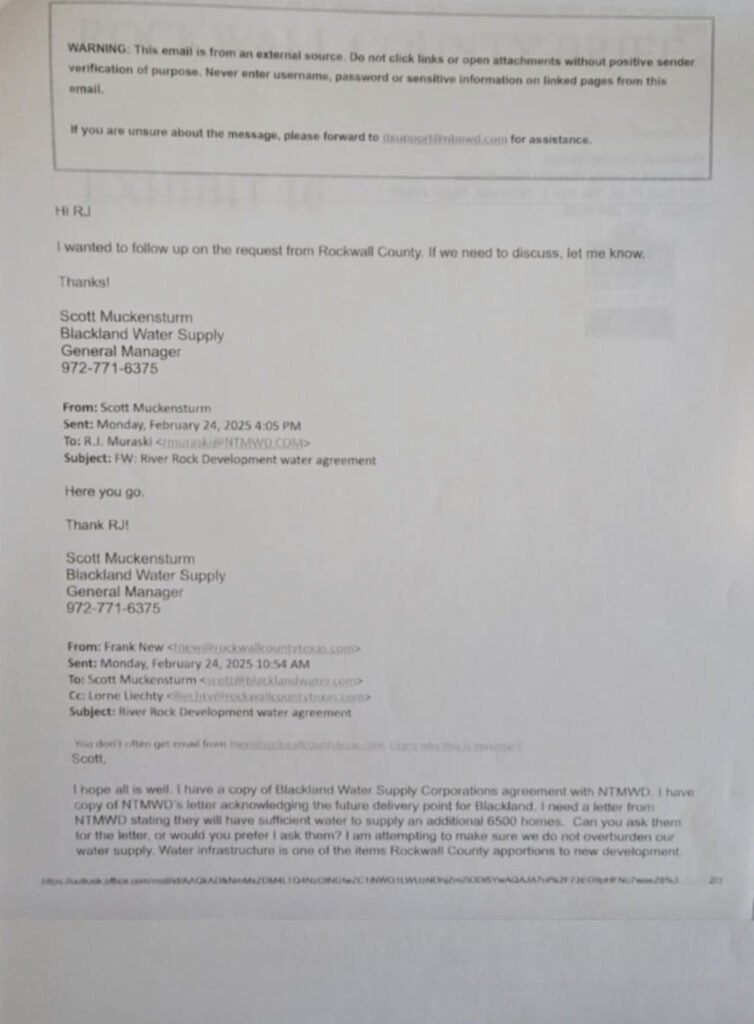
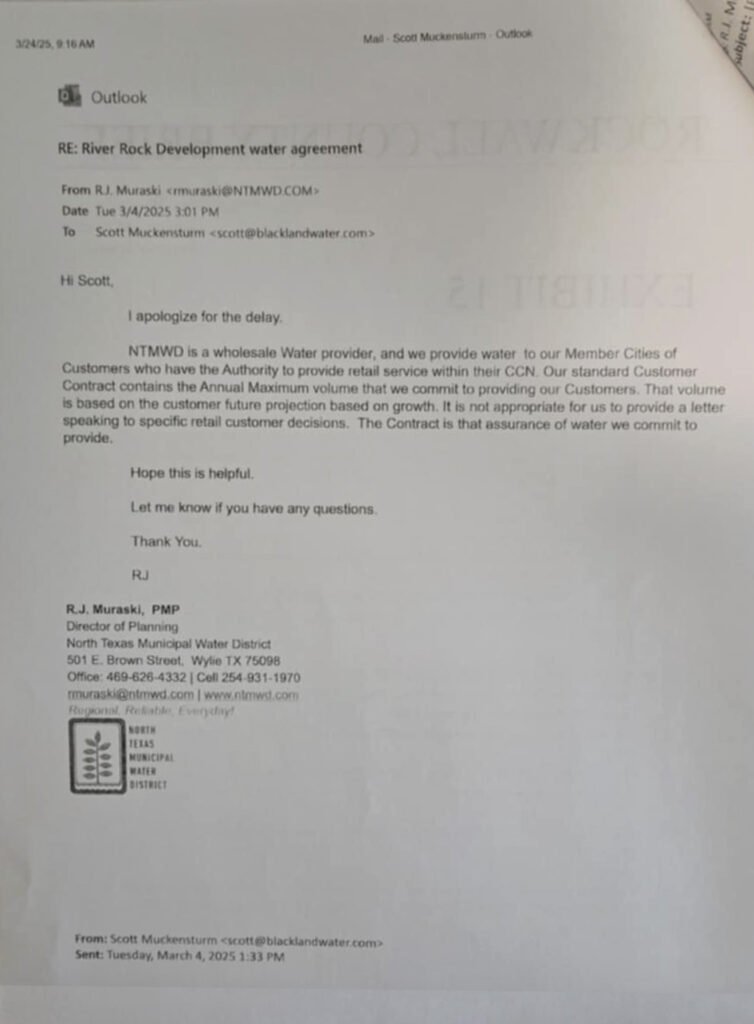
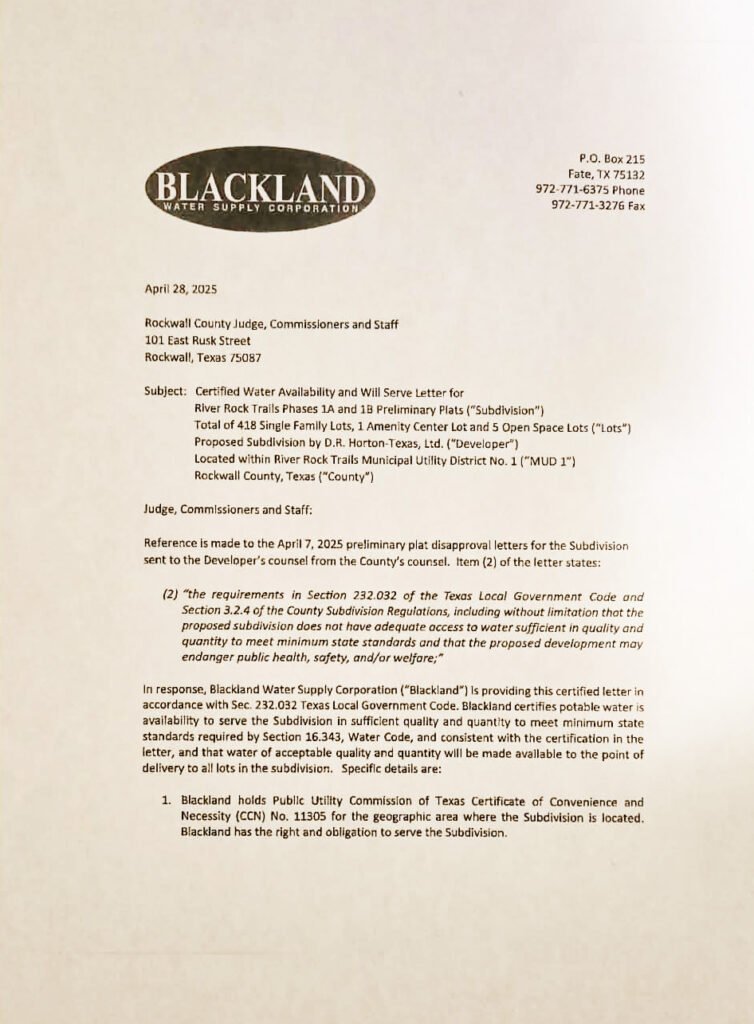

Despite public concerns about service availability, documents submitted to Rockwall County—and discussed during multiple public meetings—show that DR Horton provided written service acknowledgments from multiple providers as part of the county’s preliminary plat review process.
• AT&T, confirming the development lies within its service area, with final arrangements subject to standard agreements.
• Farmers Electric Cooperative, certifying electrical service availability subject to contractual terms.
• Live Oak Waste Services, confirming refuse and collection services at rates comparable to the area.
• All American Dogs, confirming availability of animal services.
• Water service, addressed through a certified will-serve letter from Blackland Water Supply Corporation and acknowledgment from North Texas Municipal Water District (NTMWD).
DR Horton submitted these materials in response to a county demand that outlined 16 items as “County Infrastructure” for preliminary plat consideration. Other requested items and supporting records will be examined in a forthcoming article.
Water Service Certifications and Regulatory Compliance
Water service—often cited as the most significant concern—warrants closer examination. The water-related documents included in the slideshow show sustained coordination between the developer, Blackland Water Supply Corporation, and North Texas Municipal Water District well before the current lawsuit was filed.
Blackland provided multiple written certifications to Rockwall County confirming that potable water is available in sufficient quantity and quality to serve the River Rock Trails development, including Phases 1A and 1B totaling 418 single-family lots. Those certifications reference compliance with Texas Local Government Code §232.032, Texas Water Code requirements, and TCEQ regulations.
In its April 28, 2025 certified “Will Serve” letter, Blackland stated:
“Blackland will serve the Subdivision with adequate quantity and quality of water. Any statement or suggestion Blackland cannot serve is false.”
The letter further confirms that Blackland holds a valid Certificate of Convenience and Necessity (CCN) for the geographic area, establishing both the right and obligation to serve the subdivision.
Correspondence between Blackland and NTMWD clarifies the wholesale-retail relationship: NTMWD supplies water to member entities within their CCNs, while retail service decisions and infrastructure construction remain the responsibility of the local provider and the MUD. NTMWD does not issue speculative assurance letters for future retail customers—consistent with standard industry practice.
Taken together, these records show that water service was documented, certified, and structured through the same regulatory framework Rockwall County cited when denying preliminary plat approval.
Why This Matters

The WFAA report successfully illustrated how growth pressures are reshaping local governance across Texas. The DR Horton lawsuit, however, narrows the focus to a more consequential question: how far county authority extends once a developer has complied with published statutory requirements.
That question is now before the courts. And its resolution may carry implications well beyond this single development—particularly as the legal record brings greater scrutiny to how Rockwall County has exercised its approval authority.
This lawsuit is far from resolved. Additional correspondence, meeting records, and procedural history will be examined in the new year as the case proceeds.
As questions continue to surface about the role and responsibilities of elected officials, one thing is becoming clearer. This case is no longer just about managing growth. It is about process, authority, and whether political pressure is being substituted for lawful governance.
Subscribe if you’d like to stay updated on Rockwall County developments. You’re welcome to email me or share your thoughts in the comments.