
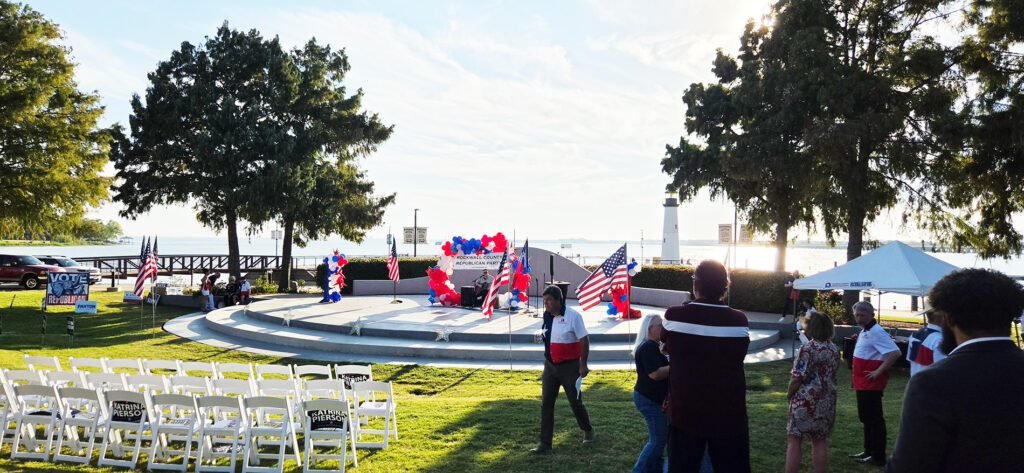

The Rockwall County Republican Party gathered candidates and elected officials at The Harbor on Friday evening for its Sept. 25 Red Rally, where one message surfaced repeatedly: Republicans need to turn out in November.
The setting was inviting. The sun dropped over Lake Ray Hubbard as a musician played familiar songs between speeches. American flags, campaign signs and red, white and blue balloon arrangements surrounded the amphitheater, where organizers had placed rows of white chairs facing the stage.
The rally also fell on a busy weekend. Friday marked opening day of the State Fair of Texas, while Rockwall-Heath families were in the middle of homecoming week. There is no way to know whether either affected attendance.
Still, many of the chairs remained unoccupied throughout the evening. Most of the people I recognized were familiar faces from other local Republican events — precinct chairs, elected officials, spouses and party volunteers who had also helped arrange chairs, decorations and campaign signs.
The event was not a candidate forum. There were no questions from the audience and no policy debate. Instead, each speaker had a few uninterrupted minutes at the microphone. What they chose to emphasize — and what they left unsaid — varied considerably.
Katrina Pierson: Accountability in the campaign, turnout at the rally
State Rep. Katrina Pierson opened with one of the evening’s recurring cultural issues: “Do we want boys competing with girls in any sports?”
From there, her remarks focused largely on Republican turnout, Rockwall County’s population growth, the possibility that more Democrats had moved into the county and the importance of widening Republican margins.
Pierson also invoked Democratic megadonor George Soros:
“Thousands upon thousands of people have moved into our county. The goal of George Soros and the others is to find out where they are.”
She offered no evidence during the speech connecting Soros to efforts to identify newly arrived voters in Rockwall County.
The contrast is notable because Pierson has recently promoted a broader agenda centered on accountability and substantive policy.
In campaign posts before the rally, she called for more efficient and transparent government and stronger oversight of taxpayer dollars, while urging institutions to “do their jobs.”
She also has policy work she could have highlighted. Pierson represents House District 33 and serves on the House Public Health and Homeland Security, Public Safety & Veterans’ Affairs committees. In August, she was named chair of the House Subcommittee on Maternal Health, Menopause and Access to Evidence-Based Medicine.
During the 2025 legislative session, Pierson authored HB 3814, which would have required certain health benefit plans to cover prescription medications used to treat perimenopause or menopause.
Those are concrete issues affecting constituents. They were not part of her Red Rally remarks, which remained focused primarily on Democrats and Republican turnout.
Where accountability becomes a local question
Pierson’s campaign emphasis on accountability also raises a question closer to home. I previously brought concerns involving RCH Water Supply Corporation and other local-government matters to her office.
My reporting on RCH documented discrepancies between information published on the corporation’s personnel page and state operator licensing records. TCEQ ultimately found no regulatory violation after RCH supplied records identifying two licensed operators, but questions remained about how those responsibilities had been publicly documented and communicated.
Water system compliance problems are not confined to one utility. TCEQ’s own 2026 enforcement actions include repeated cases involving public water systems across Texas, raising a broader oversight question about whether problems affecting an essential public health service are being identified and corrected early enough.
Pierson’s office communicated with TCEQ after the concerns were raised. I am not aware of any publicly announced broader legislative inquiry or examination that followed.
An individual representative does not personally wield the House’s formal investigative powers; those powers are exercised through legislative committees, including the House General Investigating Committee, which may investigate governmental entities, examine records and compel documents.
That makes Pierson’s campaign language about accountability relevant locally:
When constituents bring documented concerns to a legislator campaigning on stronger oversight and institutions doing their jobs, what follow-up should they expect?
Frank New: “Expect to follow the rules”
County Judge Frank New told the audience that Rockwall County is patriotic and follows the rule of law.
“When you come into Rockwall County,” he said, “expect to follow the rules.”
He then warned: “We have some people that want to change the rules.”
That statement invites a look at an unresolved dispute involving New’s own governing record and the development rules Rockwall County has applied.
Rockwall County and New are defendants in litigation brought by DMDS Land Company and D.R. Horton over the River Rock Trails development. The developers allege the County repeatedly denied preliminary plats despite compliance with statutory requirements, imposed conditions beyond its authority and shifted its reasons for denial. The County disputes those allegations and maintains its requirements are lawful.
A central disagreement involves what Rockwall County considers “County infrastructure.” In November 2024, Commissioners Court amended its Development Application Handbook to identify 16 categories of infrastructure improvements, including schools, public safety services, utilities, broadband, open space, animal control, trash and radio communications.
The state law cited by the County — Texas Local Government Code §232.110 — does not itself contain that 16-item definition and states that the section does not expand a county’s authority to regulate plats or subdivisions. D.R. Horton has challenged the County’s interpretation.
The County handbook also says apportionment fees must be paid before final plat approval. During an April 2025 hearing, however, D.R. Horton’s attorney said unpaid proportionality fees had previously been cited among the reasons for denying preliminary plats. County counsel maintained that the apportionment dispute and preliminary plat decisions were separate issues.
Earlier this year, a state district judge denied the developers’ motion for partial summary judgment, but the ruling did not resolve the underlying litigation.
The lawsuit has not established that New “changed the rules” or that Rockwall County acted unlawfully. But when the County Judge tells voters to “expect to follow the rules,” a pending dispute over what those rules allow the County to require becomes relevant to that message.
“Drawn for Rockwall County to control”
New also made a striking statement about the newly redrawn Congressional District 32, where Republican Jace Yarbrough is running for Congress.
“Our Congressional District 32 … was drawn for Rockwall County to control that district,” New said. “Even though we’re safe here, we’re fighting for a greater cause. We’re fighting for a bigger prize.”
Texas lawmakers substantially redrew District 32 for the 2026 election. The enacted PlanC2333 shifted the district away from much of its former Dallas-area configuration and farther east, significantly changing its partisan composition.
In the official redistricting materials I reviewed, I found no statement that the district was drawn specifically “for Rockwall County to control.”
That leaves a straightforward question:
What did New mean by “drawn for Rockwall County to control that district,” and what is the basis for that assertion?
Tim McCallum talked about Rockwall
Rockwall Mayor Tim McCallum spent more of his remarks on city government, discussing development, roads, the Harbor, economic development and Monday’s tax rate vote. He also said Rockwall would spend $28 million on infrastructure and had not approved a single “tract-home development” during his 15 months as mayor.
McCallum urged residents to attend Monday’s City Council meeting and oppose a rate above the no-new-revenue rate. At its Aug. 27 work session, Council first considered advertising the $0.258007 no-new-revenue rate; that motion failed. Council then voted 5-2 to advertise $0.2627 as the maximum rate it could later adopt, with McCallum and Council Member Richard Henson opposed.
Advertising the higher rate did not mean the Council had adopted it.
That debate comes amid disagreements over public safety funding. The Rockwall Police Officers Association has disputed how proposed compensation increases were characterized and raised concerns about staffing, while the Rockwall Professional Firefighters Association has urged Council to consider a modest tax rate adjustment for firefighter pay. The firefighters later said McCallum renewed his commitment to work with them on those concerns.
McCallum also credited Kason Huddleston with helping “bring God into our meetings.” Rockwall City Council, however, had opened meetings with invocations and the Pledge of Allegiance for years before McCallum became mayor. What changed was the practice of inviting local pastors, including Huddleston, to deliver some of those invocations.
Kason Huddleston: Defining the role of the State Board of Education
State Board of Education District 9 candidate Kason Huddleston spent most of his remarks discussing curriculum, history, civics and conservative values.
But one description of the office deserves clarification.
Huddleston called the State Board of Education “the executive branch of the whole education department.”
Official Texas Education Agency materials describe the structure differently. The Commissioner of Education heads the Texas Education Agency, while the 15 member elected State Board of Education sets curriculum standards, reviews instructional materials, establishes graduation requirements, oversees the Permanent School Fund and carries out other responsibilities established by state law.
TEA describes the commissioner, the SBOE and the State Board for Educator Certification as separate parts of statewide education leadership — not the SBOE as the executive branch of the entire education system.
That distinction matters for a candidate seeking a seat on the Board. Huddleston’s campaign materials emphasize curriculum and conservative values, but provide little detail about how he would approach the broader responsibilities of the office he hopes to hold.
Voters are being asked to evaluate not only the values Huddleston would bring to the Board, but how well he understands the authority and responsibilities of the Board itself.
Bob Hall: Warnings about Democrats — and “keep it to ourselves”
Sen. Bob Hall opened by praising Rockwall County, telling the audience it “tops them all when it comes to quality” and commending local judges, mayors, council members and commissioners.
Much of what followed focused on Democrats. Hall spoke about abortion, policing, guns, immigration and taxes while describing Democrats as “socialist communist.”
One statement requires factual context. Hall said Democrats would bring back what he called “late term abortions,” adding that after a baby is born, “they kill it on the table.”
Texas law treats a child born alive separately from an abortion. A child born alive after an abortion or premature delivery has the same legal rights as any other child born alive, and physicians are required to provide appropriate care and arrange immediate hospital transfer.
Hall also warned that Democratic policies would cause taxes to “go through the roof,” but identified no specific tax, rate or proposal. If he was referring to Texas property taxes, appraisal districts determine property values while local taxing units set tax rates; the Legislature establishes the laws governing that system but does not set an individual property appraisal or local tax rate.
Praise for local leadership, questions closer to home
Hall, an Air Force veteran who held the rank of captain, currently serves as vice chair of the Texas Senate Select Committee on Veteran Affairs. Its current work includes veterans’ claims assistance, deceptive practices targeting veterans, military-to-civilian transition and implementation of veterans programs.
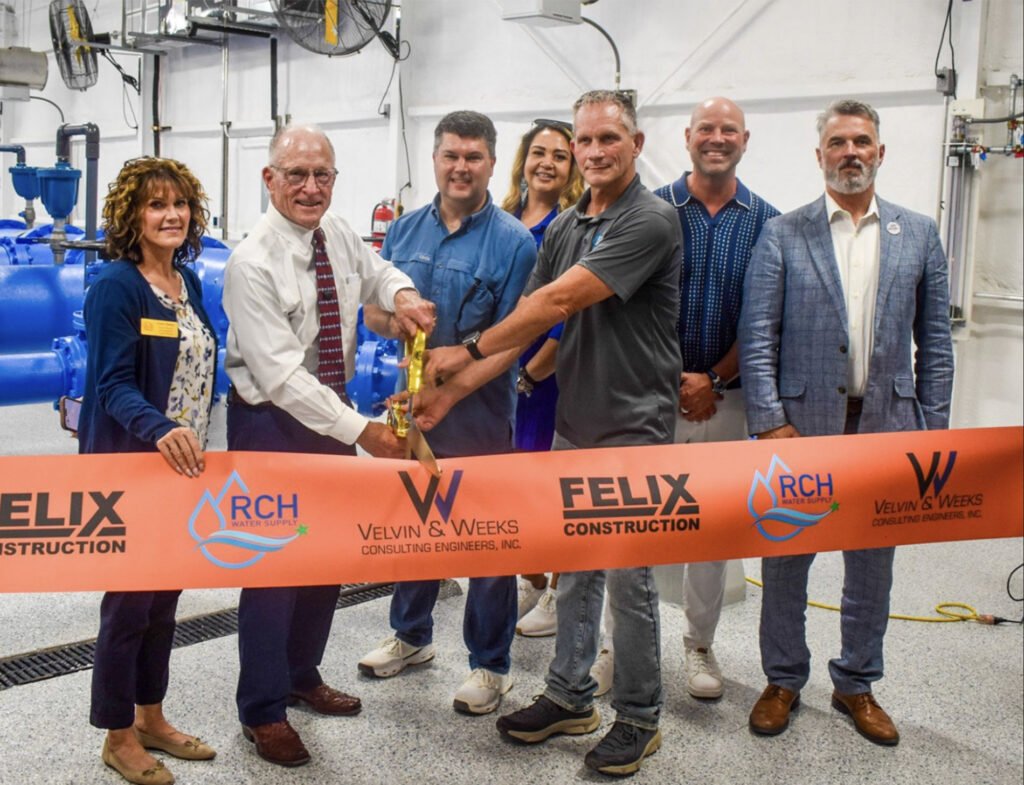
That background provides context for Hall’s public recognition of former McLendon-Chisholm Mayor Bryan McNeal, whose public profile prominently incorporated military service and veterans-related charitable work. Hall presented McNeal with a gavel honoring his service to the City of McLendon-Chisholm, and both later appeared at RCH Water Supply Corporation’s August ribbon-cutting.

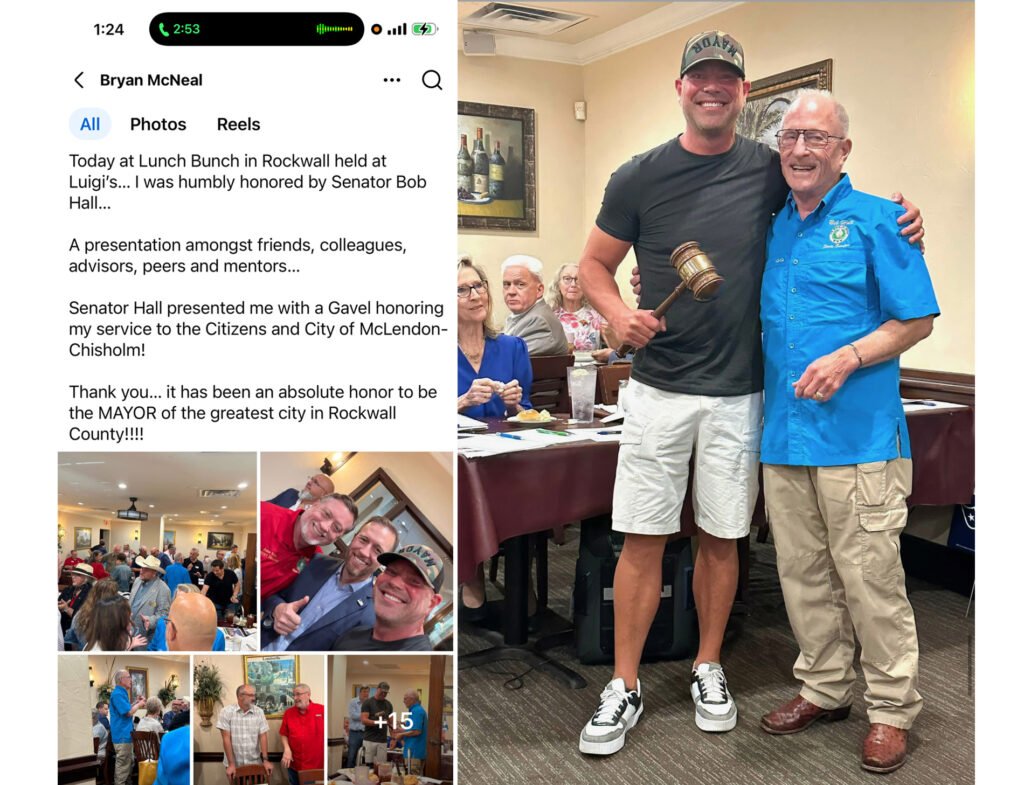
My existing FOIA reporting documented federal records listing McNeal’s final discharge rank as corporal and a DFAS response stating it had no documentation awarding him military retired pay. McNeal later said he had sought a review by the Board for Correction of Naval Records. The available record does not establish what Hall knew about those discrepancies when he recognized McNeal.
Hall’s praise of local leadership also comes amid unresolved constituent concerns involving water. In Rockwall County, he spoke at RCH’s August ribbon-cutting; my Sept. 21 Water Chronicles report documented that infrastructure milestone alongside questions about rates, financial transparency and an $808,098.77 judgment against a former manager that remains under appeal. In Van Zandt County, Edgewood residents have dealt with discolored water and water-quality concerns.
A state senator does not operate either water system, but water quality and utility accountability were not among the issues Hall chose to discuss that evening.
“Until the election is over, let’s keep it to ourselves”
Hall eventually turned from Democrats to disagreements within his own party:
“There may be some disagreement among Republicans on some of the issues but until the election is over with let’s keep it to ourselves … because we have got to have every Republican elected.”
Hall urged Republicans to set aside internal disagreements and support the party’s nominees throughout the ballot. Texas eliminated straight-party voting in 2020, so voters who want to support every candidate from one party must now make those selections candidate by candidate.
Jace Yarbrough pivoted to affordability
Congressional candidate Jace Yarbrough struck a different note from several speakers who came before him.
“Here is the thing that people care about right now. They care about their pocketbooks.”
Yarbrough said voters are concerned about affording a home, putting food on the table and supporting a family, adding that issues such as transgender participation in sports were “not the issues that matter most to folks right now.”
That stood out after earlier speeches had focused heavily on Democrats, cultural issues, immigration and partisan turnout.
Yarbrough then argued that cities cooperating with federal immigration enforcement were seeing significant rent declines. Research from Federal Reserve economists does find that unauthorized immigration can increase local housing demand and rents, but it does not establish that ICE cooperation alone explains recent rent declines. The researchers found that unauthorized immigration increased rents during the 2021–2024 surge, while housing supply and other local-market conditions also matter.
Yarbrough’s broader point was clear: affordability was the issue he wanted voters thinking about.
As Yarbrough finished speaking, a B-52 Stratofortress passed over the amphitheater as part of the State Fair of Texas’ opening-day America 250 flyover, which also included two F-35 Lightning IIs and an A-10 Thunderbolt II.
For a moment, attention shifted from the stage to the sky.
What matters to you?
Campaign photos show who stood together. The speeches show what candidates and elected officials chose to tell voters when they had the microphone.
Now I want to hear from you: Tell me what matters in your community and what you want your elected officials working on next. What issues are not getting enough attention?
Reach out and tell me. Your feedback will help shape the questions I ask, the officials I follow up with and the stories I pursue next.